

The Middle East, broadly defined, has emerged as one of the focal points of a new, more assertive, and pro-active style of Turkish foreign policy in recent years.1 The unexpected and dramatic developments in the direction of political opening in the Arab world will have profound implications for the future course of Turkish foreign policy. In the longer term, one can be more optimistic. The trends towards political liberalization in the Arab world are likely to boost Turkey’s economic and diplomatic ties and will enhance the relevance of the “Turkish experience,” as a point of reference for the region. The attractiveness of the “Turkish experience” vis-à-vis the domestic political systems of competing regional powers, like Saudi Arabia and Iran, is likely to be enhanced in a more open and pluralistic environment. In the short and medium term, however, unexpected developments in the Middle East created serious uncertainties and dilemmas for Turkish foreign policy.
Turkish foreign policy towards the region prior to the onset of the Arab Spring during the Justice and Development Party (hereinafter, AKP) era was based on the principles of mutual gain through economic interdependence and close political ties based on cultural affinity and Muslim brotherhood, which Pinar Bilgin calls “civilizational geopolitics.”2 The, AKP government’s foreign policy was not based on the notion of democracy promotion. Rather it was based on the Westphalian logic of respecting the independence of nation states and the principle of non-intervention in the domestic politics of states. Perhaps this foreign policy logic was based on the implicit functionalist assumption that with growing economic interdependence and a flexible visa regime, which encouraged free flow of labor between neighboring states, authoritarian regimes would gradually crumble over time. Nevertheless, the AKP’s soft-power based foreign policy, popularized as “zero problems with neighbors” strategy, faced ethical dilemmas prior to the onset of the Arab Spring.3 The AKP’s foreign policy stance encountered criticisms in the context of the support for the brutal and authoritarian Iranian regime, which faced internal opposition. The ethics versus self-interest dilemma and the failure to emphasize democratic norms as the single-minded priority became clearly evident in Turkey’s relations with Iran and Sudan, in particular.4
The ethics versus self-interest dilemma became especially profound with the onset of the Arab Spring
The ethics versus self-interest dilemma became especially profound with the onset of the Arab Spring. Turkish policy makers were confronted with this dilemma most notably in relation to Libya and Syria. The key problem that emerged was how to deal with internally polarized states such as Syria and Libya, given that serious economic interests in terms of trade and investment linkages had been built with such states especially as part of the pro-active foreign policy over the course of the last decade. A key dilemma confronting Turkish foreign policy elites was whether to encourage reform (especially in the Syrian case) by putting pressure on the ruling authoritarian elites or support rising opposition movements, which started to seriously challenge the existing regimes. To be fair, this ethics versus self-interest/stability dilemma was not unique to Turkey. Western powers have had to face the very same conundrum in a region where they have serious and far-reaching economic interests. In this context, the major objective of this paper is to evaluate the performance of Turkish foreign policy in the early phase of the “Arab Spring.” It highlights the limits of over-activism to engage in regional politics as well as illustrating the fact that Turkish foreign policy was able to display important elements of pragmatism at times when the conditions necessitated policy adaptation and reversals.
The Nature of the Arab Awakening: The Uncertain and Reversible Path Ahead
What renders the recent Middle Eastern experience rather distinct is that the process of change was predominantly internally driven. The youth and the disenchanted middle classes in the Arab world mobilized through the instruments of social media, which played a key role in the series of uprisings in the urban centers of the Arab world. The global context made an important contribution to this process but in a rather indirect fashion. The global economic crisis certainly had an impact through rising food prices, falling remittances, and declining demand for Arab exports. Global communication technologies also provided the means whereby the opposition groups could effectively communicate with one another and join forces, undermining the power of the authoritarian regimes from within, as part of a bottom-up process. Yet, the negative side of this is that the favorable external or global context that supported the previous transformations in Latin America and Eastern Europe are largely lacking in relation to current developments in the Middle East. Given the continuing scale of the economic crises in the United States and the European Union, the ability to marshal significant economic and political resources to support regime change on the part of key external actors remain rather limited. The direct implication is that change will have to be driven primarily by domestic actors. This, in turn, raises serious concerns about the durability and sustainability of the region wide political liberalization process. What is striking is that the direction of causation appears to have been reversed in the case of the Arab Spring. The uprisings in the Middle East appear to have generated a global impact, especially in terms of influencing other popular movements, such as the protests against Wall Street in the United States, similar protests movements in Europe, Russia, China, and elsewhere. However, the depth of this impact should not be over-emphasized, as the protest movements in the core industrialized countries were largely responses to deep-seated economic problems like high unemployment. Similarly, the protests in countries like Russia and China were also primarily indigenous responses to the absence of democracy.
Given the continuing scale of the economic crises in the United States and the European Union, the ability to marshal significant economic and political resources to support regime change on the part of key external actors remain rather limited
Having taken these broader global upheavals into consideration, the stage has been set for the discussion of Turkish foreign policy. It would, therefore, be useful to present a broad picture of the Arab Spring to date. The onset of the Arab Spring or awakening generated a profound sense of optimism with the uprising in Tunisia having a domino effect, leading to the confrontation and dismantling of authoritarian regimes in the region.5 The effects have been particularly striking and far-reaching in the cases of Egypt, and Libya. Syria’s regime, although it has managed to remain in power, is also under serious threat. The onset of the Arab Spring clearly delivered a serious blow to the existing orthodoxy that the Middle East was somehow an exceptional region, which was immune to the democratization waves that had already generated large-scale transformations in Latin America, Eastern Europe, and elsewhere as part of the “third wave.”6
The “new” Turkish Foreign policy vision based on the “zero problems with neighbors” strategy faced a dramatic and severe test, following the onset of the Arab Spring
In retrospect, the picture that emerges after a year of momentous change is that of extraordinary variation on the nature and intensity of the political opening process in the landscape of the Middle East. What constitutes the most positive element is that highly entrenched dictatorships in the regimes, such as the rule of Hosni Mubarak in Egypt and Muammar Qaddafi in Libya, have come to an end fostering a deep sense of optimism that popular rule will replace long-established authoritarian regimes in that region. Recent developments, however, fail to sustain the same sense of optimism. There is a profound degree of uncertainty concerning the future of political liberalization in the region with many commentators pointing towards the possibility of authoritarian reversals and even an “Arab Winter” replacing the Arab Spring. The central point is that even in countries where major revolutions have taken place, it is not clear that the shift of power to forces opposing the previous regimes will facilitate a natural progression towards more open and pluralistic political systems. The case of Egypt, in particular, neatly illustrates these dilemmas. Fears are clearly expressed in the case of Egypt concerning the extent to which the Egyptian military is likely to relinquish its powers. Questions have also been raised concerning the true democratic credentials of the pro-Islamist Muslim Brotherhood Party in terms of helping to move the country in the direction of a genuinely pluralistic political system.7
The situation in Syria is even more precarious. The Assad regime is under serious pressure for reform from opposition forces. However, it is not certain whether the regime will collapse in the first place and what kind of structure will emerge even if the regime eventually collapses. There is even a highly plausible risk that Syria will plunge into civil war. Furthermore, a significant part of the Arab world has been largely impervious to political change. Saudi Arabia is clearly the most striking case where authoritarian rule has continued in a largely uninterrupted fashion. Similarly, in the Gulf States, the authoritarian regimes remain firmly intact. In spite of the presence of a mounting oppositional challenges, Iran, a major player in the regional power game, has emerged as largely unaffected. The authoritarian regime in Iran appears to be quite secure at least in the medium term. Last, but not least, Iraq, following the withdrawal of the United States, looks increasingly fragile and prone to sectarian unrest and fragmentation. There is no doubt that the war of 2003 and the subsequent US military presence have failed to bring stability and a genuinely open and pluralistic polity to this country.
Any proper or fair assessment of Turkish foreign policy in the context of the Arab Spring must be set against this highly uncertain and volatile environment. Turkish foreign policy makers were clearly forced to react and develop a strategy towards a rapidly unfolding chain of events over which they had very little control. Hence, to argue that Turkey’s policy of “zero problems with the neighbors” strategy failed in the context of the Arab Spring because Turkey started to experience problems with countries like Syria, with which it previously enjoyed favorable relations, would be a gross exaggeration.
Turkey’s New Assertive Foreign Policy in a State of Turbulence: Dilemmas, Trade-offs, and the Risks of Isolation
There is no doubt that the chain of events that precipitated the Arab Spring, starting in Tunisia and then spreading to Egypt and the rest of the Arab world has come at an unexpected moment for Turkish policy makers whose medium term strategy rested on the notion that the authoritarian regimes in the Middle East would be likely to endure for the foreseeable future. To be fair, this kind of perception was not unique. Before the onset of the Arab upheavals, hardly anybody could have predicted the scale of the dramatic transformation that affected the Arab world during the course of the memorable year of 2011.
The “new” Turkish Foreign policy vision based on the “zero problems with neighbors” strategy faced a dramatic and severe test, following the onset of the Arab Spring. In principle, Turkish political elites welcomed the profound challenge mounted against the brutal authoritarian regimes. Yet, in practice, major trade-offs emerged between the need to achieve stability in the short-run given the serious economic interests, which Turkey had built up with these countries, versus the need to champion the cause of democracy and regime change, which would clearly jeopardize those economic interests, at least for a considerable period. In other words, Turkey faced a real challenge in terms of the ethics versus self-interest dilemma. An ethical or norm based foreign policy requires single-minded support for democratization versus an interest-based strategy, which requires the promotion of a gradual process of transformation, which would be compatible with a certain degree of stability and order, crucial for Turkey’s vital economic interests in the region. Needless to say, this ethical or norm-based versus interest-driven foreign policy dilemma was not unique to Turkey. The United States and Europe have faced this dilemma for a long-time and continue to face it in a striking form with the onset of the Arab Spring.
The lack of coherence or inconsistency of Turkish foreign policy during the course of 2011 has a lot to do with this ethics versus self-interest trade-off. This could explain why the Turkish approach displayed U-turns during the course of the year (Table 1). It could also explain the differences in the attitudes of the AKP government to developments in key Arab countries like Egypt, Libya, and Syria.
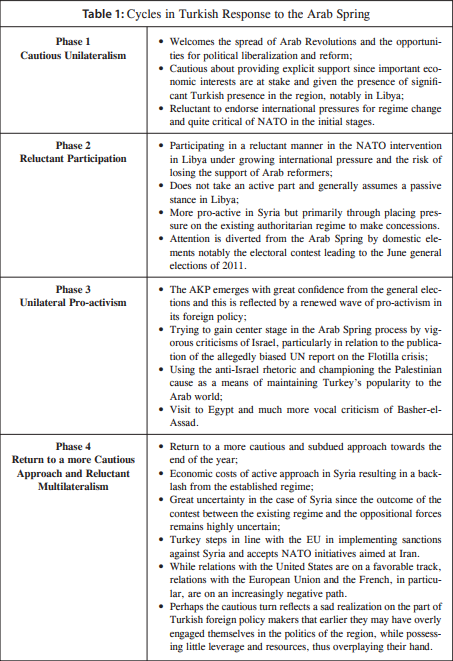
It was with Egypt that the AKP government came out with the most strong and vigorous position in favor of Egyptian pro-democratization forces, especially once President Mubarak was ousted from power.8Even prior to Mubarak’s fall, Turkey’s Prime Minister Erdoğan unequivocally urged him to leave his seat. Erdoğan during his highly popular visit to Cairo clearly expressed his support for political transformation in Egypt in the direction of an open and pluralistic political order, making reference to the importance of the Turkish experience in establishing a “secular” political order. In the cases of Libya and Syria, the initial support for forces challenging existing authoritarian regimes was much more ambiguous and diluted.
Relations with Syria epitomized the very principles on which the “new” Turkish foreign policy was based, a combination of economic interdependence and cultural affinity with no explicit agenda for democracy promotion
In the case of Libya, the Turkish government was reluctant to present itself as an active force for regime change given the fact that Muammar Qaddafi was not willing to concede defeat as readily as his Egyptian counterpart, Hosni Mubarak. Furthermore, Turkey’s economic interests, trade, investments, and the presence of Turkish manpower were on a far greater scale in Libya compared to Egypt, which clearly necessitated a more cautious approach.9 In the initial stages, Turkey was reluctant to endorse a NATO operation in Libya and as a result came under serious criticism from oppositional forces in Libya as well from the international community for being too passive and lenient against the existing regime. Realizing that remaining outside the broad Western coalition would be costly, there was a U-turn in Turkish policy towards Libya and Turkey changed its position in support of the NATO initiative. Much debate existed on the justification for the NATO operation in Libya. The main argument was that it was intended to be a humanitarian intervention to protect large segments of the civilian population against a brutal regime. However, a more critical point of view also emerged, interpreting it as NATO overstepping its mandate by taking an active part in regime change. Nonetheless, it was the NATO operation led by the French and the British with strong support from the United States in the background that eventually led to the collapse of the Qaddafi regime. Turkey remained a reluctant partner and a rather passive player in the process.
Turkish foreign policy also faced serious challenges in the case of Syria. Syria is important in the sense that it was often presented as a real success story of Davutoğlu’s “zero problems with neighbors” strategy. Relations with Syria, which have been poor throughout the 1990s, improved dramatically during the post-1999 period and they enjoyed a golden age period during the AKP era.10 Expanding trade relations and a flexible visa regime that allowed movement of people between the countries on a massive scale contributed to this highly favorable picture. Turkey presented itself as an equal partner interested in contributing to Syria’s integration to the global order through a series of economic and cultural exchanges, an approach that was clearly predicated on challenging the existing Assad regime. Relations with Syria epitomized the very principles on which the “new” Turkish foreign policy was based, a combination of economic interdependence and cultural affinity with no explicit agenda for democracy promotion.
Turkey’s growing economic strength and strong progress in terms of modernization combined with a comparatively open and pluralistic political system has emerged increasingly as an attractive point of reference for the Arab elites
Once the Arab Spring spread to Syria and started to threaten the established regime, however, this approach was tested. The new Turkish foreign policy was clearly treading on a dangerous path in the Syrian case. Inevitably, the government adopted a more cautious approach to regime change in Syria, where the Assad regime was confronted with serious opposition. Unlike the situation in Libya, however, opposition groups did not receive the kind of active support from external powers. The European Union has applied economic sanctions to put pressure on the existing regime to undertake reform. Economic sanctions alone, however, have so far not even been able to tilt the balance in the direction of serious reform in the Syrian context.
Relations with Syria were on a rough course and Turkish foreign policy towards Syria involved a series of adaptations and U-turns (Table 2). Initially, the Turkish approach was to encourage reform through the existing regime building on the political capital that had been built up with the Assad regime throughout the AKP era. The expectation was that Turkey would play a kind of mediator role and exert its soft power to induce gradual, step-by-step political opening in Syria. Indeed, the United States and the EU have pushed Turkey to play a more pro-active role vis-à-vis Syria and were often critical when Turkey failed to participate in the implementation of the economic sanctions. It was clear, however, that Turkey’s ability to exert change on the Assad regime was more limited than originally anticipated. Assad defied pressures for reform and has continued his brutal policy towards the oppositional forces in his country, which resulted in more than 15,000 deaths as of June2012 according to UN estimates. Relations between the two countries became particularly strained when it became quite clear that Turkey was also supporting opposition groups in the background, while the official policy continued to support political change through the existing regime.11 This dual approach proved to be increasingly unsustainable. During the later part of the year, the AKP government, recognizing that change through the existing system was not likely to materialize and a pro-regime stance would increasingly undermine Turkey’s international standing, accomplished another U-turn. The new approach was based on a confrontation with the Assad regime and Turkey invested in and backed the solution proposals by the Arab League and UN appointed mediator Kofi Annan.
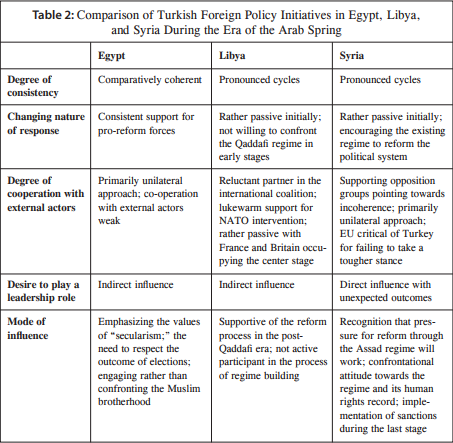
The result is that relations with Syria have seriously deteriorated. In the longer term, if the existing regime collapses and is replaced by pro-democratization forces, Turkey’s relations with Syria may be revitalized. However, if the existing regime manages to hold onto to power and resist change, this will be a serious blow to the significant improvement in the economic, diplomatic and cultural links that have developed in such a striking fashion over the course of the past decade.
The Limits of Turkey’s Regional Leadership Aspirations: The Case for Controlled Pro-Activism and Co-operative Leadership
During the AKP era, Turkey’s relations with the Middle East and the Arab world have improved dramatically to the extent that the Middle East has become increasingly the focal point of Turkey’s assertive and confident multilateral foreign policy initiatives in recent years. The Arab elites and the public at large have also been much more receptive to Turkish presence in the region.12 In retrospect, Turkey’s rediscovery of the Middle East and its growing presence in the region is a multi-dimensional phenomenon and is rooted in the following forces.
It was the “new” Turkish model epitomized by the AKP, rather than the traditional classical Turkish model based on top-down, state-led modernization led by secular elites, which caught the imagination of large segments of the Arab elites and the society at large
Turkey’s growing economic strength and strong progress in terms of modernization combined with a comparatively open and pluralistic political system has emerged increasingly as an attractive point of reference for the Arab elites. Indeed, as Turkey has moved closer to Europe, as a candidate country for EU membership, its attractiveness increased. It is fair to argue that it was the “new” Turkish model epitomized by the AKP, rather than the traditional classical Turkish model based on top-down, state-led modernization led by secular elites, which caught the imagination of large segments of the Arab elites and the society at large. The AKP experience represented a mixture of “conservatism” and “globalism.”13 Unlike its hyper-secularist, Kemalist counterpart, it projected a more flexible and nuanced understanding of “secularism” that allowed more space for religion in public space and everyday life. In other words, the AKP’s understanding of secularism was similar to what Ahmet Kuru has classified as “passive secularism” as opposed “assertive secularism” associated with the Kemalist modernization project.14 The AKP was “globalist” in the sense that it was willing to engage with the West and develop strategies to capitalize on the benefits of global integration. At the same time, it was willing to stand up against the West and to take independent positions especially in relation to the dominant power, the United States.
In that respect, the decision not to send Turkish troops to Northern Iraq in support of the American war effort in March 2003 proved to be a turning point that effectively started to erase the negative memories of the Ottoman legacy and tilted the balance towards a more positive and favorable perception of Turkey in the Arab world. Subsequently, the strong and assertive positions taken by Prime Minister Erdoğan, in terms of his vocal criticisms of Israel starting in Davos and his championing of Palestinian cause have helped to bolster the popularity of Turkey quite dramatically in most Arab countries.15 It is not perhaps an exaggeration to state that the appeals of Erdoğan’s popularity in the Arab streets and the overall popularity of the second-generation Turkish model represented by the AKP experiment have become quite inseparable. Indeed, one can quite legitimately ask the question of whether it was the personality and standing of Erdoğan himself, or the attractiveness of the new Turkish model generally that contributed more to Turkey’s rising popularity in the region. While the Arab Spring was a predominantly internally driven process, the Turkish experience in Kemal Kirişçi’s terminology had a positive demonstrative effect in the region.16 The Arab world’s growing encounters with Turkey both in economic and cultural terms have helped to build up perceptions and expectations that the authoritarian regimes in the Arab world were increasingly unable to accommodate the growing social and economic demands of their own citizens. Turkey’s total trade with Middle Eastern countries increased from 4.4 billion dollars in 2002 to almost 26 billion dollars in 2010. Turkey’s outward foreign direct investment stock, apart from construction investments, also improved in the same period. Accordingly between 2002 and 2009, it reached 11.2 billion dollars, 3.1 of which is directed to Asia, including Near and Middle Eastern countries.17
Over-engagement and over-assertiveness on Turkey’s part could contribute to further instability in an already highly unstable region
Hence, one can argue that the Turkish experience and presence had a role to play in the emergence of the Arab Spring and once the Arab Spring was underway there was growing recognition that the Turkish experience could prove to be an important source of inspiration or a reference point for Arab reformers, even though the term “Turkish model,” as something that can be readily replicated, might be somewhat far-fetched and inappropriate.18 For Turkey to play a constructive role in the context of the highly uncertain, volatile and potentially reversible environment of the on-going Arab spring, which some commentators quite legitimately state may turn out to be an Arab Winter, there is a need to recognize the limits of its regional power and influence.19 A predominantly unilateralist and over-assertive approach, which will raise fears of the rise of “Neo-Ottomanism” is most likely to backfire.
The more Turkey is actively engaged in the region and becomes an active participant in on-going conflicts, the less likely it will have the ability to play a constructive stabilizing and reformist role
The Middle East is a contested space. Turkey is in competition with Iran and Saudi Arabia. These two countries clearly have the resources and would like to shape the developments of many countries in the region, such as Egypt (which itself is a contender in the regional power game), Syria, and Iraq - all of which are in a state of flux.20 The reform process is under way in these countries, but the outcomes are highly uncertain. The worst that Turkey could do would be to take active positions in sectarian conflicts that seem to be endemic to most Middle Eastern regimes in transition. For example, championing the Sunni cause in Iraq against the rising support of Shiite influence reflecting the growing engagement of Iran in the region could prove to be a recipe for disaster. In other words, over-engagement and over-assertiveness on Turkey’s part could contribute to further instability in an already highly unstable region. There is clearly a paradox here. The more Turkey is actively engaged in the region and becomes an active participant in on-going conflicts, the less likely it will have the ability to play a constructive stabilizing and reformist role. What Turkey should aspire to is to involve itself as part of a co-operative leadership process working through multilateral channels, similar to the way it operates and works with the Arab League. The aim should be to influence developments in such a way as to support co-operative solutions to avoid sectarian violence and to overcome deep political divisions that clearly hamper the path to reform and eventual stability in many of these countries.21 Fortunately, recent Turkish foreign policy in Iraq constitutes an attempt to play a constructive role in this direction. Turkey has clearly avoided presenting itself as a supporter of Sunni groups and has been working for the unity of Iraq while engaging with the Kurdish authorities at the same time. Furthermore, Turkey has been trying to influence Iran not to engage in sectarian politics by providing overt support to Shiite elements although the likelihood of success seems to be low.
Arab Awakening as an Opportunity Space: Democratic Deepening and the Case for Re-Engagement with the European Union
The rediscovery of Turkey’s immediate neighborhood, notably the Middle East, as part of a broader multi-lateral strategy to diversify its economic, political, and diplomatic relations constituted the positive side of the AKP’s increasingly pro-active foreign policy in recent years. The negative side was that it was accompanied by a parallel process involving a progressive retreat away from the West and notably from the long-established ideal of EU membership. A central and often voiced critique of the new BRICS-like foreign policy behavior was the following. Turkey could have developed its multi-dimensional foreign policy and rediscover the Middle East while remaining firmly anchored to the West and the European Union, in particular.22 Indeed, the two elements could be seen as complementary rather than contradictory, as one of the key reasons that made Turkey attractive to the Arab world was the country’s deepening relations with the European Union. The reverse was also the case in the sense that Turkey was attractive to the European Union as part of its broader neighborhood policy and the special assets that Turkey seemed to possess culturally and economically in terms of further engagement with the Middle East. Although key Turkish foreign policy figures denied the fact that Turkey had lost interest in EU membership, in rhetoric, there appeared to be little concrete evidence in practice to suggest that the stalemate would be overcome.23
The crisis in Syria reflected the limits of Turkey’s soft power resources, in economic and diplomatic terms, to induce effective reform by putting pressure on Bashar-al-Assad, a leader with which the AKP leadership was previously on friendly terms
Although not openly admitted, Turkey, from the perspective of the United States and Europe, increasingly looked like an independent Middle Eastern power. As Larrabee underlines, Turkey “enhances its freedom of action and increase its leverage, both regionally and globally.”24 While the importance of Turkey was duly recognized, the image of Turkey as a country firmly committed to a Western course came under increasing scrutiny. Turkey’s over-blown criticisms of Israel, while helping to bolster the AKP’s positive image in Turkish domestic politics and the Arab streets, tended to support this growing sense of a new Turkey that was changing direction, although this did not mean a total withdrawal from the West and its key institutions such as the EU and NATO. Similarly, the overly favorable treatment of Iran in negotiations over nuclear disarmament and a lenient attitude towards its authoritarian political style also helped to project a similar image. In the main policy circles of the United States and Europe, the AKP no longer seemed to sustain its reformist, pro-western stance of its early years of government. Indeed, the conservative elements of its “conservative globalist” makeup rose more clearly and openly to the surface and it were only natural that these elements would be reflected in the government’s foreign policy style. Indeed, the third successive victory of the AKP in the general elections of June 2011 rendered the party leadership even more confident and this confidence was directly reflected in the party’s foreign policy approach towards the Middle East. The onset of the Arab Spring was important in highlighting the changing position of Turkey. While the Turkish experience was clearly important and relevant for the construction of the New Middle East, its limits of being able of playing a largely independent role was also seriously exposed. The crisis in Libya clearly highlighted the fact that effective foreign policy required re-alignment with the West and participation in Western-led coalitions. The crisis in Syria reflected the limits of Turkey’s soft power resources, in economic and diplomatic terms, to induce effective reform by putting pressure on Bashar-al-Assad, a leader with which the AKP leadership was previously on friendly terms.
The relevance of the Turkish experience to the rest of the Arab world will rest not only on the depth of its economic modernization, but also on the quality of its democracy
Although the European Union is in a state of crisis, it still has the combination of economic and diplomatic resources to affect change in the Middle East in a significant direction that far outweighs the resources that Turkey could marshal on its own initiative.25Clearly, the structural context that emerged with the Arab Spring involves a convergence of interests between Turkey and the EU and encourages co-operative behavior. With the Obama administration, relations with the United States have improved considerably. Yet, the EU element in the Turkey-US-EU triangle appears to be weak. Structural forces may open new opportunity spaces, but they alone cannot determine the outcomes. The role of key actors both in Europe and Turkey are crucial in this context. It is not enough for Turkish policy makers to engage with their European counterparts. Their European counterparts must also be willing to engage in a similar dialogue. The role played by the French President Nicolas Sarkozy, for example, has been particularly negative in this respect. The current mood with a dramatic decline in Turkish-French relations, following the French Parliament’s recent decision on the Armenian question does not generate much hope for the near future. Yet, in the medium-term, there is an opportunity for effective re-engagement between Turkey and the EU, especially with the election of Francois Hollande as new president in France. The outcome of the French election could help both parties to play a more constructive role in the context of Arab awakening, if only the key actors could seize the occasion and capitalize on the opportunity to work together in the Eastern Mediterranean. In the longer term, this could also pave the way for a revitalization of Turkey’s EU membership drive, with its continued importance not only in the economic realm, but in terms of raising the quality of democratic standards in Turkey.
Turkish foreign policy was clearly confronted with an ethics versus self-interest dilemma
This brings us to an important point that developments in domestic politics and foreign policy are intrinsically interrelated. The relevance of the Turkish experience to the rest of the Arab world will rest not only on the depth of its economic modernization, but also on the quality of its democracy. While the AKP era has been quite successful for the growth and expansion of the Turkish economy, still major questions exist concerning the quality of its democracy.26 To criticize Israel and its maltreatment of the Palestinians is perfectly legitimate. Yet, for this kind of criticism to be effective and achieve wide-ranging international attention, it is important for Turkey to overcome deep divisions within its own polity and move towards a genuinely open and pluralistic political order, as opposed to simply a kind of procedural and majoritarian democracy in which the basic rules of the game are not embraced by all segments of society. Clearly, if Turkey is not able to put an end to violent conflict and resolve its own Kurdish conflict in a peaceful and democratic manner, the same kind of criticisms that are leveled against Israel will also be leveled against Turkey, which will clearly undermine the valuable features that Turkey can project to the rest of the region.27
Concluding Observations
The dramatic set of events in the Middle East, described as the Arab Spring, creates a tremendous bias for hope for the future of open and pluralistic political systems in a region, which has often been identified as being one of the major exceptional strongholds of authoritarianism. The Arab Spring in the longer-run is also likely to have positive repercussions on the relevance of the Turkish experience and the nature and depth of its influence. Turkey is more likely to build up its economic and cultural ties if countries in the region are characterized by open, democratic systems. In the short-term, however, the Arab Spring exposed the assertive foreign policy of the AKP to a series of major challenges and in doing so exposed some of its major limitations. In economic terms, Turkey’s relations with the Arab Middle East, notably in countries like Libya and Syria have experienced serious setbacks.28 Turkey was able to withstand the impact of the global financial crisis in 2008 by diversifying its trade away from Europe towards the Middle East and North Africa. In the midst of continuing global recession in 2011 and 2012, further diversification towards the Middle Eastern markets may not be a viable option. Furthermore, “the zero problems with neighbors approach” experienced serious setbacks as Turkish policy makers were squeezed between the existing regimes that they previously supported in the past and the opposition movements that challenged these same regimes. The result was lack of coherence and a series of adaptations, which led to a U-turn in Turkey’s foreign policy.
Turkish foreign policy was clearly confronted with an ethics versus self-interest dilemma. An ethical approach demanded a single-minded commitment to democratic policy. This, in turn, however, came into contradiction with stability and economic interests, at least from a short-term to medium term perspective. Our major conclusion is that this dilemma is not unique to Turkey. Similar criticisms apply to Europe and the United States. One could easily criticize that the Western response also lacked coherence. Why, for example did a NATO intervention take place in Libya and not in Syria where the regime was equally brutal against its domestic opposition forces? Clearly, important economic interests were involved in Libya, which were not present in the Syrian case. Similarly, how could one explain the lack of pressure or action in much of the Arab world where authoritarian regimes continued without any kind of opposition, such as Saudi Arabia or where opposition movements were repressed at an early stage in gulf countries such as Bahrain?
A central argument of the present paper is that Turkey could make a bigger and more constructive impact in the region through controlled activism, acting through coalitions and in close alignments with the United States and major European countries. Excessive pro-activism and the overly vocal criticism of Israel may pay dividends in Turkish domestic politics and reaching the Arab streets. Yet, it may not be the best strategy in terms of Turkey’s longer-term interests. The more that Turkey is actively involved in the domestic and regional politics of the Middle East, the more its likely to contribute to further instability and divisiveness in an already highly volatile region where political change for the time being may lead to further divisions and sectarian violence, as opposed to a relatively smooth transition to open and pluralistic political systems.
Endnotes
- The present paper should be considered as a sequel to two earlier contributions, see Ziya Öniş and Şuhnaz Yılmaz, “Between Europeanization and Euro-Asianism: Foreign Policy Activism in Turkey during the AKP Era” Turkish Studies, Vol. 10, No. 1, (2009), pp. 7-24; Ziya Öniş, “Multiple Faces of the ‘New’ Turkish Foreign Policy: Underlying Dynamics and a Critique,” Insight Turkey, Vol. 13, No. 1, (2011), pp. 47-65. On recent dynamism of Turkish foreign policy, see Ronald Linden et. al., Turkey and its Neighbors: Foreign Relations in Transition (Boulder Co: Lynne Rienner, 2011). For the political economy of Turkish foreign policy, see Kemal Kirişci, “The Transformation of Turkish Foreign Policy: The Rise of the Trading State,” New Perspectives on Turkey, No. 40, (2009), pp. 29-57. For the domestic Dynamics of Turkish foreign policy, see Fuat Keyman, “Globalization, Modernity and Democracy: Turkish Foreign Policy 2009 and Beyond,” Perceptions: Journal of International Affairs, Vol. XV, No. 3-4, (2010), pp. 1-20. For a recent special issue on Turkey’s changing relations with Middle East, see Turkish Studies, Vol. 12, No. 4, (2011).
- Pınar Bilgin, “A return to ‘Civilizational Geopolitics in the Mediterranean? Changing Geopolitical Images of the European Union and Turkey in the post-Cold War Era” Geopolitics, Vol. 9, No. 2, (2004), pp. 269-291; Pınar Bilgin, and Ali Bilgiç, “Turkey’s New Foreign Policy Towards Eurasia,” Eurasian Geography and Economics, Vol. 52, No.2, (2011), pp. 173-195.
- On the AKP’s zero problems with neighbors strategy and the importance of Ahmet Davutoğlu’s “strategic depth” perspective in this context, see Ahmet Davutoğlu, Stratejik Derinlik: Türkiye’nin Uluslararası Konumu, (İstanbul: Küre Yayınları, 2001).
- In the case of Sudan, for example, Erdoğan backed Omar al-Bashir, the infamous Sudanese leader due to his human rights violations, by saying, “a Muslim can never commit genocide.”
- Asef Bayat, Life as Politics: How Ordinary People Change the Middle East (Amsterdam: Amsterdam University Press, 2010); Robert Springborg, ‘The Precarious Economics of Arab Springs,’ Survival, Vol. 53, No. 6, (2011), pp. 85-104.
- Eva Bellin, “Coercive Institutions and Coercive Leaders,” Marsha Posusney and Michele Angrist (ed.), Authoritarianism in the Middle East: Regimes and Resistance (London: Lynne Rienner Publishers, 2005), pp. 36-37; Oliver Schlumberger (ed.), Debating Arab Authoritarianism: Dynamics and Durability in Non-democratic Regimes (Stanford: Stanford University Press, 2007); Milan Svolik, “Power Sharing and Leadership Dynamics in Authoritarian Regimes,” American Journal of Political Science, Vol. 53, No. 2, (2009), pp. 477-94; Erica Frantz, and Natasha Ezrow, The Politics of Dictatorships: Institutions and Outcomes in Authoritarian Regimes (Boulder: Lynne Rienner, 2011)
- Recent impact of the elections in Egypt and its likely political consequences is visible as of January 2012. Indeed, the rise of Islamist politics is not a phenomenon unique to Egypt. Similar processes are occurring in countries such as Tunisia and Libya. See, “Egypt election tallies favor Islamists,” Al Jazeera, December 1, 2011; Martin Indyk, “Prospects for Democracy in Egypt,” Brookings Institute Foreign Policy Trip Reports 35, (January 23, 2012).
- Erdoğan called Mubarak to leave by saying that “You should listen to the people and their rightful demands... You should take the necessary steps to satisfy the Egyptian people’s demands first without providing an opportunity for those who have other plans for Egypt. Demands for freedom cannot be postponed and cannot be neglected.” For details, see “Erdoğan urges Mubarak to heed people’s call for change,” Today’s Zaman, February 2, 2011. For further discussion on Turkey’s approach to Egypt, see İhsan Dağı, “Turkish Model: Neither Authoritarian Nor Islamist,” Today’s Zaman, February 14, 2011.
- Turkey heavily invested in Libya especially in the contracting sector. Projects worth up to 20.5 billion dollars in total were undertaken by Turkish contracting and construction firms. The number of registered companies operating in Libya by the end of 2009 was 115. The total trade volume in 2010 amounted to 2.36 billion dollars. This data was gathered from The Republic of Turkey Ministry of Foreign Affairs.
- For the improvements in Syrian-Turkish relations during the AKP era, see Meliha Benli Altunışık and Özlem Tür, “From Distant Neighbors to Partners? Changing Syrian-Turkish Relations,” Security Dialogue, Vol. 37, No. 2, (2006), pp. 229-248.
- Liam Stack, “In Slap at Syria, Turkey Shelters Anti-Assad Fighters,” The New York Times, October 27, 2011.
- According to a recent survey, 73 percent in the Arab world believes that Turkey has become more influential in the Middle Eastern politics and 66 percent of them think that Turkey can be a model for countries in the Middle East, as a recent survey reveals. See, Mensur Akgün et al., The Perception of Turkey in the Middle East 2010 (İstanbul: TESEV Publications 2011), p. 12. According to Telhami’s survey results Erdoğan is the most favorable leader in the Arab world, see Shibley Telhami, “The 2011 Arab Public Opinion Poll,” conducted in October 2011. Available at www.brookings.edu.
- Ziya Öniş, “Conservative Globalists versus Defensive Nationalists: Political Parties and Paradoxes of Europeanization in Turkey,” Journal of Southern Europe and the Balkans, Vol. 9, No. 3, (2007), pp. 247-261.
- Ahmet Kuru, Secularism and State Policies toward Religion: The United States, France, and Turkey (Cambridge University Press, 2009).
- Malike Bileydi Koc, “Reflections on the Davos Crisis in the Turkish Press and the Views of Opinion Leaders of the Turkish Jews on the Crisis,” Turkish Studies, Vol. 12, No. 3, pp. 383-398.
- Kemal Kirişci, “Turkey’s ‘Demonstrative Effect’ and the Transformation of the Middle East,” Insight Turkey, Vol. 13, No. 2, (2011), pp. 35-55.
- Data is obtained from the Central Bank of the Republic of Turkey.
- On discussion of the relevance of the “Turkish model” or “models” with reference to the Middle East, see Seymen Atasoy, “The Turkish Example: A Model for Change in the Middle East?,” Middle East Policy, Vol. 18, No. 3, (2011), pp. 86-100.
- For a comprehensive empirical account of Turkey’s regional power capabilities in the Middle East, see O. Bahadır Dinçer and Mustafa Kutlay, “Türkiye’nin Ortadoğu’daki Bölgesel Güç Kapasitesi: Mümkünün Sınırları,” USAK Reports, Report No: 2012-03.
- Sean Kane, “The Coming Turkish Iranian Competition in Iraq,” USIP Special Report, 276, (June 2011).
- See Mohammad Ayoob’s recent contribution in this context, “Beyond the Democratic Wave in the Arab World: The Middle East’s Turko-Persian Future,” Insight Turkey, Vol. 13, No.2, (2011), pp. 57-70.
- Ziya Öniş, “Multiple Faces of the ‘New’ Turkish Foreign Policy: Underlying Dynamics and a Critique,” Insight Turkey, Vol. 13, No. 1, (2011), pp. 47-65.
- Adrian Michaels, “Turkey says joining EU is still top priority,” The Telegraph, July 8, 2010.
- F. Stephen Larrabee, “Turkey’s New Geopolitics,” Survival, Vol. 52, No. 2, (2010), p. 159.
- On the importance of a reformed European neighborhood policy in promoting democracy in the wider Middle east in the context of the Arab Spring and the need to co-operate with Turkey in this respects see Eduard Soler I Lecha, “The EU, Turkey, and the Arab Spring: From Parallel Approaches to a Joint Strategy?,” Natalie Tocci et. al. (eds.), Turkey and the Arab Spring: Implications for Turkish Foreign Policy From a Transatlantic Perspective, GMF Mediterranean Paper Series, 2011; see also, Nathalie Tocci and Jean-Pierre Cassarino, “Rethinking the EU’s Mediterranean Policies Post-1/11,” IAI Working Papers, No.11|06, (March 2011).
- On Turkey’s continuing democratization challenges see Meltem Müftüler-Baç and Fuat Keyman, “The Era of Dominant-Party Politics,” Journal of Democracy, Vol. 23, No. 1, (2012), pp. 85-99; Berna Turam, “Are Rights and Liberties Safe?”, Journal of Democracy, Vol. 23, No. 1, (2012), pp. 109-118.
- On Turkey’s continued inability to resolve the Kurdish question, see Ragan Updegraff, “The Kurdish Question,” Journal of Democracy, Vol. 23, No. 1, (2012), pp. 119-128. Also relevant in this context is Kerem Öktem, Angry Nation: Turkey Since 1989 (London: Zed Books, 2011).
- After the crackdown of relations, Turkey-Syria economic relations deteriorated abruptly. For example, Damascus had closed down its crossing near Urfa, in eastern Turkey. Turkish truck drivers in Syria were forced to leave their trucks on the Syrian side of the border and walk to Turkish side. In December 2011, Syria unilaterally suspended its free trade agreement with Turkey, and introduced taxes of up to 30 cents on Turkish exports entering Syria, whereby Turkey retaliated quickly by doing the same. For further details, see Dan Bilefsky, “Turkish Border Businesses Miss the Syrian Neighbors,” The New York Times, December 12, 2011.
