
Current Issue


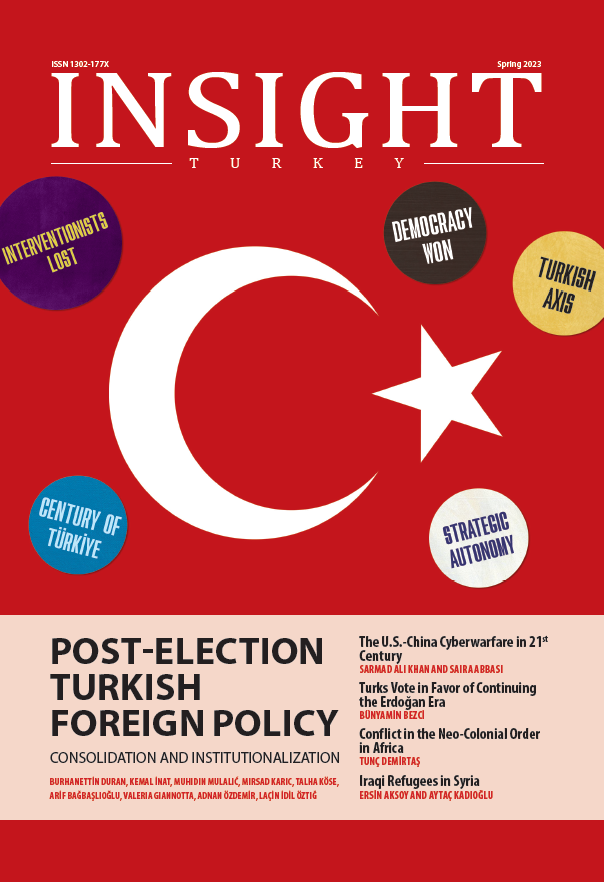
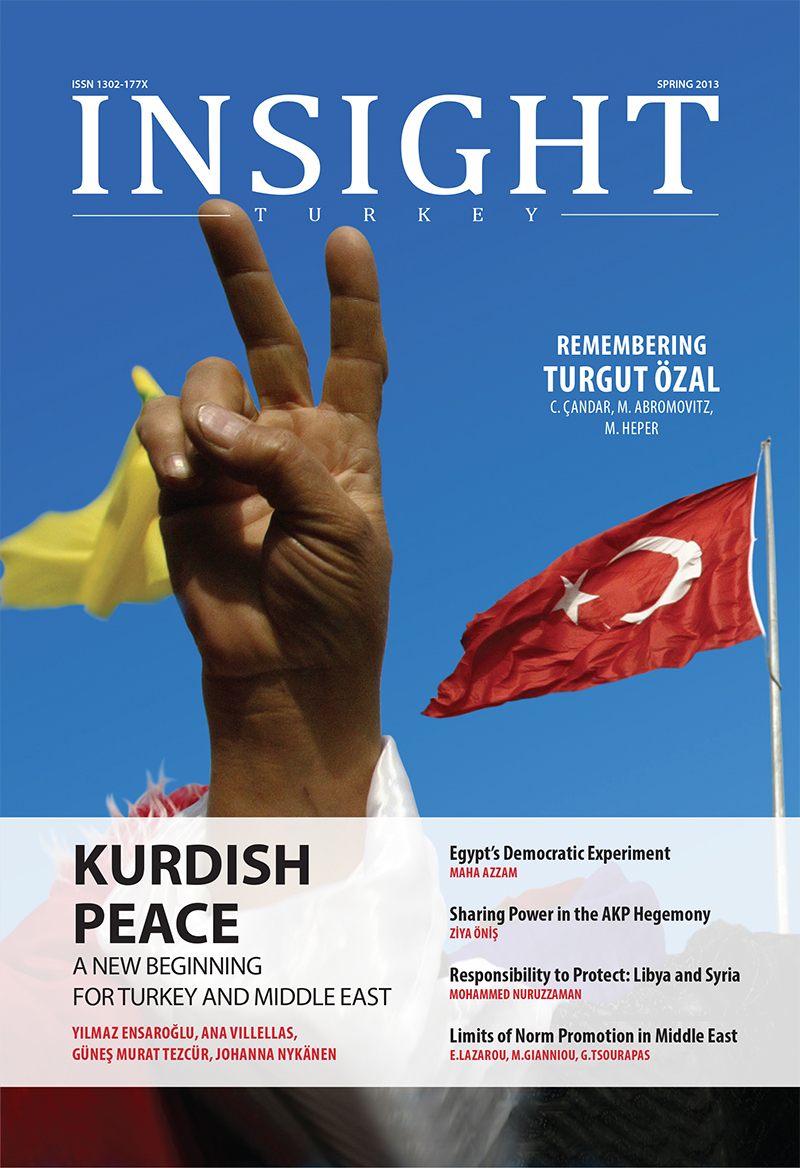
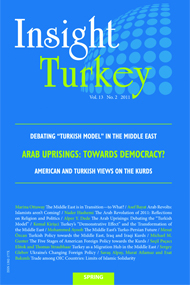
Spring 2013 Volume 15 No 2


Insight Turkey Volume 15 No 2

COMMENTARIES

Turkey’s Kurdish Question and the Peace Process

YILMA Z ENSAROĞLU

Vol.15 No.2  P. 7-18

Turkey currently is witnessing a series of events that are most likely to go down in history as truly important milestones. The country is attempting to tackle the age-old Kurdish question. Thus far, the peace process has given rise to more hope than ever. Yet, it has not been devoid of worries and concerns.  Hope arises out of the fact that we are witnessing major progress that was unimaginable until a short time ago. However, the shadow of past experiences makes it difficult to overcome reservations.  [Read More]

New Peace Talks in Turkey: Opportunities and Challenges in Conflict Resolution

ANA VILLELLAS

Vol.15 No.2  P. 19-26

The restart of peace talks between the Government and the  PKK has brought renewed optimism about the possibility to settle a nearly three-decade conflict, one of the oldest ongoing armed conflicts in the world and one with a major impact on neighbouring countries. These new efforts can be understood as part of the rapprochement process started in the mid 2000s. While it comes after a tremendous peak in violence, there seem to be very positive signs of the seriousness of this new  stage. However, there are also doubts on its strength, structure, and direction. [Read More]

Turgut Özal Twenty Years After: The Man and the Politician

CENGİZ ÇANDAR

Vol.15 No.2  P. 27-37

Whether Turgut Özal was a good politician remains up for debate. However, there is no question that he indeed was (and is) a significant historical persona. He guided his country into the twenty-first century. When Özal suddenly passed away in 1993, he had already led Turkey to the next century, even though the twenty-first century would technically begin only seven years later. . [Read More]

Remembering Turgut Özal: Some Personal Recollections

MORTON ABRAMOWITZ

Vol.15 No.2  P. 38-46

Two very different Turkish leaders have played impressively on both the world and domestic stages—Turgut Ozal and Recep Tayyip Erdogan. Both have been transformational leaders with great achievements. Ozal was a new type of Turkish leader with a realistic vision for where Turkey should be headed, and the intellect, pragmatism, determination and political skill to remake the economy. He dominated the Turkish scene for a decade. [Read More]

Turkey and the European Union: 2014 and Beyond

JOOST LAGENDIJK

Vol.15 No.2  P. 47-56

It seems likely that in 2013 Turkey and the EU will restart technical negotiations on one or more chapters. A real breakthrough, however, can only be expected in 2014, after the German elections and after the EU has regained the confidence that the current euro crisis can be overcome. Turkey for its part first needs to successfully conclude the fundamental reforms it has started on the Kurdish problem and in writing a new constitution. The “Responsibility to Protect” Doctrine: Revived in Libya, Buried in Syria [Read More]

The “Responsibility to Protect”  Doctrine: Revived in Libya, Buried in Syria

MOHAMMED NURUZZAMAN

Vol.15 No.2  P. 57-68

Proponents of the “responsibility to protect” doctrine, commonly referred to as R2P, claim that it came of age with NATO’s successful military intervention to protect the civilian population in Libya. This commentary raises questions of whether NATO’s intervention under UN Security Council Resolution 1973 followed the original 2001 R2P report and other related UN documents, and contends that if R2P had come of age with NATO’s intervention in Libya, it has had a tragic death with the Security Council’s inability to initiate actions on Syria. The death of R2P in Syria has been rendered inevitable by NATO’s abuses in Libya, and the doctrine is doomed to a bleak future. [Read More]

ARTICLES

Prospects for Resolution of the Kurdish Question: A Realist Perspective

GÜNEŞ MURAT TEZCÜR

Vol.15 No.2  P.69-84

The developments in early 2013 generated expectations that the almost three decades old armed conflict between the Turkish state and PKK would eventually come to an end. This article adopts a skeptical position and identifies two principal factors that make a peaceful settlement a distant possibility. First, the current military situation is a stalemate that is not ripe for peace. The costs of the conflict remain highly tolerable for both sides. Next, huge differences separate what the Turkish government is willing to deliver and what the Kurdish insurgency is willing to accept for disarmament. In particular, the PKK has no incentive to accept disarmament and demobilization given current geopolitical dynamics conducive to Kurdish self-rule. Identity, Narrative and Frames: Assessing Turkey’s Kurdish Initiatives. [Read More]

Identity, Narrative and Frames: Assessing Turkey’s Kurdish Initiatives

JOHANNA NYKÄNEN

Vol.15 No.2  P.85-102

In 2009 the Turkish government launched a novel initiative to tackle the Kurdish question. The initiative soon ran into deadlock, only to be untangled towards the end of 2012 when a new policy  was announced. This comparative paper adopts Michael Barnett’s trinity of identity, narratives and frames to show how a cultural space within which a peaceful engagement with the Kurdistan Workers’ Party (PKK) would be deemed legitimate and desirable was carved out. Comparisons between the two policies reveal that the framing of policy narratives can have a formative impact on their outcomes. The paper demonstrates how the governing quality of firmness fluctuated between different connotations and references, finally leading back to a deep-rooted tradition in Turkish  governance.  [Read More]

Sharing Power: Turkey’s Democratization Challenge in the Age of the AKP Hegemony

ZİYA ÖNİŞ

Vol.15 No.2  P.85-102

After a major wave of democratization over the last decade, the stalemate in Turkey’s reform process and the rising concerns about ‘creeping authoritarianism’ under the ruling AKP government attracted the attention of many scholars. How could Turkey manage to achieve substantial progress in democratization over the last ten years and why has the current government lost its reformist spirit? This article seeks to answer these questions by developing a multi-dimensional, holistic approach that tries to integrate structures and actors, domestic and external forces, rather  than single-mindedly focusing on certain aspects whilst downplaying other crucial elements.    [Read More]

The AK Party and the Evolution of Turkish Political Islam’s Foreign Policy

GALİP DALAY and DOV FRIEDMAN

Vol.15 No.2  P.123-140

Turkish foreign policy under the AK Party government has long drawn scrutiny from a wide range of analysts. The Syrian uprising has raised the intensity, variance, and rapid change of such analysis. Though the events in Syria have forced a recalibration of Turkish foreign policy, this change can be better understood with attention to the history of the AK Party’s foreign policy. That history is rooted in a tradition of both continuity and change vis-à-vis the AK Party’s political Islamist predecessors, the Refah and Fazilet parties. By understanding the values, motivations, failures, and lessons of the AK Party’s political forebears, we may better understand the last decade of the AK Party’s foreign  policy—and its continuing evolution. [Read More]

Islam, Conservatism, and Democracy in Turkey: Comparing Turgut Özal and Recep Tayyip Erdoğan

METİN HEPER

Vol.15 No.2  P.141-156

In the absence of a politically influential aristocracy and the entrepreneurial middle class, the political and economic transformations in Republican Turkey have been the handiwork of the political elites.  Thus, late Dankwart A. Rustow talked of the cultural revolution of Atatürk, the democratic revolution of İsmet İnönü, and the economic revolution of Turgut Özal. The first two transformations were top-down revolutions and have not had a considerable impact on the social and economic stratification in the country. In contrast, with the Özal revolution a new entrepreneurial middle class began to flourish. Furthermore, during the current Recep Tayyip Erdoğan period, the peripheral social groups led by the entrepreneurial middle class have become influential players in Turkish polity.  [Read More]

Egypt’s Democratic Experiment: Challenges to a Positive Trajectory  

MAHA AZZAM

Vol.15 No.2  P.157-170

As Egypt charts a path to democracy, it confronts the legacy of 60 years of dictatorship. President Morsi faces an ongoing power struggle with state institutions, including the judiciary, that are  resistant to change. Furthermore, the opposition is unwilling to play by the rules of the democratic game and is primarily focused on undermining the government through street protests rather than the ballot box. If Morsi can navigate through these political challenges, Egypt can emerge from the present economic downturn and move towards a potentially dynamic political and economic  trajectory. [Read More]

The Limits of Norm Promotion: The EU in Egypt and Israel/Palestine

ELENA LAZAROU , MAR IA GIANNIOU and GERASIMOS TSOURAPAS

Vol.15 No.2  P.171-194

Policy implications aside, assessing the EU’s involvement in the Mediterranean region necessitates a reconsideration of the impact and limits of the so-called ‘normative power’ upon which its approach has been based, implicitly or explicitly. This paper does so by examining the EU’s engagement with Egypt and the Israel-Palestine conflict; it sets out to challenge the notion that EU-style normative power alone is well-suited to promote democracy and regional cooperation, particularly in regions with diverging dynamics where the promotion of EU-associated norms may stumble upon European trade- and diplomacy-related interests. In this sense, it aims to enrich and inform the debates on ‘normative power Europe’ and Euro-Mediterranean relations. [Read More]

BOOK REVIEWS

Iran-Turkey Relations, 1979-2011: Conceptualizing the Dynamics of Politics, Religion and Security in Middle-Power States
Reviewed by Süleyman Kızıltoprak p. 195

Toward an Islamic Movement: The Gülen Movement 
Reviewed by Can Özcan p. 197

Spatial Conceptions of the Nation: Modernizing Geographies in Greece and Turkey
Reviewed by Ergun Özbudun p.200

Militarist State Discourse in Turkey
Reviewed by İbrahim Efe p.203

İncirlik Military Base: Military Base Politics of the US and Turkey
Reviewed by Müjge Küçükkeleş p.205

Knowledge in Later Islamic Philosophy: Mulla Sadra on Existence, Intellect, and Intuition
Reviewed by Rahim Acar p.207

Leaving Without Losing: The War on Terror After Iraq and Afghanistan
Reviewed by Patrick C. Coaty p.210

Nationalism, Ethnicity, Citizenship: Multidisciplinary Perspectives
Reviewed by Panikos Panayi  p.212

After Yugoslavia: Identities and Politics Within the Successor States
Reviewed by İrfan Kaya Ülger  P.214

A Mirror for Our Times: “The Rushdie Affair” and the Future of Multiculturalism
Reviewed by Tahir Abbas   p.216

REVIEW ARTICLE Reviewed by Kılıç Buğra Kanat  P.219

That Used to Be Us: How America Fell Behind in the World It Invented and How We Can Come Back
THOMAS L. FRIEDMAN and MICHAEL MANDEL BAUM
Zero-Sum Future: American Power in an Age of Anxiety
GIDEON RAC HMAN
The Short American Century: A Postmortem
ANDREW J. BACEV ICH