

Introduction
Twentieth century political realism dominated by traditional security perspectives placed the military security agenda at the forefront of competing great power foreign policies for many decades. Contrary to the traditional school of thought, the intellectual, temporal and spatial narratives supplanted by the Aberystwyth,1 Copenhagen,2 Paris3 and Welsh schools offered a variety of approaches that culminated diverse theoretical centers of axes to utilize Western vernacular to unpack the meaning of security and what constitutes the roadmap for national security and peace agendas. Great powers from past empires to the nation-states formation under the Westphalian Treaty have always enjoyed exceptional political powers yielding major changes in geopolitical designs, from territorial demarcations to neocolonialist influence over "semi-independent states."4
Today, we witness the 21st century's hyper-race for power, wealth, and territorial contestation as a more robust continuity in the voracious pursuit to attain critical resource acquisition. In the midst of this race, there is a unique approach brought forth by Muslim realists that aims to provide a new response to the traditional understanding of realism. The following study seeks to unpack the complexities of unchecked power and whether a Muslim realist mindset couched in moral and ethical approaches can propel the rise of a new strand in the realist school of thought. In doing so, the main challenge in answering this question lies at the heart of transforming human nature from conflictual behavior to a peaceful nature while reciprocating the Leviathan nature that generally tends to surpass within and without. Faith, from this perspective, is undertaken as a blueprint for guide in navigating state-to-state relations and political dynamics that are centered in the nature of state actors who actively seek to drive forward particular policies for their national interests.
In the post-truth age, there is a massive lacuna as to what kind of vision state policies can initiate to curtail pernicious intents of unrestrained desire for power and wealth. As the attack surface expands beyond physical territories into the cognitive domain, defending society against AI-enabled disinformation and synthetic manipulation has become a paramount security imperative that requires robust cognitive diplomacy.5 In this vein, the ascendancy of discussions around faith, beliefs, and ideologies across international politics have gained an unprecedented momentum in the clash of civilizations narrative incessantly pursued by the Huntingtonians of today.6 The advancement of technology and artificial intelligence is worrying millions across the board as to what sets of beliefs will carry humanity toward a higher progress and whether beliefs have any purpose or meaning at all for a positive transformation of a vast and diverse human civilization. Within the galvanizing impact of various debates taking place, the rapid growth of hyper-technology impacting sharp changes in geopolitical competitiveness, societies, and nations draw attention to an alarming challenge. Unquestionably, leaders around the world seem to have a higher tendency to pursue emotionally driven decision-making unscrupulously and are less compelled to develop coherent rational strategies for their national interests.
Faith is undertaken as a blueprint for guide in navigating state-to-state relations and political dynamics
For a country like Türkiye, the path is unequivocally different. As the country prepares to host the NATO Ankara Summit, there is more than just the bona fide policies the country offers to ameliorate the ongoing rift in the trans-Atlantic community against the larger backdrop of the East-West tug-of-war arms race in strategic military competition. This divide is further exacerbated by the U.S. administration's push for a "NATO 3.0" framework, which pressures European allies to shoulder a heavier burden in collective defense and threatens to scale back cooperative security missions.7 Driven by the new U.S. administration's overarching "policy of restraint" and looming threats to scale down trans-Atlantic security guarantees, European capitals are currently facing an unprecedented crisis regarding the credibility of their standalone conventional and nuclear deterrence.8 The Turkish Republic, having already surpassed the centennial of its birth, continues its quest to construct a state-of-the-art doctrine and its adroit implementation of strategic goals as part of a steady re-configuration of policies -soft, hard, smart- into a muessir power.9 This encapsulates security, knowledge production, technology/AI and cyber powers within an intrinsic connection to the nucleus of the moral and ethical parameters broadly outlined in the faith of peace.
Muessir/efficacious, originally an Arabic derived word, holds significant weight in Turkish vernacular and implies a protagonist taking up the role of creating a leap forward to transform an undesired deleterious status-quo. The term reflects the efficacious nature of an actor that assumes the devoir to refine a moral and ethical state persona to potently create a desired change for collective progress and improvement in a system with abandoned values and norms. As he/she adopts a policy of being the propeller for a paradigm-shift, the actor proactively seeks to dispel a pervasively negative environment in the aim of uplifting universal human values such as fairness, equity, and prosperity for the mutual gain of humanity. By doing so, a muessir actor makes a notable contribution to opening the discussion in the plurality of converging universal values and norms that harmonize and also highlights the need to enhance paradigmatic skills to eclipse the vicissitudes brought by the gloom of war.
In a dismal geopolitical atmosphere, more than ever, there is a need to beckon a gamut of human thought, beliefs, and reason to put forward the willpower to expand on strategic policies that enable peaceful measures
The critical turn in security studies has undeniably widened the referent objects of security beyond the state to encompass emancipation, securitization, everyday practices of insecurity, and human welfare. Yet, for all their intellectual richness, these schools have remained tethered to a Western vernacular and a secular epistemology that treats faith either as an object of securitization or as an ideological residue to be explained away, rather than as a constitutive source of strategic reasoning. Classical and structural realism, on the other hand, bracketed morality by subordinating ethical considerations to the imperatives of survival under anarchy, leaving no conceptual space for a statecraft in where values and security operate hand in hand. It is precisely within this dual lacuna, the critical schools' secular horizon and realism's moral silence, that the present study intervenes.
Accordingly, the central research question guiding this study is whether a Muslim realist mindset, couched in moral and ethical approaches derived from the faith of peace, can propel the rise of a new strand in the realist school of thought, and whether Türkiye's muessir power praxis offers the empirical validation of such a paradigm at a moment when the trans-Atlantic order is confronting its deepest crisis of cohesion since 1949. In pursuing this question, the study further interrogates how the conflictual tendencies of human nature can be transformed toward peaceful conduct without abandoning strategic preparedness, what the concept of muessir power adds to existing typologies of soft, hard, and smart power, and how Türkiye reconciles its simultaneous roles as mediator, humanitarian actor and hardened deterrent power within a single value-laden security doctrine.
A Strategy of Transilience for Collective Survival of Humanity
During times of heightened hostilities, the arms-tech-cyber-AI race is fueling a rivalry of nations that often misperceive one another as enemies. In a dismal geopolitical atmosphere, more than ever, there is a need to beckon a gamut of human thought, beliefs, and reason to put forward the willpower to expand on strategic policies that enable peaceful measures toward de-escalation and initiate rational military objectives/actions all the while soar investments for the welfare of the region and global neighborhood. Practically, to be able to achieve a promising and outlasting outcome, there is a greater need to advance discussions around imagining a broad and all-encompassing common civilization10 perspective. Ideally, deterrence through military force alone does not suffice in safeguarding values that stand as the pillars of protection of life, liberty, and pursuit of happiness for liberal democracies. In order to bring down the walls of friction among ideologically antagonistic warring views, there is opportunity for the realization of embracing the principle of kesretten vahdete (from diversity to unity)11 as a pluralistic harmony and peace among various worldviews.
The United Nations Alliance of Civilizations12 was precisely founded at this conjuncture to address the need for effective moral and ethical reasoning as a major impetus to inspire amicable and goodwill relations to unite under a "commonality of differences" understanding. The Qur'an, the holy book of Muslims, in this regard, provides ample guidance to start an earnest conversation about the meaning of peace and collective prosperity ensconced in the natural co-existence of nations. There are two eye-opening verses that stand out the most in describing the diverse structure and an all-encompassing vision of humanity premised on the imperativeness for good neighborly relations among communities. The verses, interestingly, have an overarching impact in bringing different worldviews under a common denominator as part of the divine construct of humanity living in a kaleidoscopic mosaic.
The chapter titled "Rooms" intriguingly refers to the nobleness of the human race coalesced into spheres of nations as the Creator mentions in the following verse, "O humanity! Indeed, We created you from a male and a female, and made you into peoples and nations so that you may get to know one another. Surely the most noble of you in the sight of Allah is the most righteous among you. Allah is truly All-Knowing, All-Aware" (Hujurat, 13).13 Another alluring verse referring to the chromatic design of humanity expressed by the Creator in the chapter titled "Heifer" is where God reveals his view of humanity in the following verse, "Everyone turns to their own direction. So compete with one another in doing good. Wherever you are, Allah will bring you all together. Surely Allah is Most Capable of everything" (Baqarah, 148).14
Both of the aforementioned verses serve as an enlightening maxim for a muessir power perspective evinced within the principle of enrichment of plurality and encouragement of noble works devoted to the benefit of humanity as a righteous race among civilizations with a "fellowship of nations" consciousness. The multi-civilizational conversations in the broader panorama of a common civilization consultations perhaps could serve as the most reliable mechanism to pursue solution-oriented policies during heightened risks of conflicts and disputes. Muessir power's cognizance of humanity, in this scope, advocates the principle to compete in doing beneficial, constructive works that serve the collective good rather than seek a competition focused on the loss, deprivation, or exclusion of another nation or society.
The Qur'an in almost every passage or parable confirms the axiom to progress in doing good work that benefit global society -without resorting to distinction on belief, gender, race, ethnicity, culture or language- that inculcates the necessity of doing good as a universal truth with a plethora of methods and ways to achieve it. Fundamentally, of course, a human security purview that regards the dignity of everyone at the core of a state-centric vision stands in stark difference to acts of annihilation of any neighboring society or community of peoples. Since Islam stipulates that peace can only prevail vis-à-vis respect to diversity, it also highlights the acceptance of multiple interpretations of eudaemonia15 -in developing and exercising virtues- as the essence and continuity of peaceful relations among nations as the hallmark of its departure point.
The concept of territorialization in international relations and the history of wars, unequivocally and more so tragically, provide a paradoxical narrative. In the comparison of the ideological civilizational pursuit for dominance, faith and value-driven religious wars resulted in the fallible nature of human reason to fully comprehend the implementation of moral and ethical values across battlefields. Islam, in distinction, offers a uniquely humanitarian and emphatic approach even in the most difficult conditions of wars. Not violating the sanctity of the natural environment (particularly trees), places of worship, the elderly, disabled individuals, women, children, and men as civilians who do not take part in war can never be targets of aggression. Administering with justice, equity, and fairness are exemplified in parables of David and Solomon alongside themes on the use of defensive force, iron as a pliable production for the beneficial use of humanity, economic freedom, respect to the inalienable right of life and dignity of all creation. These have been framed in divine law as a collective right of peaceful co-existence.
In today's world, recognition of the major loss of countless innocent civilian lives necessitates a greater scope of discussion around what consists ethics of war, reasons as to why it has been dejected from current war contexts and what could be done to re-insert the conversation amid unrestrained violence
In all of the lessons encapsulated in Qur'anic stories, adhering to the principles and values or choosing not to seek wisdom illustrate a startling narrative of the rise and fall of nations as a broad theme addressed in divine revelation, with utmost attention given to the Day of Accountability. The Day of Reckoning will see each individual and leaders of nations held responsible for their decisions, actions, and inaction in the face of various forms of injustice or rewarded for having an upright character in defending justice and stopping forms of violence and oppression. In the chapter titled the "Table Spread" in Verse 8, the Creator draws specific attention to restraining sentiments of hatred that could override a sound judgment. He says, "O believers, stand firm for Allah and bear true testimony. Do not let the hatred of a people lead you to injustice. Be just! That is closer to righteousness. And be mindful of Allah. Surely Allah is All-Aware of what you do."16 In the chapter titled "Saad" Verse 26, He also refers to the weight and seriousness of leadership responsibility in addressing the Prophet David with a serious warning that having authority over a nation requires a just, honest, equitable and fair decision-making epitomized in the concept of truth. He says, "O David, we have surely made you an authority in the land, so judge between people with truth. And do not follow your whims or they will lead you astray from Allah's way. Surely those who go astray from Allah's way will suffer a severe punishment for neglecting the Day of Accountability."17
In the aforementioned verses, Islamic tradition under the umbrella of the Abrahamic faith highlights the necessity of wise leaders to be cognizant of the responsibility of their decisions. The Creator's foreshadow of the Day of Reckoning emphasizes that each individual will be questioned whether his/her exercise of free will or the choices pursued in earthly life served the progress and improvement of nations or resulted in the negative consequences that were counter-productive to the well-being of peoples. In today's world, recognition of the major loss of countless innocent civilian lives necessitates a greater scope of discussion around what consists ethics of war, reasons as to why it has been dejected from current war contexts and what could be done to re-insert the conversation amid unrestrained violence.
Effective leadership, exemplified in the parables of many messengers across Islamic tradition, demonstrates crucial skills in times of crisis that call for rational reasoning and reasonable action deduced from sound logic
The idea of updating just war theory18 expressed by Pope Leo XIV in the Magnifica Humanitas brings to light a critical conversation that corresponds with the need to re-establish ethics of war similarly outlined in Islam -the faith of Peace. Specifically, the unbridled ferocity against the innocent witnessed in the Middle East region warrants the urgency for collective thinking, common understanding and consultation for maximum degree of minimization of the violence directed at civilians and search for methods to maximize conflict-resolution approaches. In setting sensible measures, the updated interpretations of the ethics of war in the post-truth age require wise judgment with utmost planning and regard to the protection of civilian lives by abolishing systematic dehumanization of individuals. In this respect, there is an abundant number of virtuous teachings that highlight phronesis -practical wisdom such as hikmah and sophia- in both Muslim and Christian traditions that bring to light universal wisdom in defending and protecting the rights of victims of genocide and war. At the same time, it is urgent to develop ethical norms of precautionary measures for the full protection of residential areas, worship places, hospitals, schools, nurseries, animal shelters, food and water supplies, libraries and various city infrastructure that form the pillars of community life.
The political realism of the 20th and 21st century, however, fails to address the challenges surrounding the ethics of war across many aisles of contemporary battlefields.19 Despite the lack of regard to weighing in on debates regarding whether values dovetail with actions or not, there is an essential yet universal behavioral norm that Islam gives eminence to in a virtuous character. These leadership behavioral norms illuminate one's humbleness before the divine while accepting differences in the sisterhood/brotherhood of humanity, aiming to accentuate what lessons could be drawn from the Islamic tradition in setting a framework for ethical and moral conduct in war environment. In following such wisdom, there is a strong emphasis on defensive methods advised as a mandatory action to survive in the face of suppression or decimation without exceeding the limits of proportionate reciprocation.
In a broader revelation context, the breadth of knowledge by the Holy Qur'an as part of Abrahamic tradition focuses on many parables in offensive and defensive posturing, though surprisingly, not through use of force but vis-à-vis messages aimed to inspire rational thinking. Stories in a larger scope render a key divine interest in the construction of righteous characters to strive in defending a message of commitment to peace through peaceful methods against a multitude of falsehoods geared toward regression, conflict, corruption of human nature, and destruction of natural environment. In the parables of Adam, Noah, Eber, David, Solomon, Jacob, Joseph, Job, Jethro, Elija, Lot, John, Zachariah, Mary, Jonah, Enoch, Elisha, Abraham, Isaac, Ishmael, Moses, Aaron, Jesus and the Prophet Muhammed (peace and blessings be upon all of them), they all struggled to relay the corresponding message of peace despite the backlash, criticism, and the brutal attempts of extermination they faced. All messengers were sent at different time periods and put into different circumstances, but their leadership persona and the message they carried remained constant despite alterations in temporal and spatial context. From a Qur'anic perspective, they did not cede nor veer away from fulfilling a mission for the collective good of humanity as they built charactership based on patience-honed peaceful resistance and consistent messaging while remaining steadfast.
In order to cultivate a discernment between right and wrong, the struggle of the messengers and their leadership serve as an inspirational mind-map in Islamic dialogue that forms the nucleus of wise, strategic, cautious, and patience-prone approach during taxing times that urgently call for well-thought-out diplomatic engagement and impactful line of communication. Their unwavering dedication to rectify morally and ethically decadent societies extensively shaped methods of communication across situations of tyranny, abuse of power, oppression, and denigration. They exemplified that the best form of messaging never desecrates the sacredness in another culture or tradition but aims to elevate fellow nations on the principle of equity, humility, diversity, and collectivity as a peaceful construct of co-existence in the omnipresence of the divine.
Effective leadership, hence, exemplified in the parables of many messengers across Islamic tradition, demonstrates crucial skills in times of crisis that call for rational reasoning and reasonable action deduced from sound logic. In such a cause, choosing piety over the lewdness in one's nature allows virtue to rise innately where such a process akin to the Socratic rational reasoning method propels one to question his/her volatile, ambiguous nature and inspires one to make a conscious decision to struggle in disengaging from a Leviathan type of innate characteristic. And, in doing so, one begins to embark on the path of an intellectual journey of the inner-self to explore the divine demand to seek and excavate genuine peace and courteousness embedded within oneself.
A Muslim realist, therefore, in war time and battle-worn conditions reflects on the stories of righteous leaders who have come and passed-on, yet left behind significant lessons that resonate wisdom and courage in addressing the chronic diseases of hate, malice, and indignation. A virtuous actor's prestige across conflict-ridden environments tends to irradiate in positive messaging to inhibit any condition that can lead to an assailant behavior and actively speaks against contentious types of actions inconducive to resolving disputes. In this respect, the perception for a counter-method to minimize threats and risks hearkens the call for dialogue, communication, and negotiations in Islamic tradition without abject treatment of a counterpart, all the while pursuing peace efforts by dissuading any party from taking up belligerent posturing. In effect, a peace-promoting persona never desires, seeks, or demands contention as a baseline in conflict resolution. Despite the shortfall of negative traits that manifest in a Hobbesian human behavior, there remains is a copious number of lessons to extract from faith and values instilled in the minds and hearts of diverse moral and ethical teachings with commonality in themes found in overlapping civilizational teachings.
Now more than ever, the intellectual analysis in current geopolitical deadlock, to an unprecedented degree, requires conflict-resolution models that take dialogue to the core of its peace mission. In such an endeavor, a holistic understanding of geopolitical vastness and various power dimensions ought to favor an amicable exchange of views among civilizations rather than hostile engagement. It is precisely for this reason that Türkiye, as a Muslim realist leadership model, provides compelling input across many cross-regional and global decision-making environments in the pursuit of peace agendas.
Türkiye, as a loyal ally in troubling times, affirms its indispensable role in the NATO alliance -not only for its military might- but the prowess it courageously displays for its emphasis on virtue, ethics, and earnest multilateral diplomatic engagement.20 During heightened hyper-vigilant environments of conflicts, we witness triggers of extreme aggression downplaying the significance of mediation and negotiations as an Achilles' heel that hinders parties from catapulting toward peace goals. Türkiye's muessir state nature, nonetheless, defies challenges that stand against the pursuit of peace in which the medium- and long-term framework of security doctrine concentrates on maximum reduction in consequences for civilian lives and promotes reasonable methods of de-escalation through collaborative negotiations and partnerships.
Turkish foreign policy focuses on building a cooperative and inclusive peace rather than pursuing hegemonic dominance. This inclusive goal reveals the multifaceted nature of a highly rational and strategic state persona that elegantly balances national interests with a firm commitment to international law and humanitarian law.21 With an exceptional peace and security-driven paradigmatic view, Türkiye exhaustively shapes the contours of a statecraft nested on a solid foundation of beliefs, values, and norms as the basis for respecting the sovereignty and territorial integrity of all nation-states. In the scope of the "win-win understanding" maxim of Turkish foreign policy, inclusion of all confronts the elitist idea of "exclusivity of a few." A tangible manifestation of this anti-exclusive vision is the push for intermediate institutional models, such as the proposed "SAFE-plus" framework, which aims to structurally link non-EU NATO allies to the broader European defense rearmament without falling victim to unanimous political vetoes. By seeking a collaborative middle ground, Türkiye actively resists the marginalization of capable allies from continental security architectures.22 This long-standing axiom of comprehensiveness in Turkish foreign policy -pursued for more than two decades- has expanded the nation-state's domestic and regional capacity to endure hardships within and without while giving due diligence to peace discourse with composure and perseverance in becoming a muessir power. In imbuing a state persona shrouded in an amicable character reflecting peaceful speech-act, conduct and good neighborly relations without resorting to hostile behavior, undoubtedly, has advanced an overarching peace agenda girded with a defensive shield for the protection of life and dignity of all stakeholders in the broader region.
In the broader struggle for power, the veraciously peace-driven foreign policy agenda of Türkiye assesses threats and risks based on challenges inherited from territorial power competition that go beyond the centuries-long historical backdrop
This sensible approach provided in the Türkiye's vast geopolitical environment, indeed, mirrors a foreign policy behavior with utmost sensitivity in navigating diverse political tensions. As time lapses, the varieties of methods to solve an expansive amount of cross-layered conflict environments becomes challenging with geopolitical power competition gaining momentum. As opposed to making improvident foreign-policy choices leading to collateral repercussions, Muslim realists exemplify steady, tranquil, and well-balanced approaches to foreign policy endeavors across turbulent geopolitical terrains vis-à-vis consultations with regional partners and like-minded leaders in cross-continental engagements. Türkiye's strategic and value-ethics-based framework, in this regard, aims to fortify a sound doctrine serving the interest of not a singular nation-state but the stability and prosperity of allies, the regional neighborhood and the larger global village. As a clear testament to the essence of aligning actions with values, Turkish foreign policy harbors immense weight and a 360-degree geostrategic web of influence to deescalate tensions and increase cooperation to formulate concentrated solutions toward peace efforts.
A Call for Collective Thinking, Mutual Understanding, and Common Solutions
In the broader struggle for power, the veraciously peace-driven foreign policy agenda of Türkiye assesses threats and risks based on challenges inherited from territorial power competition that go beyond the centuries-long historical backdrop. In hoc sensu, from a historical frame of reference, the geopolitical reality of today's warfare in the Middle East is a continuity of past military campaigns for territorial dominance. In a perplexing environment with multiple levels of regional disquiet and uncertainty, the perils of menace seem to be swelling to the scale of causing phase-by-phase spillovers.
In Türkiye's surrounding neighborhood, the ideological warfare and its expansion manifesting in multiple directions has engulfed the region in a gridlock of wars posing the greatest danger for civilians being impacted the most
In clamorous times of war, it is exigent to ask why masses of civilians have turned a blind eye. What can we make of the meaning of peace by "Western or Eastern vanguards" who are unabashedly in pursuit of "bringing peace" by unapologetically exercising overt political military force to the detriment of countless lives being trivially sacrificed along the way. The tragic culmination of this dynamic is painfully evident in states like Ukraine, which have fallen victim to the relentless rivalry between the West and Russia. While great powers negotiate peace solely based on territorial and strategic compensations, the devastating human cost is entirely sidelined, resulting in millions of displaced civilians and hundreds of thousands of casualties.23 Such hypocrisy is particularly evident in the global fight against terrorism, where double standards and the lack of a universally agreed definition allow states to harbor certain terrorist groups while claiming to fight others.24 Is it possible that the rhetoric of extermination, carnage, and ruin could somehow exalt any civilization's narrative of legitimacy with moral and ethical values, or a lack thereof? Common wisdom across civilizational thoughts all disagree in principle, yet actions belie values due to the blatant reality that faith has always been arrayed with ideological elements utilized as a political weapon in the pursuit of dominance. In the 21st century, the rivalry gates for territoriality have painstakingly brought to light a vivid reality on the unremitting continuity of constructing the "other" as a commodity of power subjugation where faith-based values are co-opted and weaponized in the name of ideological survival in the pursuit for self-legitimization. Particularly in Western societies, this takes the form of systemic Islamophobia, where Muslims are increasingly alienated and framed as security threats rather than integral parts of the community.25
Türkiye's distinctive geopolitical position features an intersection of various ideas, beliefs, and values that link Eurasia and the Middle East across various regional challenges. The diversity of linkages that take center stage in a civilizational competition illustrates the country's outstanding persistence to maintain a balance of power while actively engaging to resolve discord and hostilities. One can see that the eccentric region faces a multitude of aggressive military pursuits easily discernible as a testament to realpolitik actions disregarding the independence of others in a pawn-like treatment of nations in several strategic power projections aimed for control, dominance, and legitimacy.
Russia's military control of Abkhazia and South Ossetia since 2008, followed by the annexation of Crimea in 2014 and coupled with control of Donetsk, Luhansk, Kherson, and Zaporizhzhia in 2022 became a critical litmus test in what will happen to principles of sovereignty and territorial integrity with artificial partitioning processes.26 Despite the Russia-Ukraine war leading to destabilization of the Black Sea zone with a series of triggered tensions, Türkiye's muessir role in mediating peace negotiations in the İstanbul process, facilitation of a prisoner war swap and initiating the Black Sea Grain Deal with the United Nations served as a critical action in easing tensions during high-stakes.27 Concurrently, within the alliance, Türkiye supports mechanisms like the Prioritized Ukraine Requirements List (PURL) to maintain Ukraine's defensive resilience, carefully balancing its mediation efforts with its NATO obligations.28
In the Gaza genocide policy carried out to annihilate Palestinians in the post-October 7 attacks, there has been further violation of the Sharm al-Sheikh established ceasefire by the Netanyahu government's encroachment in the West Bank. Meanwhile, there has been outrage and reactions among international public masses, i.e. the Sumud Flotilla citizens of various nationalities who were illegally detained in international waters yet with no power to stop the torture, collective punishment or the mass murder of Palestinian civilians. Türkiye's muessir political messages have continuously called on parties to refrain from violence and have aimed to halt the decimation of civilians as it actively calls for the facilitation of humanitarian aid, health services and food supplies to reach to the vulnerable citizens who are victims of war.29 By 2024, Türkiye had ascended to the position of the world's leading provider of humanitarian aid to Gaza, delivering approximately 88,000 tons of essential supplies. Furthermore, Ankara became one of the first nations to implement full-scale trade restrictions against Israel and has formally applied to intervene in the genocide case at the International Court of Justice, thereby grounding its mediation efforts in concrete legal action.30 The pressure on neighboring Jordan is exceedingly creating a congestion of the region's public masses in the build-up of tensions, morphing into a major political and insecurity quagmire. In the unyielding aggression of Israel towards Southern Lebanon, the rising civilian death toll demonstrates further disregard for international law, humanitarian law, and human rights as legitimate legal frameworks to defend the safety and security of civilians are ignored.
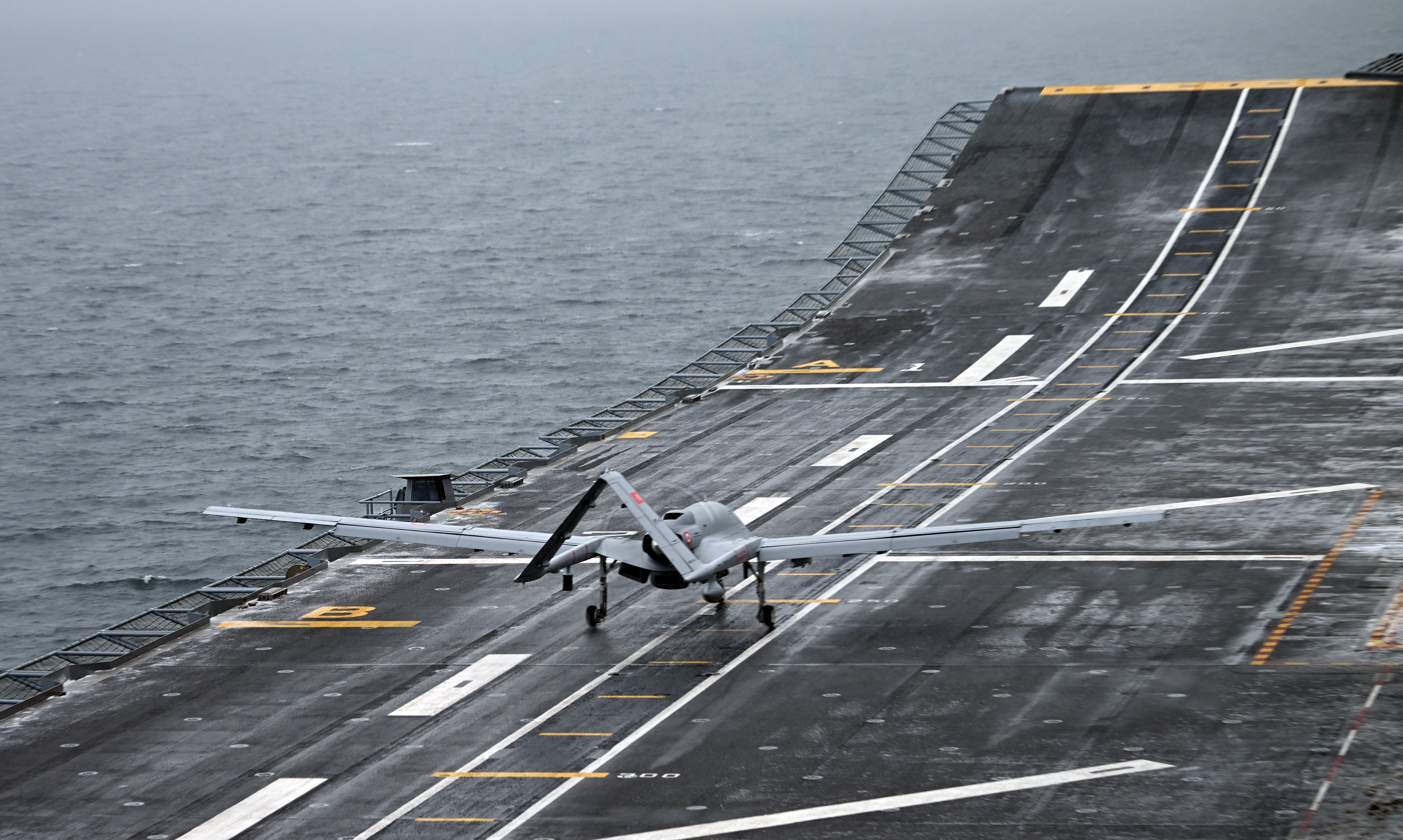
The Turkish Navy takes part in NATO'S Steadfast Dart 2026 exercise in the Baltic Sea, deploying the amphibious assault ship TCG Anadolu alongside the Bayraktar TB3 unmanned combat aerial vehicle. DURSUN AYDEMİR/AA
The onset of the U.S.-Israel preemptive move against Iran and the latter's reprisal in targeting U.S. bases in the Gulf eventually culminated into a stalemate storm. This escalating conflict not only risks long-term U.S. entrapment in the Middle East but also threatens to drain vital military resources, such as interceptor missiles, thereby undermining the alliance's broader strategic commitments across other fronts.31 The geopolitical permeability of the Gulf region demonstrates that critical energy and water supply infrastructures can be vulnerable during heightened risks of war. The March 9 ballistic missile launched from Iran into Türkiye's airspace intercepted by NATO air defense and missile system also showcased the scope of expansion and the possible extension of the degree of retaliation. In a regional backdrop, the on-and-off disputes with Greece in the Eastern Mediterranean over the de-militarized status of islands such as Limnos and Karpathos inflated the security tensions in the region despite the conditions set forth in the 1923 Treaty of Lausanne and 1947 Paris Peace Treaties.32 Türkiye's muessir approach in navigating resolute diplomatic messaging to respect treaties and a call to adherence to agreements in numerous cases demonstrates its determination to remain firm in its unwavering position to safeguard the Turkish nation's rights, interests, and the broader security of the region.
In Türkiye's surrounding neighborhood, the ideological warfare and its expansion manifesting in multiple directions has engulfed the region in a gridlock of wars posing the greatest danger for civilians being impacted the most. In a cross-regional conundrum, the context of the U.S./Israel-Iran War resulted in a strategic quandary with blind spots creating major high stakes with heightened risks across the Middle East. In hindsight, it doesn't come as a surprise that a morose sitting target has far greater potential to demonstrate acrimonious behavior that is likely to broaden its outreach of retaliation to the detriment of millions. For this reason, both the strong and the weak mutually constitute a power struggle for survival in an imbalanced, asymmetrical retaliatory reciprocation where technical talks in the aim for a deal did come to fruition.
In a system where values and norms are dissipating, there is a greater need for collective wisdom and consultation to establish a prosperous and balanced order where all nations can thrive
Demonstrating the Grit to Speak Words of Peace and Wisdom
It would be correct to assume that upheaval of conflict causing deep fragmentation in the aim of re-alignment of great powers in partnership with regional state and non-state actors renders a seismic endeavor in the re-creation of a somewhat neocolonialist stratagem of the 21st century. To the dismay of world societies, ordinary citizens of the international community do not have a power-wielding opportunity to guide security-driven interests and decisions of their elected leaders or governments. They do, however, actively voice their valor to stop the carnage of civilians while expressing the need to achieve sensible well-grounded talks toward gradual conflict-resolution steps that ultimately, with an optimistic view, burgeons peace and stability. Citizens of the region, instead of condoning the conflation of security decisions with elite preferences, choose to express the voices of the nations calling for common sense and wisdom in leadership actions.
There stands one leader in the region who chooses to respond to that call. President Recep Tayyip Erdoğan's voice across the Islamic world has singularly been that of one leader to echo the political messaging of peace and calmness shared by ordinary Muslims and non-Muslims beyond trans-national boundaries. With more than 60 years of political experience, whose agility, foresight and insight manifests with a remarkable acumen in decision-making, Erdoğan's frank and outspoken persona goes well beyond his national audience.33 At home, he skillfully exercises his command at the democratically won leadership pulpit to usher the voices of millions across the nation beyond political, ethnic, racial, and religious divides, showcasing an interesting phenomenon of "No to Regional Wars and No to WWIII" demanded by citizens from all walks of life. For the very first time, constituents of the People's Alliance and the Nation's Alliance created a bi-partisan united front to collectively support peace and reconciliation efforts rather than stoking the rhetoric of war. The voter-base across public voices promptly fortified Ankara's stabilizing position to consolidate itself as an muessir power in raising the voices of reasonable policy actions toward peace and mediation. In other words, a 360-degree muessir actor has become an axis of stability and hub for implementing peace-agendas while, simultaneously, maintaining its strategic prudence with foresighted and inward-analytical approach with a capacity to critically assess the back-and-forth waves of impact between domestic, regional, and international risk-burden environments.
For a muessir power like Türkiye, human security is couched as the locus of a state-centric vision that integrates technology and AI as indispensable elements for securing and protecting the well-being of civilian lives and infrastructure
The civilian voices across the broader trans-Atlantic community similarly voice their concern against reckless military actions that endanger the well-being and national security of ordinary citizens. Policy-makers of the international community are left aghast by the destruction of the post-1945 world order unanimously indicated in the Munich Security Report of 2026.34 This ongoing disintegration of the rules-based liberal international system has left its core proponents, particularly the European Union, increasingly paralyzed and unable to project a coherent, lawful approach amid intensifying global rivalries.35 It makes many wonder: does this mean the world order is being parsed out before a new re-construction of an order is set into place? Undeniably, from a regional environment mired in conflict and major initiation of an overhaul of new lines of demarcation experiment, the answer is not so ambiguous. The voices of reason across the Western community are also being raised in a jarring disarray. In the midst of an intentional withdrawal of attention from reasonable views and with a careless disregard to the rise of death tolls, there still lays hope in a global leader like President Erdoğan working diligently at the apex of a cross-civilizational hub of solutions. He is making a timely plea for de-escalation alongside efforts toward concrete progress in navigating peace talks in the Black Sea region between Russia and Ukraine, in the Horn of Africa between Somalia and Ethiopia, Sudan, the Eastern Mediterranean and the broader Middle East. These mediation efforts culminated in the historic "Ankara Declaration," signed by both leaders in Ankara on December 11, 2024, institutionalizing what is now known in diplomatic literature as the "Ankara Process." Türkiye's facilitation role has effectively minimized regional conflict risks, establishing a durable model for peace and stability in the Horn of Africa.36
In light of the fire ignited around Türkiye's geo-political vicinity, however, the question is to what extent the nation-state and its leadership will be able to effectuate its muessir power position of axis to proliferate a 360-degree influence of tranquility to ease tensions, all the while, as high-alert risks continue to soar on its foreign policy agenda. The difficulty in answering the question goes far beyond the recollection of past strategic plans in the quest for dominance, wealth, and territorial power many civilizations have fought for in a relentless competition. As egregious acts by the powerful actors violate and disregard the values and norms of the international liberal order then, consequently, who has the onus to re-constitute and re-build a regional or global system in which nation-states can once again establish a decorum of respect to sovereignty and territorial integrity? In a system where values and norms are dissipating, there is a greater need for collective wisdom and consultation to establish a prosperous and balanced order where all nations can thrive. While rigorous diplomacy efforts do continue on Türkiye's part, there is also greater emphasis on the values and norms outlined in the UN Charter as a critical trademark for compliance. The Ankara policy of maximum restraint and calls for de-escalation coupled with the facilitation of peace talks vis-à-vis bringing parties to the negotiation table forms the essence of a forward-looking dual-track diplomacy premised on the resolute pursuit of achieving permanent peace.37
Muslim idealism, in this regard, as the nucleus of a Muslim realist mind map predicates the progress of humanity on a verisimilitude of hope rather than despondency. From this particular perception and cognitive approach, the inter-regional and inter-continental ties are entirely envisaged as an international system that harbors the prospect for a collective prosperity and equitable representation in the "World Is Bigger than Five" global campaign to reform the UN Security Council for an all-encompassing representation of nation-states. This demand for reform is particularly acute from the African perspective, where the continent -despite comprising over a quarter of UN member states- remains excluded from permanent Security Council representation, a historical injustice that fundamentally undermines the organization's legitimacy and global representative authority.38 Good neighborly relations with a unanimous position of voice on the global stage, in this regard, is punitively concurred to be the sine qua non for a balanced security decision-making process that can give precedence to addressing international crises through collective action that prioritizes amities rather than enmities.39 Islamic values in this scope, protection of human life, adhering by the ethics of war, upholding humanitarian law, international law and its principles, form a moral infrastructure of a foreign policy agenda as a cornerstone provision to pursue regional and collective peace initiatives.40
Per contra, in a self-help world, the practice of moral and ethical values embodied in Muslim idealism alone do not suffice in ensuring that peace agendas are implemented through a power of discourse alone. The central idea and purpose of values and norms need greater explication to bring regional partners and great power stakeholders to a common ground for effective conflict-resolution policies that foster cross-regional dialogue and understanding in upholding the sanctity of human life.
A Muslim realist's objective precisely aims to do just that by delving into the abyss and ventures to carve-out light even in the darkest of times. As part of a mind-set that harnesses a counter-strategy statecraft that is adaptable and sophisticated in devising counter-hegemonic policies, a Muslim realist anchors moral and ethical values encapsulated in humanitarian law and laws of war at the core of its peace agency -a position that stands in stark difference to a death, destruction, and "no mercy" brand of war. He/she stands solemnly against the elimination of values and norms and instead pursues a strategy to allay the constrictions directed toward eradication of values that bind the global community. As an ardent actor who solemnly stands against the demolition of values and norms, there is at the same time, a vehement attempt to re-build inter-regional and inter-continental relations for the sake of establishing ties of amities to re-bind the international community on a consensus of shared understanding. In doing so, a Muslim realist offers a policy framework that positions value-laden principles as a vanguard of reason-based action policy to achieving strategic decisions toward reconciliation, peace, and stability while maintaining focus on security and welfare. Yet, the question is to what degree security and welfare can be re-constituted in the region for the flourishment of nations where fear and violence continues to reign under missile strikes causing major insecurity?
As is standard practice in any conflict or war scenario material strength is an indispensable part of security arrangements to ensure proportionate military actions are conducted with precision toward a constructive restoration of peace as opposed to a total destruction approach. The 21st century's hyper-arms race with utmost exacerbation of cybersecurity challenges enabled by rapid advancement of AI and new capabilities in technological warfare, indeed, require a vital and climactic component integral to the value-laden dimension of the statecraft assumed by a Muslim realist. Türkiye's evolving military strategy and strengthened deterrence architecture serve as a resilient shield against external interventions. This multi-layered state management, built on a transformed military mindset and active power projection, successfully positions the state alongside major powers in strategic decision-making and policy implementation.41 In its respective vision, a muessir regional security architecture foresees a well-grounded firmness of security largely dependent on building welfare and allowing opportunities for peace policies to prevail in which reconstruction, development, prosperity and virtuous ethics are inseparable parts for an effective policy framework.
This entails a variety of strategic reasons due to major developments exemplified in Türkiye's defense and tech-sectors. The capability and capacity of Türkiye's military combat power and the accelerated development of indigenous defense industry should not be interpreted as saber rattling per se but, rather as a strategic preparation for defensive responses for potential territorial vulnerability. While many European allies severely struggle with fragmented defense ecosystems, chronic personnel shortages, and a heavy reliance on the U.S. for critical enablers like command-and-control and satellite intelligence, Türkiye's cohesive and self-reliant defense posture acts as a crucial strategic offset for the alliance.42 Currently, nearly 85 percent of indigenous production has been achieved thus far under the Defense Industry Presidency alongside sophisticated surveillance and advanced military/AI alignment in warfare, best exemplified in "Bayraktar breakthroughs" -TB2s/TB3s, Kızılelma, Akıncı. Türkiye's rising prominence as a supplier in the European defense market and its hosting of the largest defense industry forum in the alliance's history during the 2026 Ankara Summit demonstrate its pivotal role in addressing NATO's defense production shortfalls.43 While the Baykar defense company ranks as the largest drone exporter on a global scale, there is at the same time a strategic military alignment with NATO allies in its geostrategic posturing that positions Türkiye at the epicenter of Asia-Europe-Middle East and North Africa cross-roads, with maximum resilience in owning a stabilizing axis as the hub of geostrategic balance.44
In times of turmoil in averting conflictual behavior, a Muslim realist promises a vital and exigent perspective that hails the call for mediation, dialogue, and mutual understanding on the imperative of achieving peace
The country's path of autonomy and independence paves the way for it to be a pre-eminent actor in generating countervailing military policies against possible recrudescence of external intervention in the case of conflict-prone circumstances that could manifest. In addition, designing counteracting defense methods against any geopolitical alteration attempts operating on a policy of "destabilization moves intended to re-create new lines of demarcation" surrounding the country's geopolitical vicinity can be extinguished by a forceful military with colossal power to outweigh hostile attempts. In the overarching security architecture, for a muessir power like Türkiye, human security is couched as the locus of a state-centric vision that integrates technology and AI as indispensable elements for securing and protecting the well-being of civilian lives and infrastructure in order to ensure there is no interruption to everyday common life of civilians. This vision of digital sovereignty is tangibly operationalized through national initiatives like the 2026-2030 AI Action Plan and the development of sovereign large language models, ensuring that technological dependencies do not compromise strategic autonomy.45
Conclusion
Some of the main findings garnered from this study illuminate the necessity for a Muslim realist to not only brand itself as a strategic actor that is self-interested. A value-laden actor that harmonizes morality and ethics in battles, wars, and disputes requires a holistic and steady judgment of reason to pursue all avenues of peace for all stakeholders. While pursuing peace and result-oriented solutions, the strategic nature of a Muslim realist embodies the foundational tenet of faith in striving for peaceful actions, means and ways to minimize conflictual behavior while maximizing amicable relations. By doing so, one does not overlook the enmities or the hostile nature of actors. But, rather one understands the necessity of being well equipped to meet the challenges of the aggressive and assailant behavior it may face by ratcheting defense capabilities and amplifying military readiness. The Qur'anic wisdom and values instilled in the heart and mind of a believer bind human nature with a code of conduct that one is advised to adhere to and to never exceed limits of reciprocation when met with aggression. In a broader scope, the Holy Qur'an, as part of a Muslim's everyday socio-political and economic reality, serves as overarching wisdom in guiding one's approach in governing human relations which rest at the core of advancing nation-to-nation and state-to-state relations. Dialogue, conflict resolution and embodying an updated conversation on ethics of war all form critical components that shape a Muslim realist agenda in foreign policy, security and humanitarian affairs.
For the greater good of the world community, optimizing mutual reliance, trust, dialogue, and cooperation in safeguarding and imparting the meaning of values to the benefit of humanity will serve as a critical ground to bolstering collective resilience and security
In the larger scheme of power dynamics, a Muslim realist views values and security as manu in manu where both of their various facets are encapsulated in an astute statecraft. On the brink of change and fortifying collective resilience, this is precisely the nexus where citizenry and state leadership have a dynamic to reify values of morality, ethics, and protection of the dignity of all human life within and without national boundaries. As part of a potent foreign policy agenda, the actor harbors security-driven interests in the ultimate decimation of terrorist networks in the region and their offshoots and actively seeks to stabilize regional instabilities by initiating peace talks in war circumstances. In doing so, muessir power generates the sinew to disseminate ethical political messaging by presenting the image of a Muslim realist as a peace broker rather than being a firebrand in fueling crises of hostilities. This peace-brokering role is actively demonstrated by opening borders to millions of refugees regardless of their ethnic or religious backgrounds, transforming ethical statecraft into a fundamental humanitarian duty.46 As a balanced action exemplified in such an image, global policy giants are able to witness a sui generis praxis in international security where Türkiye refuses to bandwagon with war proponents and instead prefers to singularly act on a "balanced and restrained peace policy" in its geostrategic proximity.
It doesn't suffice to say that in today's regional war calamities, we witness the current military campaigns around Türkiye's region wreaking havoc with unrestricted targeting of civilian and energy infrastructures as a gradual expedition of some sort of neo-colonial stratagem in full force. Past civilizational legacies and the competing narratives of Western, Eastern, Sino and Islamic civilizations in today's geopolitical race for dominance have inducted a new genesis in world history. Who will write a narrative of victory in the "provenance of peace" will be determined by the most tenacious nations and their elected leaders taking their seat around the notable negotiation tables. And, certainly, it will not be an uneventful task to achieve.
On the eve of the Ankara NATO Summit of 2026, there is more than a considerable amount of contribution a Muslim realist like President Erdoğan will generate as Türkiye centers at the nexus of multi-regional conflicts. In a war-torn regional environment, President Erdoğan's sustained contribution will have decades of stabilizing and trail-blazing reverberation for the region and beyond. A peace agenda aimed to cast out enmities and hostilities upheld as a wise strategic choice in Ankara's policy forbids any enterprise aimed at being subsumed into a spiral of obliteration. This decisive strategy, unduly, confirms the significance given to a value-laden approach in foreign policy decision-making that perceives long-term wisdom of peace and stability over short-sighted policies aimed at instability.
As Türkiye seeks to alleviate regional and global anxieties wrought by war and insecurity to the regional neighborhood, a determined nation and ardent state apparatus strengthens its will to maintain 360-degree geostrategic risk-prone environment. In doing so, the onerous task of constructing a new role of leadership illustrates an earnest actor with an exceptional forward-looking resolve calling for peaceful relations as its modus operandi. Under the exceptional call for a unified NATO Ankara Summit 2026, Türkiye's unwavering role as a loyal ally with a unique geostrategic position in the region ipso facto speaks volumes to the shared interests, common goals and policies for allies convening at a time the region has become increasingly fragile and fragmented. Building upon the contentious defense spending negotiations of the 2025 Hague Summit, where allies grappled with the U.S. push for an ambitious 5 percent GDP commitment, the Ankara Summit will be a decisive test for sustaining equitable burden-sharing without fracturing alliance solidarity.47 Furthermore, the significance of this summit extends beyond immediate diplomatic posturing, heralding a deeper institutional integration as Türkiye prepares to assume command of NATO's Allied Reaction Force starting in 2028. This upcoming leadership role undeniably signifies that Türkiye's weight within the core operational structures of the alliance is expanding precisely when the European security order is being radically rewritten.48
In times of turmoil in averting conflictual behavior, a Muslim realist promises a vital and exigent perspective that hails the call for mediation, dialogue, and mutual understanding on the imperative of achieving peace. There can be disagreements as to how this could be done. Yet, in such extraordinary times of profound changes, in safeguarding values and norms, a muessir power like Türkiye favors a phronetic approach to governing trans-Atlantic relations as an essential foundation for contributing to a peace-oriented, rules-based order that many nations across the world call for and envisage for future generations. Over the coming decade, while such debates and deliberations portend an overhaul and taxing labor across fora of international environments, the voices of the masses in their plea for a good-faith approach has become a paramount obligation for the allies seeking ways and means to bring peace and stability to the trans-Atlantic community's 360-degree vision. For the greater good of the world community, optimizing mutual reliance, trust, dialogue, and cooperation in safeguarding and imparting the meaning of values to the benefit of humanity will serve as a critical ground to bolstering collective resilience and security.
Endnotes
-
Ozan Sabri Tuncer and Önder Aytaç Afşar, "A Critical Look at Migration and Security within the Framework of the Aberystwyth School: The Case of Poland," Problemy Polityki Społecznej, Vol. 63, No. 4 (2023), pp. 5-7.
-
Barry Buzan, Ole Wæver, and Jaap de Wilde, Security: A New Framework for Analysis, (Boulder: Lynne Rienner Publishers, 1998).
-
Didier Bigo, "Security and Immigration: Toward a Critique of the Governmentality of Unease," Alternatives, Vol. 27, No. 1 (2002), pp. 63-92.
-
Andreas Osiander, "Sovereignty, International Relations, and the Westphalian Myth," International Organization, Vol. 55, No. 2 (2001), pp. 251-287.
-
Erman Akıllı, "NATO in the Technopolar World: Deterrence, Norms and Challenges," (Ankara: SETA Publications, 2026), pp. 18-19.
-
Errol A. Henderson and Richard Tucker, "Clear and Present Strangers: The Clash of Civilizations and International Conflict," International Studies Quarterly, Vol. 45, No. 2 (2001), pp. 317-338.
-
Rıfat Öncel, "NATO's Ankara Summit: Agenda and Expectations," (Ankara: SETA Publications, 2026), pp. 16-19.
-
Rıfat Öncel and Murat Yeşiltaş, "Amerikan Sınırlaması Altında Avrupa Güvenliği," (Ankara: SETA Publications, 2025).
-
F. G. Abushanab, A Muslim Realist: Strategies, Methods and Approaches from Türkiye's Experience, (London: Bloomsbury Publishing, 2023).
-
"Common civilization" idea proposed here is a "Sisterhood and Brotherhood Civilization" as opposed to the divisions and competing aggresive ideologies of past policies focused on the loss and deprivation of another identity. Common civilization concept can rather be explored as a nascent paradigm in contributing to a discussion on Western, Chinese, Slavic, African and Islamic Civilizations' nature, characteristics, values and teachings can be brought to light for a common ground, mutual understanding and respect in new foreign policy visions.
-
A tasavvufi philosophy from the Anatolian tradition that renders civilizations made up of diverse ethnic, religious, cultural groups that emphasize sisterhood/brotherhood as an enriched source of solidarity and unity under the common denominator of the Creator.
-
United Nations Alliance of Civilizations (UNAOC), retrieved from https://www.unaoc.org/.
-
Holy Qur'an Chapter Rooms Verse, 13.
-
Holy Qur'an Chapter Heifer Verse, 148.
-
Anne Baril, "Eudaimonia in Contemporary Virtue Ethics," in Stan van Hooft (ed.), The Handbook of Virtue Ethics, (London: Routledge, 2014), pp. 17-27.
-
Holy Qur'an Chapter Table Spread Verse, 8.
-
Holy Qur'an Chapter Saad Verse, 26.
-
Pope Leo XIV, "On Safeguarding the Human Person in the Time of Artificial Intelligence," Magnifica Humanitas, Encyclical Letter (192), (2026).
-
Valerie Morkevičius, "The Shared Logics of Realism and Just War Theory," Ethics & International Affairs, Vol. 29, No. 1 (2015), pp. 11-34.
-
"National Foreign Policy in the "Century of Türkiye:" A Synopsis," Republic of Türkiye Ministry of Foreign Affairs, retrieved June 30, 2026, from https://www.mfa.gov.tr/synopsis-of-the-turkish-foreign-policy.en.mfa.
-
Bülent Aras, "The Davutoğlu Era in Turkish Foreign Policy," Insight Turkey, Vol. 11, No. 3 (2009), pp. 131-132.
-
Murat Yeşiltaş and Başar Baysal, "SAFE-Plus Çerçevesi: Türkiye'nin Avrupa Savunmasındaki Yapısal Dışlanmasından Çıkış Yolu," (Ankara: SETA Publications, 2026).
-
Muhittin Ataman, "What Awaits Ukraine?" Daily Sabah, (December 17, 2025).
-
Recep Tayyip Erdoğan, Daha Adil Bir Dünya Mümkün: Birleşmiş Milletler Reformu İçin Bir Model Önerisi (İstanbul: Turkuvaz Kitap, 2021), pp. 1-20.
-
Erdoğan, Daha Adil Bir Dünya Mümkün, pp. 21-40.
-
Sabine Fischer, Not Frozen! The Unresolved Conflicts over Transnistria, Abkhazia, South Ossetia and Nagorno-Karabakh in Light of the Crisis over Ukraine, (Berlin: Stiftung Wissenschaft und Politik, 2016), pp. 11-12.
-
Recep Tayyip Erdoğan, "Address by President Erdoğan to the 77th Session of the United Nations General Assembly," (September 20, 2022), Presidency of the Republic of Türkiye, retrieved from https://www.tccb.gov.tr/en/speeches-statements/.
-
Öncel, "NATO's Ankara Summit: Agenda and Expectations," pp. 15-16.
-
Recep Tayyip Erdoğan, "Address at the Grand National Assembly of Türkiye," (May 29, 2024), Presidency of the Republic of Türkiye, retrieved from https://www.tccb.gov.tr/en/speeches-statements/.
-
Burhanettin Duran, Kemal İnat, Nebi Miş, and Mustafa Caner, Turkish Foreign Policy Yearbook 2024, (Ankara: SETA Publications, 2024), pp. 181, 197.
-
Rıfat Öncel, "NATO's Hague Summit: Agenda and Expectations," (Ankara: SETA Publications, 2025).
-
Yücel Acer, "Aegean Disputes between Turkey and Greece," Ankara Hacı Bayram Veli University Faculty of Law Review, Vol. 22, No. 2 (2018), pp. 1-36.
-
Aylin Ş. Görener and Meltem Ş. Ucal, "The Personality and Leadership Style of Recep Tayyip Erdoğan: Implications for Turkish Foreign Policy Turkish Studies, Vol. 12, No. 3 (September 2011), pp. 357-381.
-
"Under Destruction: Munich Security Report 2026," Munich Security Conference, (2026), retrieved June 30, 2026, from https://securityconference.org/assets/02_Dokumente/01_Publikationen/2026/MSR2026/Under_Destruction%E2%80%93Munich_Security_Report_2026.pdf.
-
Muhittin Ataman, "Where Are You Going, Europe?" Daily Sabah, (February 18, 2026).
-
Duran, et al., Turkish Foreign Policy Yearbook 2024, pp. 385,423.
-
"Peaceful Resolution of Conflicts and Mediation," Republic of Türkiye Ministry of Foreign Affairs, retrieved June 30, 2026, from https://www.mfa.gov.tr/resolution-of-conflicts-and-mediation.en.mfa.
-
Elsadig Elfaqih, "The United Nations: African Perspective," (Ankara: SETA Publications, 2022).
-
Recep Tayyip Erdoğan, "Address by President Erdoğan to the 78th Session of the United Nations General Assembly," Presidency of the Republic of Türkiye, (September 19, 2023), retrieved from https://www.tccb.gov.tr/en/speeches-statements/.
-
Ramazan Erdağ, "How Many Is Greater than Five: A Comprehensive Model Proposal for the United Nations Security Council, Alternatives: Turkish Journal of International Relations, Vol. 13, No. 4 (2014), pp. 83-95.
-
Murat Yeşiltaş, "Deciphering Turkey's Assertive Military and Defense Strategy: Objectives, Pillars, and Implications," Insight Turkey, Vol. 22, No. 3 (2020), pp. 89-92.
-
Öncel and Yeşiltaş, "Amerikan Sınırlaması Altında Avrupa Güvenliği."
-
Öncel, "NATO's Ankara Summit: Agenda and Expectations," pp. 12-15.
-
"SSB's 2024 Evaluation and 2025 Goals," Defence Turkey, (March 18, 2025), retrieved June 30, 2026, from https://defenceturkey.com/news/ssbs-2024-evaluation-2025-goals.
-
Erman Akıllı, "NATO in the Technopolar World, pp. 19-20.
-
Erdoğan, Daha Adil Bir Dünya Mümkün.
-
Öncel, "NATO's Hague Summit: Agenda and Expectations."
-
Yeşiltaş and Baysal, "SAFE-Plus Çerçevesi,"
