

Introduction
We are in the Second Space Age (1991- present), which has undoubtedly built upon the First Space Age (1957-1990).1 Yet, it is quite different from the first one. The major difference is how the private sector, as well as the developing world, has entered the field and is reshaping the extent and scope of space activities. In this new architecture, first of all, the space realm is no longer exclusive to major powers, and second, neither cooperation nor competition between and among space actors is defined solely by the priorities of sovereign nation-states. This means that emerging powers in space have to navigate their path through a maze of not only worldly geopolitical dynamics between nation-states but also technopolar considerations regarding non-state (and state) actors where they need to continuously evaluate the innovation of new and the evolution of already-existing key technologies to carve out a role for themselves in the future.
Today, it is time to question whether classical geopolitical considerations of the First Space Age are being replaced with the technopolar exigencies of the Second Space Age. Space is an area where the use of many key technologies, such as information and communication technologies, artificial intelligence, biotechnology, cybertechnology, etc., are/will be interconnected. Most of these technologies are invented and developed by private sector companies. The concept of technopolarity highlights and brings forward a discussion on the impact of private companies in this equation as a challenge for nation-states. If the world is indeed in the process of turning technopolar, this would point to a moment of a paradigm shift, and the success of any state in finding its roadmap through this maze and effectively implementing a space policy would thus become fundamental in securing their place in the world, today and for the future. That is why, although the major focus of the concept of technopolarity is based on the digital world, social media, and now AI, this analysis goes one step further and explores how the space sector is (inter)connected to the debates about technopolarity.
Türkiye is one of the new actors in outer space, having established the Turkish Space Agency (TUA) in 2018. Turkish space activities certainly predate 2018 since the country already had a successful satellite program, which gave it a crucial learning curve, resulting in the acquisition of much-needed know-how in space activities. The institutionalization of the TUA in 2018 and the declaration of the Turkish National Space Program in 2021 put Türkiye’s growing ambitions in outer space on the map. For the past decade, the rapid institutionalization of space activities, the growing space sector, and a rising prominence of space studies in Turkish academia have also drawn attention to the widening investment and interest. It is therefore safe to say that technologically, politically, economically, and academically, Türkiye is aware of the need to engage in the dynamics of the Second Space Age, which may be redefined by a technopolar moment.
This paper asks the question of how an emerging spacefaring nation like Türkiye should prepare for a world where technology companies increasingly challenge or add to the power of nation-states. In other words, the paper assesses Türkiye’s path as an emerging space actor in taking its space policy to the next level in a world that is evolving into a technopolar one. The author argues that while the characteristics and direction of this technopolarity are up for debate (as it is explained in the next section), one thing is clear: the dynamics of power plays between states and technology companies are ever more influential in world affairs. It is debatable whether this dynamic is in favor of companies where they can dictate, control, or direct what states can do, or whether the dynamic is still controlled by the states, where they draw even more power out of their tech sector and work closer with them to increase their status in the world hierarchy.2 In either case, how should middle powers such as Türkiye prepare for a world where technology is becoming a determinant factor, whether this factor is in the hands of private businesses or leading world powers? The analysis uses Turkiye’s space policy as a case study to tackle this question.
The study first contextualizes technopolarity into the wider theoretical theme of polarity, as a neorealist concept. It is followed by a section discussing the way space activities and the space sector are connected to the concept of technopolarity. It then looks at Türkiye as an emerging space actor by examining factors such as the level of institutionalization and achievements in its space sector, Turkish space law, emerging Turkish private space companies, and Turkish human capital in the space sector. An ensuing section assesses Türkiye’s roadmap for outer space during an eventual technopolar paradigm shift and makes recommendations. In that sense, the study can serve as a guide for Türkiye to take additional steps in its march toward space, shifting from a classical geopolitical thinking to an emerging technopolar one. As such, this contribution will not only be useful for Turkish policymakers but may also constitute a case study for other actors to reassess their efforts in a vision complicated by discussions on technopolarity.
Technopolarity as a Paradigm Shift
The question of polarity has been central in international relations theory. Dougherty and Pfaltzgraff Jr. define polarity in the international system as “the number of actors and the distribution of capabilities among them.”3 Among the mainstream theories of international relations, realism in general and neorealism in particular are where one finds extensive literature on it. A student of international relations would most likely be introduced to discussions about polarity through the work of Kenneth Waltz,4 known as the father of structural realism (or neorealism). He offers historical examples of a multipolar world of mostly European powers at the end of the 19th and early 20th centuries, a bipolar structure of the Cold War based on the rivalry between the U.S. and the USSR, and a unipolar moment of American hegemony that followed its end. Distinguishing between different configurations of polarity is no easy task, but the type of polarity is often assessed by looking at the military and economic strengths of the leading powers in the international system.5 Sometimes a period may even be dubbed as apolar if no major power/s seems to be leading the scene.6 Realists and their critics have often tackled the question of polarity in the past, discussing which system is more stable, and recent publications try to expand the horizon of the conversation and take on the concept from a variety of angles.7
The field has been debating about how long the American unipolarity after the end of the Cold War would last, whether that end would mean the return to a multipolar structure or the resurgence of a bipolar one between the U.S. and China, and to what extent that end would come as a result of internal or external pressures on U.S. dominance.8 An article from Ian Bremmer published in the Foreign Affairs journal in 2021 brought another argument to the table: technopolarity.9
What exactly is technopolarity? Bremmer defines the technopolar world as “one where technology companies wield unprecedented influence on the global stage, where sovereignty and influence are determined not by physical territory or military might, but control over data, servers, and, crucially, algorithms.”10 Bremmer, in his 2021 article, originally argues that states, as the major actors in world politics since the Treaty of Westphalia, are now being seriously challenged by a small group of big technology companies. These firms have managed to expand their role beyond the activities in their sectors to the detriment of the state, the clearest example being in their role in national security.11 He goes so far as to claim that their power is similar to that of states12 and argues that the new superpower would not be a nation-state but Big Tech companies that now assert themselves as global actors with confidence.13 The reasons for the emergence of this technopolarity may be various, however, states losing credibility vis-à-vis their citizens and what is called a “global governance deficit” are significant factors.14 Regardless of the reasons for its emergence, a technopolar order is often seen as being based on power derived from big data and its usage for political purposes, as was the case in Cambridge Analytica.15
Discussions about the role of business entities, especially multinational corporations (MNCs), in international politics have been going on for quite some time, especially within the school of liberalism.16 Liberalism has not often addressed them as potential world powers but rather introduced them (as well as international organizations and nongovernmental organizations) as legitimate actors in international relations aside from states.17 Looking at works of science fiction in the movie and TV series industries, one would find that the genre offers rich examples of company-ruled worlds. These worlds are depicted in several ways: as the dominant center of power, as in the cases of Wall-E, Elysium, Blade Runner, or Avatar, as companies with strong hints of contending to become world masters but not yet there in works such as The Expanse and Moon or as powerful actors constantly challenging governments or rivaling them as in the cases of For All Mankind and Mars.18 Bremmer’s article warns that we may even be at the beginning of that kind of future.
In this new architecture, first of all, the space realm is no longer exclusive to major powers, and second, neither cooperation nor competition between and among space actors is defined solely by the priorities of sovereign nation-states
Discussions about the impact of technology or the influence of non-state actors on international relations are not new. One can go as far back as the East India Trading Company to discuss the impact of business entities and how they were able to exhibit state-like properties/characteristics, such as amassing armies.19 It is possible to see the role of multinational corporations in international politics through different prisms: either as companies working to serve the interests of their nation-states, as entities asking their nation-states to advance the business interests of the company, or as global profit-seeking actors who champion the interests of their stockholders.20 Bremmer’s article on technopolarity has kicked off a debate about a paradigm shift, since it introduces companies as potential actors to sideline nation-states and have a direct say in world affairs. Within the idea of technopolarity, a neorealist concept (polarity) meets a neoliberal one (companies as international actors) to challenge how we might view the future of the international system after the Westphalian order. Bremmer may be the one to coin this term; however, he does not welcome such a world as good news. Jacob and Bremmer list the technopolar world as one of the top 10 risks of 2022 in a Eurasia Group report because digital space creates risks, such as weaknesses in the protection of personal information or the spread of conspiracy theories, and the issue of it being governed by digital companies and not nation-states.21 There is also a considerable body of authors who write about how advanced digital capabilities may facilitate authoritarianism.22
Of course, it is too early to call today’s international system a technopolar one. It may even be premature to claim that the system will eventually evolve into technopolarity. In a piece he wrote in 2023 based on a TED talk he gave, Bremmer distinguished between a unipolar security order led by the U.S., a multipolar economic order with China, the EU, and Japan as major powers, and a technopolar digital order where Big Tech companies reign.23 In May 2025, Bremmer published a follow-up article to his 2021 piece to update some of his earlier statements and arguments. His first article in 2021 asserts that technological companies are driven either by globalism (where tech companies assume global power), nationalism (where tech companies are controlled by and thus contribute to state power), or techno-utopianism (where major services are offered by a techno-elite, putting an end to state power).24 However, his most recent one from 2025 includes a course-correction in his arguments, stating that neither of these three scenarios seem to hold since the future seems to signal the U.S. on one side where tech companies have more and more influence on politics, facing a China on the other, where the state has a firm grip on the tech sector.25
The introduction of technopolarity as an idea has prompted several articles and opinion pieces on the internet. These have mostly been in support of Bremmer’s ideas, either by drawing attention to how Big Tech will not be easily subject to state control,26 exemplifying how Elon Musk’s Starlink connectivity helped Ukraine’s defense when Russia attacked,27 discussing the need for small states to align with a new power center in a technopolar world28 or putting forward ‘data sovereignty,’ ‘algorithmic capacity,’ and ‘hardware autonomy’ as the three major areas affecting sovereignty.29
Since technopolarity is a rather new concept, any scholarly work addressing it would be regarded as a contribution to the field. Recent international relations literature has witnessed a rise in books discussing how science, technology, and politics influence one another in general.30 A few works have also been written in Turkish.31 When it comes to discussions on technonationalism and/or technoglobalism,32 or more specific areas of high technology such as nanotechnology, biomedical technology and genetics, quantum computing, robotics, and space technologies and what the progress in these particular fields mean for international relations, there is also a dynamic research agenda and emerging literature.33 However, unlike on the internet, within the academic world, technopolarity seems to have generated limited debate. A quick search by author in the article database JSTOR revealed no matching academic articles written on the topic at the time of this analysis. Still, the idea may be slowly getting the attention of scholars. Columbia University’s School of International and Public Affairs (SIPA) has initiated a capstone project on technopolarity for the Spring 2025 semester in cooperation with the Eurasia Group.34 This current special issue of Insight Turkey on technopolarity, in which the very article you are reading is published, is another attempt at studying the issue from a more academic perspective.
Within the idea of technopolarity, a neorealist concept (polarity) meets a neoliberal one (companies as international actors) to challenge how we might view the future of the international system after the Westphalian order
Nevertheless, technopolarity has received some criticism from realists, such as Stephen Walt and Daniel Drezner. Stephen Walt makes several highly clear and persuasive points of objection. He states that digital space can never be as important as physical space, which is under the domination of states. He suggests that most of these tech firms grew their strengths during an “unfettered environment,” meaning a more flexible, liberal, global time, which is now being challenged with the enforcement of state authority over the digital world. He goes on to claim that one of the reasons why these companies were able to thrive was because of the privileges states granted to them.35 The impact of the public-private partnership between NASA and SpaceX and how this partnership has facilitated the growth of the company is one example; likewise, how NASA also significantly helped Blue Origin in its efforts to achieve spaceflight is another that proves Walt’s points.36 Drezner goes even further in his blog-post critique ““Technopolarity” Is Not a Thing,” in which he explains how states take steps to control tech companies, even if these steps may differ from country to country, giving examples from the U.S., Europe, and China.37
The jury seems to be out on deciding whether technopolarity as a concept will engender more debate and garner more acceptance within academic circles. The fact that Bremmer came back to his idea in a second article to refine it tells us that this is a phenomenon in the making. What’s not up for debate is that the level of technology states and/or companies will be decisive on how much control or impact these actors will have on other international actors and how influential they will be in establishing the rules of the game in the international system. It is then essential to ask how the rise of power of tech companies will affect space activities and how the emerging spacefaring countries should respond to such a realignment.
Space and Technopolarity
The space sector is not necessarily the focus of discussions about the technopolar order. The focus in Bremmer’s articles is mostly the digital world, and the ensuing commentaries about technopolarity in the press generally address the digital world, social media, big data, and the AI revolution.38 Yet some of the companies mentioned as part of the new technopolar order also own space companies and/or assets. Elon Musk, who bought Twitter (rebranding it as X), also owns SpaceX. One can even say that he has invested in several different areas of digital space: social media (X), internet access (Starlink), and space access (SpaceX). Jeff Bezos, who owns Amazon, is the name behind the space company Blue Origin. It is no coincidence that these two names, along with Mark Zuckerberg, who invented and runs the popular social media platforms Facebook, Instagram, and WhatsApp, were featured in the audience during the inaugural ceremony of President Donald Trump in 2025. This signals an era in which businesspeople will not only influence politics from behind closed doors but may even be actively engaged with the power they hold with, or over, governments.39 Bremmer himself mentions Elon Musk’s space-related activities in his first article from 2021 while explaining why his companies are seen as within the confines of a technopolar order.40 That is one way of connecting how the space sector is linked to any discussion on technopolarity.
Unlike on the internet, within the academic world, technopolarity seems to have generated limited debate
Another way of looking at this issue is the interconnectedness of many of the activities involving space often also involve advanced technology offered by tech companies. For example, today, it is impossible to imagine a robust space program without AI or cybersecurity. Typically, a good space program would depend on certain factors on the governance side, including a good scientific and technological base encompassing highly educated human capital in STEM areas. It would also include a healthy and stable economy to be able to invest in programs whose fruits are to be reaped years ahead into the future, continuous political will that is above party lines to keep space programs running when the political party in power changes as well as popularity of the program in the eyes of the public and the bureaucracy to claim legitimacy. That is how the space activities of the Cold War years were kept alive, or how they died down when some of these factors proved not to be at satisfactory levels. On top of these factors regarding governance, space technology includes the collaboration of many different fields of science and engineering. Whereas one can innovate in AI or cybersecurity through the employment of good software engineers, any novelty in space would require several scientists and engineers from a variety of fields, such as physics, chemistry, materials science, mechanical and electrical, electronic and computer engineering, etc., working together. The picture becomes even more complicated when we factor in human spaceflight. Space missions are especially complex by nature, requiring long-term planning and coordination of multiple stakeholders from a variety of backgrounds. AI is expected to help organize these processes as well as onboard operations faster and more accurately, cutting down time and expenses. Cybersecurity is a sine qua non for ensuring the safety of the systems used in space missions. Plus, social media platforms are important in increasing popularity and support toward such programs, establishing their legitimacy. When all of these services are offered under the roof of a big tech company, space activities run more efficiently.
Continuing with the AI example, AI is currently being used in space by a variety of actors in different ways. AI programs are employed for missions such as the James Webb Telescope or the Perseverance Rover, the International Space Station (ISS), or Chandrayan 3 for various purposes.41 Satellites can already do course corrections to avoid collision with other satellites or help process massive amounts of data they collected from space for either Earth observation or for space exploration, thanks to integrated AI technologies.42 AI technology is expected to support space activities in the future in multiple fields such as remote sensing/earth observation, navigation, mission planning, and communication,43 as well as telemedicine,44 astronaut health monitoring and robotics.45 The use of AI in space also presents serious challenges to be overcome such as hardware problems in the radiation-rich space environment, onboard energy consumption to allow for AI to process data while on mission in space, openness to cyber threats, legal hurdles over liability issues,46 as well as training AI with limited data for missions in distant and unfamiliar environments.47 Dealing with such hard issues can further exacerbate and streamline research in both fields.
One would expect that complexity in the space sector would increase opportunities for transnational cooperation. As a matter of fact, during the post-Cold War period, cooperation was important in outer space projects, especially for cost-cutting. Today, we see that the contribution of space technologies to state power and to sovereignty reemerges as a geopolitical factor. States are already in competition to dominate the space domain. Aware of the dependencies that space-based services offered by other countries bring, each country would like to create its own national know-how and develop its own versions of already existing systems. The clearest example is the creation of regional/national navigational system projects such as Galileo by the EU, Beidou by China, and Glonass by Russia to reduce/escape GPS dependency on the U.S. Even the biggest powers do not want to be dependent on other actors. Until SpaceX returned human spaceflight to the U.S. in 2020, having to fly to the International Space Station on Soyuz rockets was perceived as a problem by the American authorities.48 While cooperation in space with like-minded countries still continues, the determination to advance the power of a nation via space technologies is also clearly out there.
AI technology is expected to support space activities in the future in multiple fields such as remote sensing/earth observation, navigation, mission planning, and communication, as well as telemedicine, astronaut health monitoring and robotics
However, a recent report by World Economic Forum states that, “The space economy is forecast to soar to $1.8 trillion by 2035 in an increasingly connected and mobile world, impacting and creating value for nearly all industries on Earth and providing solutions to many of the world’s greatest challenges.”49 The report lists certain state-sponsored fields such as “defense and civil investments” as well as private industries such as “supply-chain and transportation,” “food and beverages,” “retail, consumer goods/electronics and lifestyle,” “media, entertainment and sports,” and “digital communications” as fields that space assets will have a positive impact on.50 As one can easily observe, this rather comprehensive list can even be expanded to include other sectors such as spin-offs from space technologies to the medical field. Many of these fields are part of the global economy and are essential for running societies smoothly. Companies with large investments in the space sector will not only have a piece of this big pie, but also will become stakeholders in how politics are run within and among states. This situation makes an assessment of space capabilities of nations a necessity to plan for their future in a changing global frame, causing us to take a closer look at the Turkish space sector.
An Assessment of the Turkish Space Sector
Türkiye entered the space realm when it had its first satellite, TÜRKSAT 1A, launched by ESA in 1994. This was a rather late date compared with other middle powers such as India or Brazil, which started their space programs as early as the 1960s. The 1990s may have marked the beginning of space activities for Türkiye, which decided to invest in communication technologies through satellites, allowing the country to develop a know-how since then. However, it was only within the last ten years that Türkiye has seen serious developments in its institutionalization and activities in the space realm. TÜRKSAT,51 the only satellite operator of the country at the time, ran all its activities in a country without a space agency, a space program, or space legislation. At that time, much of the space activities of the country were planned either through TÜRKSAT or Tübitak Uzay. It was as late as 2018 when the Turkish Space Agency was finally established.52 A National Space Program came later in 2021, only four years ago from today.53
One deficiency today in Türkiye’s institutionalization of its space activities is national space law. Türkiye is party to all five UN Treaties on Outer Space Activities,54 yet the country still does not have national legislation for space. While there is no obligation for states to codify such a law, in the day and age when space activities become more and more commercialized, the lack of a legal framework would not instill confidence in potential investors.55 Space activities are covered in Türkiye under Presidential Decree No. 23 on the Turkish Space Agency and the Electronic Communications Law No. 5809.56 Since international treaties do not regulate activities of private actors in space and put the entire liability on the shoulders of states, national space laws facilitate the emergence and functioning of private actors who also need such laws to establish their competitiveness.57 A recent amendment in Presidential Decree No. 23 now also includes an added clause for allowing the TUA to establish private companies or buy/sell shares at home or abroad,58 demonstrating that the decision-makers are aware of the importance of the private sector. Recently, many emerging spacefaring nations codified their national legal frameworks, including even small nations such as Luxembourg in 2017 and the United Arab Emirates (UAE) in 2019, with limited space activities, clearly aiming to attract investment from local and foreign companies.59 Türkiye will need to take this step, as well.
Companies with large investments in the space sector will not only have a piece of this big pie, but also will become stakeholders in how politics are run within and among states
The reasons for this late institutionalization in Türkiye might be a topic for yet another paper; however, it carries the risk of impeding the future of the Turkish space program, given the fact that Türkiye has accelerated (but not yet completed) its institutionalization during a period when the space sector is revolutionizing everywhere else. Before the country could consolidate some of the gains from finally establishing its space program, the global space sector is transforming rapidly. Türkiye will have to not only catch up with building infrastructure but also has to worry about building a healthy space sector with private companies. This is necessary if it wants its program to be nationally competitive among other emerging powers, as well as survive a technopolar shift if private Big Tech companies prove to be more and more challenging to state power.
Türkiye gained considerable experience in the space field through operating the TÜRKSAT family of communication satellites, Göktürk satellites for reconnaissance, and BILSAT, RASAT, and İMECE for earth observation. It furthered its expertise through developing the skills to engineer its own nationally built satellites in the cases of İMECE and TÜRKSAT 6A. The country does not have the means to launch its own satellites yet in the absence of a launcher or a spaceport, but steps have been taken to remedy this situation. Turkish companies such as ROKETSAN60 and DeltaV61 are working on launchers and propulsion systems, while the authorities have taken action to build a Turkish spaceport in Somalia.62 Therefore, Türkiye still has some miles to go in completing its institutionalization in the space sector.
At the same time, Türkiye needs to encourage its private capital holders to invest in the space sector. Many of the new technologies have been and are being developed through the activities of private companies as well as academia, where even a nation such as the U.S. has a hard time keeping track of all activities.63 Most of the major Turkish companies active in the space sector, such as TÜRKSAT, ROKETSAN, and DeltaV, are state-sponsored private companies. Purely private initiatives also exist, but on a smaller scale. Companies such as Plan-S,64 Fergani,65 or Gumush66 are all private enterprises with activities mostly in the satellite business based in the capital city, Ankara, and in İstanbul. For any country, the lack of a private sector in space is admittedly a hurdle when it comes to its space activities. This is even more so when facing the eventuality of a technopolar world. Türkiye was performing rather well in AI in 2018, holding the top position in the number of transactions as well as the amount invested in the sector in the Middle East and Africa.67 The same dynamism is needed for the space sector as well.
Türkiye gained considerable experience in the space field through operating the TÜRKSAT family of communication satellites, Göktürk satellites for reconnaissance, and BILSAT, RASAT, and İMECE for earth observation
Another important factor in the new space age is human capital in the space sector. Türkiye sent its first astronaut, Alper Gezeravcı, to the ISS in 2024, flying aboard a Falcon 9 flight of SpaceX, after being trained by Axiom Space. Later within the same year, a second astronaut, Tuva Cihangir Atasever, completed a suborbital research flight on Galaxy 07, a Virgin Galactic flight. The fact that the country has sent humans into space is not only important for gaining experience in human spaceflight, but it is also instrumental in inspiring new generations to take an interest in space activities and to work for a career in this or related sectors. The flights of the first and second Turkish astronauts also indicate that Türkiye is already used to working together with private companies in the space sector in the international arena.
Türkiye is rich with academic programs on aviation and space technologies. More than 80 universities have undergraduate programs in aviation and space sciences or related fields, and some 54 institutions offer graduate degrees in such programs.68 When the number of appropriate institutions/companies where these graduates can be suitably employed increases, the space sector will also gain dynamism. Given the complexity of the space sector as explained earlier, Türkiye should also take necessary measures to prepare its higher educational system to offer degrees to students who will need multidisciplinary, cross-disciplinary, and interdisciplinary skills or prepare the graduates of existing degree programs to work together with people from diverse careers and backgrounds. The role of academia is surely not limited to educating the human capital, but also includes doing research and creating synergy. The last 5-10 years have seen increased academic interest and activity in the number of books and articles published and conferences organized on space issues.69 However, surely more is needed to help facilitate public-private partnerships and boost interdisciplinary thinking, as well as public understanding of the importance of the space program through public-oriented educational programs.
A Roadmap for Space through Technopolarity
As explained earlier, technopolarity includes more than one possible scenario, depending on whether it is the nation-states or private companies that will control and utilize the technologies that will shape the future of the world, and to what degree, even if these technologies are now predominantly created by the private sector. As the first quarter of the 21st century ends, in a highly volatile international atmosphere and an era of technological revolutions, which type of technopolarity (globalism, nationalism, or techno-utopianism) or technopolarities (a combination of some of these models) will materialize is uncertain.
Currently, debates about the traditional types of polarity in the international system are ongoing. While the U.S. post-Cold War hegemony may be over, the world is not yet divided between the two competing camps of China and the U.S. as a bipolar structure; nor can we confidently argue that there is a fully multipolar world: yes, there are multiple powerful leading nations in the world today, however, they do not yet shift alliances to balance this or that power.
Technopolarity is not yet fully here either. The question around what shape and form it may arrive in engenders a highly complex debate. Discussions involve many actors, like major world powers such as the U.S., the EU, Russia, and China. It also includes the rising private Big Tech world, especially major companies from the U.S., since American private companies seem to have more agency to act and have clout on a global scale. The debate is also influenced by factors like how much a state lends support to its private sectors and how much it is willing to let go of some of the “areas” traditionally known as within the realm of the state.
Space is one such area where the U.S. has decided to boost its private space sector to relaunch itself. Whereas in other places, like Europe, for example, even very successful private aerospace companies such as Arianespace seem to still be confined to their original role of launch businesses.70 In India, a state that is regarded as an established space power, there were concerns about the state of its private space sector around 2015.71 More recently, The New York Times reported on the booming private space sector in India with several start-ups.72 Yet, although many U.S. entrepreneurs in the high-tech sector come from India, the country itself still seems to lack major private tech companies active in space. China has also understood the importance of developing a private space sector, passing Document 60 in 2014, which allowed for private investment in the space sector.73 There is increased activity in the Chinese private space sector now, but the hand of the state nonetheless still seems to be felt.74
Having an active, dynamic, and innovative private space sector seems to be highly significant for boosting space activities to the next level. Yet, getting there takes time, and global competition is harsh under the American dominance of the space sector. Thus, even though some private companies from countries other than the U.S. may become highly influential in the medium and long term, for the moment, when we refer to technopolarity in a global sense, American companies seem to carry more weight. However, global geopolitical competition highlights characteristics of a transition from a unipolar to a multipolar world order in outer space. On the other hand, despite years of competition and cooperation among major players such as the U.S., Russia, India, Japan, and the EU under different configurations, there is now a clear and stark competition between the dominant U.S. and a rising China.
The major question for Türkiye (and for any other emerging spacefaring nation) would be: How can they catch up with the times, encourage their private sectors, and therefore decrease their vulnerability against a rise of a technopolar world during a time when they still need to develop state-based capabilities?
In this ambiguous, fast-changing, but surely challenging moment, how should emerging spacefaring nations such as Türkiye shape their national space policies? One definition of an emerging spacefaring nation is “countries that are increasing their efforts in the space domain, which are in the process of establishing broader autonomous capacities to access and operate in space and benefit from a variety of space activities.”75 As the definition suggests, these countries, such as Türkiye, are not yet space powers but aspire to become more active in the space domain with a focus on increasing the range of their activities as well as the benefit they draw from them. The major question for Türkiye (and for any other emerging spacefaring nation) would be: How can they catch up with the times, encourage their private sectors, and therefore decrease their vulnerability against a rise of a technopolar world during a time when they still need to develop state-based capabilities?
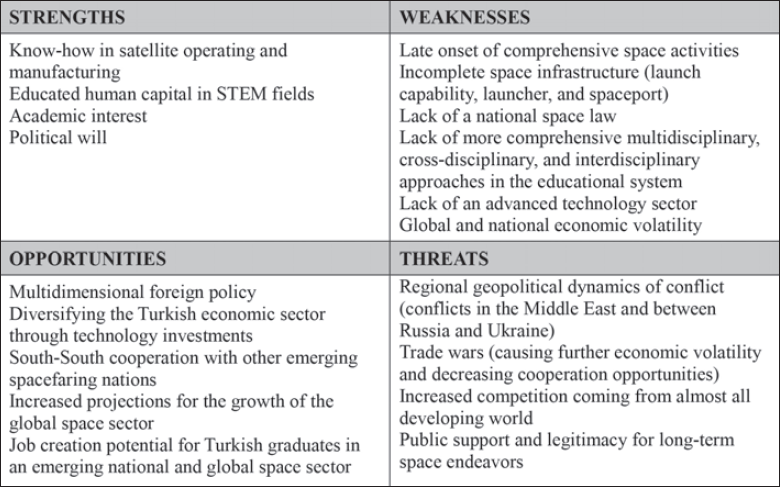
Here, the analysis will employ a mini-SWOT (strengths, weaknesses, opportunities, and threats) analysis of Türkiye’s space activities to suggest concrete recommendations.
Table 1: Türkiye Space Sector Mini-SWOT Analysis
Source: Created by the author
On the basis of the previous assessments of Turkish space activities and the space sector, and this SWOT analysis, the following points are recommended. Many of these recommendations are valid regardless of whether technopolarity gains momentum or whether it follows a global or a nationalist path, since there are things that Türkiye should accomplish to have a successful and sustainable space program.
First, Türkiye should further strengthen the know-how that it has gained in satellites and aim to achieve similar capabilities in other key space technologies. Likewise, it should continue to work on developing its lacking infrastructure in space (launcher and spaceport), not only to gain independent access to space, but also to offer launch services to other nations. Moreover, providing a sustainable financial support system and resources for subsidizing or encouraging space-related activities of private companies and academia to protect them from global and national economic volatility should be another priority for a successful space program. Türkiye should also apply its multidimensional foreign policy expertise and the strength of Turkish diplomacy to increase collaboration and partnerships in space. Additionally, launching a public awareness campaign as to why and how space activities benefit states and individuals is important to achieve long-term public support and would increase the legitimacy of the program. Finally, being aware of threats emerging in the global arena and drawing attention to the fact that staying behind in the new space age is not an option for forward-looking countries is also key to maintaining political will.
It is a tight rope to walk to build national strength in space and resilience amid an eventual global domination of business circles
A technopolar world would necessitate even further actions to be taken and would make certain points even more crucial for long-term achievements in space. These points include: codifying national space law to boost private space sector initiatives; encouraging the private sector to invest in Big Tech in general and space activities in particular; improving academic education and multidisciplinary, cross-disciplinary and interdisciplinary research in fields related to space activities; diversifying the Turkish economic sector by choosing key advanced technology sectors to become a global player and finally, promoting job creation in advanced technology sectors with added the benefit of decreasing the effects of economic volatility, carving out a place for Türkiye and reenergizing the business world.
Despite this categorization of recommendations, the author would like to clarify that these two groups of recommendations are to be taken as a whole, and this categorization is intended for simplification only.
As a latecomer to the space realm, Türkiye will have to build its national space capabilities and boost its private sector at the same time, whether the world turns technopolar or not
Conclusion
Regardless of how influential Big Tech will be, there is no doubt that these companies are already influential regarding the present and future of the space sector. Türkiye will have to build the same type of capabilities to be successful in space, whether the world turns technopolar or not. The country already cooperates with private space companies internationally. It bought its first satellites from European manufacturers, had foreign agencies and companies launch its satellites, and trained and sent two astronauts into outer space via American companies. Clearly, the policymakers understand the importance of international private partners. Cooperating with international Big Tech companies may even be easier for emerging nations in space like Türkiye in some cases, since companies often have more pragmatic considerations than states in partnerships.
It is a tight rope to walk to build national strength in space and resilience amid an eventual global domination of business circles. In the post-Cold War world, space activities in the world are no longer only about how the public authorities make the needed investments to come up with advanced technologies to launch a rocket, build and deploy a satellite, or send a human into space. It is all that and more. It is about building an ecosystem where space activities can thrive. To build such an ecosystem, establishing the institutions is only the start. Having a dynamic emerging private space sector, cooperating with reliable international partners, codifying an appropriate national legal infrastructure, and convincing the public about the necessity of spending time, effort, and money on space activities are all essential for preparing for the next stage.
The biggest advantages Türkiye has in furthering its space activities are the existence of political will to move the country’s space program further, emerging interest in all matters related to space issues across all fields in the academic world, a space vision that understands the dynamics of the space sector and the already existing built-up know-how. As a latecomer to the space realm, Türkiye will have to build its national space capabilities and boost its private sector at the same time, whether the world turns technopolar or not. Choosing one side or the other, if the world turns into technopolar camps, may not be compatible with Türkiye’s multidimensional foreign policy approach. If, on the other hand, technopolarity manifests itself as a world where private businesses challenge nation-states more and more, developing Turkish companies to challenge or work with these private actors in the global realm would still give some advantage to Türkiye. While the answer to the question of how an emerging spacefaring nation like Türkiye should prepare for a technopolar world where technology companies increasingly challenge or add to the power of nation-states does not have a straightforward answer, flexibility in response to the exigencies of technopolarity would be key to navigating these uncertain times.
Endnotes
1. Todd Harrison, Zack Cooper, Kaitlyn Johnson, and Thomas G. Roberts, Escalation and Deterrence in the Second Space Age: A Report of the CSIS Aerospace Security Project, (Lanham: Rowman and Littlefield, 2017), retrieved July 8, 2025, from https://csis-website-prod.s3.amazonaws.com/s3fs-public/publication/171109_Harrison_EscalationDeterrenceSecondSpaceAge.pdf, pp. 2-9.
2. This discussion constitutes the basis of the two articles Ian Bremmer wrote on the topic of technopolarity; one in 2021 and the other in 2025 which will be discussed in detail in the next section. See: Ian Bremmer, “The Technopolar Moment: How Digital Powers Will Reshape the Global Order,” Foreign Affairs, Vol. 100, No. 6 (November/December 2021); Ian Bremmer, “The Technopolar Paradox: The Frightening Fusion of Tech Power and State Power,” Foreign Affairs, (May 13, 2025), retrieved May 15, 2025 from https://www.foreignaffairs.com/united-states/technopolar-paradox-ian-bremmer-fusion-tech-state-power .
3. James E. Doughterty and Robert L. Pfaltzgraff Jr., Contending Theories of International Relations-A Comprehensive Survey, 5th, (New York: Addison Wesley Longman, 2001).
4. Kenneth Waltz, Theory of International Politics, (Long Grove, IL: Waveland Press, 1979).
5. Paul Horness, “Understanding Paradigms and Polarity in International Relations,” Atomi University Humanities Forum, 13 (2015), p. 152.
6. Niall Ferguson, “A World without Power,” Foreign Policy, No. 143 (July-August, 2004), pp. 32-39.
7. See for example: Nina Graeger, Bertel Heurlin, Ole Wæver, and Anders Wivel (eds.), Polarity in International Relations: Past, Present, Future, (Cham: Palgrave Macmillan, 2022); Goedele de Keersmaeker, Polarity, Balance of Power and International Relations Theory-Post-Cold War and the 19th Century Compared, (Cham: Palgrave Macmillan, 2017).
8. Robert J. Lieber, “Polarity, Non-polarity, and the Risks of A-Polarity,” in Nina Graeger, et al. (ed.), Polarity in International Relations-Past, Present, Future, (Cham: Palgrave Macmillan, 2022), pp. 171-189.
9. Bremmer, “The Technopolar Moment: How Digital Powers Will Reshape the Global Order.”
10. 0Ian Bremmer, “What Is a Technopolar World?” com, (August 30, 2023), retrieved May 15, 2025 from https://www.gzeromedia.com/ai/what-is-a-technopolar-world.
11. Bremmer, “The Technopolar Moment: How Digital Powers Will Reshape the Global Order,” p. 116.
12. Bremmer, “The Technopolar Moment: How Digital Powers Will Reshape the Global Order,” p. 113.
13. Bremmer, “The Technopolar Moment: How Digital Powers Will Reshape the Global Order,” pp. 112-128.
14. Jared Cohen and Ian Bremmer, “The Global Credibility Gap,” Foreign Policy, (December 6, 2023), retrieved from https://foreignpolicy.com/2023/12/06/global-geopolitics-credibility-us-china-competition-alliances-deterrence-military-economic-power/.
15. Lazaros Siantsis, “Understanding Global Power Configurations: Unipolar, Bipolar, Multipolar, Apolar and Technopolar Realities,” Aristotle University of Thessaloniki, Observatory of International and European Affairs Website, (December 22, 2024), retrieved May 15, 2025, from https://eur-int.polsci.auth.gr/2024/12/22/understanding-global-power-configurations-unipolar-bipolar-multipolar-apolar-and-technopolar-realities/.
16. For a detailed study on literature about the role of Multinational Corporations in International Political Economy (IPE) see: Srijan Shukla, “Revisiting Structural Power in the Global Economy: It’s Multinationals, Not States,” Journal of International Affairs, Vol. 75, No. 1 (2022), pp.187-202.
17. Marc A. Genest, Conflict and Cooperation: Evolving Theories of International Relations, 2nd, (Belmont, CA: Wadsworth/Thomson Learning, 2004), pp. 123.
18. “Wall-E,” Pixar Animation Studios, retrieved July 8, 2025, from https://www.imdb.com/title/tt0910970/; “Elysium,” TriStar Pictures, retrieved July 8, 2025, from https://www.imdb.com/title/tt1535109/; “Blade Runner,” The Ladd Company, retrieved July 8, 2025, from https://www.imdb.com/title/tt0083658/; “The Expanse,” Alcon Entertainment, retrieved July 8, 2025, from https://www.imdb.com/title/tt3230854/; “Moon,” Liberty Films, retrieved July 8, 2025, from https://www.imdb.com/title/tt1182345/; “Avatar,” Twentieth Century Fox, retrieved July 8, 2025, from https://www.imdb.com/title/tt0499549/; “For All Mankind,” Sony Pictures Television, retrieved July 8, 2025, from https://www.imdb.com/title/tt7772588/; “Mars,” Imagine Entertainment, retrieved July 8, 2025, from https://www.imdb.com/title/tt5290382/.
19. Terrence K. Kelly, Quentin E. Hodgson, and Sarah Lovell, How Will Technology Shape and Be Shaped By, Policy Choices in the Coming Decades? – A Research Agenda from the Technology Futures Policy Summit, (Santa Monica: RAND Corporation, 2023), p. 2.
20. John C.W. Pevehouse and Joshua S. Goldsmith, International Relations, 7th, (Pearson, 2017), p. 214.
21. Ian Bremmer and Cliff Cupchan, Top Risks 2022, (New York: Eurasia Group, 2022), retrieved May 15, 2025, from https://www.eurasiagroup.net/files/upload/EurasiaGroup_TopRisks2022.pdf.
22. See for example: Adrienne LaFrance, “The Rise of Techno-Authoritarianism,” The Atlantic, (January 30, 2024), retrieved May 18, 2025, from https://www.theatlantic.com/magazine/archive/2024/03/facebook-meta-silicon-valley-politics/677168/; Eileen Donahoe, “System Rivalry: How Democracies Must Compete with Digital Authoritarians,” Just Security, (September 27, 2021), retrieved May 8, 2025 from https://www.justsecurity.org/78381/system-rivalry-how-democracies-must-compete-with-digital-authoritarians/.
23. Ian Bremmer, “Who Runs the World?” com, (June 14, 2023), retrieved June 1, 2025 from https://www.gzeromedia.com/by-ian-bremmer/who-runs-the-world.
24. Bremmer, “The Technopolar Moment: How Digital Powers Will Reshape the Global Order,” pp. 113-114.
25. Ian Bremmer, “The Technopolar Paradox: The Frightening Fusion of Tech Power and State Power.”
26. Veronique Nguyen and Daniel Brown, “Why Big Tech Will Remain Beyond Government Control,” com, (January 12, 2024), retrieved May 15, 2025, from https://www.forbes.com/sites/hecparis/2024/01/12/why-big-tech-will-remain-beyond-government-control/?sh=3dcbc69155da.
27. Adam Satariano, et al., “Elon Musk’s Unmatched Power in the Stars,” The New York Times, (July 28, 2023), retrieved May 15, 2025, from https://www.nytimes.com/interactive/2023/07/28/business/starlink.html.
28. Hammad Waleed, “Forced to Choose in a New Technopolar Order,” Asia Times, (April 23, 2025), retrieved May 15, 2025, from https://asiatimes.com/2025/04/forced-to-choose-in-a-new-technopolar-order/#.
29. Erman Akıllı, “Rewiring Diplomacy in the Technopolar World,” SETA, (April 18, 2025), retrieved May 15, 2025, from https://www.setav.org/en/opinion/rewiring-diplomacy-in-the-technopolar-world.
30. P. Singh, et al., (eds.), Science, Technology and Art in International Relations, (New York: Routledge, 2019); Francisco del Canto Viterale, International Scientific Relations: Science, Technology and Innovation in the International System of the 21st Century, (London: Anthem Press: 2021); Pierre Bruno Ruffini, Science and Diplomacy: A New Dimension of International Relations, (Cham: Springer 2017); Carolin Kaltofen, et al., (eds.), Technologies of International Relations: Continuity and Change, (Cham: Palgrave Macmillan, 2019); Maximilian Mayer, et al. (eds.), The Global Politics of Science and Technology-Vol 1: Concepts from International Relations and Other Disciplines, (Heidelberg: Springer 2014); Maximilian Mayer, et al., (eds.), The Global Politics of Science and Technology-Vol.2: Perspectives, Cases and Methods, (Heidelberg: Springer, 2016); Bhaskar Balakrishnan, Technology and International Relations, (Delhi: Vij Books, 2017).
31. İsmail Ermağan, Uluslararası İlişkiler ve Teknoloji İlişkisi: Endüstri 4.0, Siber Uzay, Uzay ve ÇAT Dünyası, 5th, (Ankara: Nobel Akademik Yayıncılık, 2024); Ömer Aydın and Çağdaş Cengiz (eds.), Teknoloji ve Uluslararası İlişkiler, (Ankara: Nobel Akademik Yayıncılık, 2021).
32. Alex Capri, Techno-Nationalism: How It’s Reshaping Trade, Geopolitics and Society, (Wiley: 2024); Sylvia Ostry and Richard R. Nelson, Techno-Nationalism and Techno-Globalism: Conflict and Cooperation, (Brookings Institution Press, 1995).
33. While it is impossible to give examples from all of these areas one by one see: Bhaso Ndzendze and Tshilidzi Marwala, Artificial Intelligence and Emerging Technologies in International Relations, (Singapore: World Scientific Publishing, 2021); Anne Clunan and Kirsten Rodine-Hardy, Nanotechnology in a Globalized World: Strategic Assessments of an Emerging Technology, Project on Advanced Systems and Concepts for Countering WMD (PASCC) Report Number 2014 006, retrieved June 1, 2025, from https://www.files.ethz.ch/isn/186025/http___www.hsdl.org__view%26did%3D756947.pdf.
34. “The Technopolar World: Do Tech Companies Matter as Geopolitical Actors?” Columbia SIPA, (September 23, 2022), retrieved from https://www.sipa.columbia.edu/sites/default/files/2025-06/Capstone%20Project%20SIPA%20-%20Eurasia%20Group%20%281%29.pdf.
35. Stephen Walt “Big Tech Won’t Remake the Global Order,” Foreign Policy, (November 8, 2021), retrieved May 28, 2025, from https://foreignpolicy.com/2021/11/08/big-tech-wont-remake-the-global-order/.
36. Tim Fernholz, Roket Milyarderleri, (İstanbul: Destek Yayınları 2019), p. 203.
37. Drezner addresses this issue in a blog post in a rather casual language yet given limited discussions on the topic, the piece was added here as a reference. See: Daniel W. Drezner, ““Technopolarity” Is Not a Thing” Drezner’s World, (November 7, 2022) retrieved May 28, 2025, from https://danieldrezner.substack.com/p/technopolarity-is-not-a-thing.
38. See: Christian Baghai, “AI and the New ‘Technopolar’ World Order,” com, (October 17, 2025), retrieved May 15, 2025, from https://christianbaghai.medium.com/ai-and-the-new-technopolar-world-order-2bc0c57406e1; Ian Bremmer and Mustafa Suleyman, “The AI Paradox: Can States Learn to Govern Artificial Intelligence: Before It’s Too Late?” Foreign Affairs, (August 16, 2023), retrieved May 15, 2025, from https://www.foreignaffairs.com/world/artificial-intelligence-power-paradox; Nadia Situmeang, “The Emergence of Techno-polar World: Questioning Digital Govervance and Global Order,” Medium.com, (October 12, 2023), retrieved May 15, 2025, from https://enpointa.medium.com/the-emergence-of-techno-polar-world-questioning-digital-governance-and-global-order-f952471b433a; Shadab Peerzada, “The Technopolar World: AI’s Role in Reshaping Global Politics and Security,” Kashmir Pen, Vol. 9, No. 9, retrieved May 8, 2025, from https://www.kashmirpen.in/the-technopolar-world-ais-role-in-reshaping-global-politics-and-security/.
39. Hello Jill Hoffman, “Musk, Bezos, Zuckerberg… and the President? The Real Power Behind Space and Tech,” com, (January 21, 2025), retrieved May 31, 2025, from https://medium.com/in-her-orbit/musk-bezos-zuckerberg-and-the-president-the-real-power-behind-space-and-tech-7d1ddbfb6c30.
40. Bremmer, “The Technopolar Moment How Digital Powers Will Reshape the Global Order,” p. 122.
41. Gomathi and V. Nisha. “A Study on Artificial Intelligence in Space Exploration,” International Journal of Novel Research and Development, Vol. 9, No. 3 (March 3, 2024), retrieved May 25, 2025, from https://www.ijnrd.org/papers/IJNRD2403114.pdf.
42. “Artificial Intelligence in Space,” European Space Agency, (August 3, 2023), retrieved May 31, 2025, from https://www.esa.int/Enabling_Support/Preparing_for_the_Future/Discovery_and_Preparation/Artificial_intelligence_in_space.
43. Justin Goodwill, et al., “Current AI Technology in Space,” Goddard Space Flight Center, (July 2023), retrieved May 8, 2025, from https://ntrs.nasa.gov/api/citations/20240001139/downloads/Current%20Technology%20in%20Space%20v4%20Briefing.pdf.
44. Connor Greatbatch, “The Role of Artificial Intelligence in Space Medicine,” Journal of Australasian Society of Aerospace Medicine (JASAM), No. 13 (2024), pp. 1-5.
45. Matthew N. O. Sadiku, et al., “Artificial Intelligence in Space Exploration,” International Journal of Trend in Scientific Research and Development, 8, No. 6 (November-December 2024), retrieved May 8, 2025, from https://www.ijtsrd.com/papers/ijtsrd71619.pdf.
46. Space Law and Policy Project Group’s AI and Space Law Team, “The Future of Artificial Intelligence in Space: Navigating Challenges and Opportunities,” Space Generation Advisory Council, (November 20, 2024), retrieved May 22, 2025, from https://spacegeneration.org/the-future-of-ai-in-space-navigating-challenges-and-opportunities; Larysa Soroka and Ksenia Kurkova, “Artificial Intelligence and Space Technologies: Legal, Ethical and Technological Issues,” Advanced Space Law, Vol. 3, (2019), pp. 131-139, retrieved from https://asljournal.org/journals/2019-3/ASL_vol_3_SorokaKurkova.pdf.
47. Goodwill, et al., “Current AI Technology in Space.”
48. Christian Davenport, Uzay Baronları: Elon Musk’tan Jeff Bezos’a Evreni Kolonileştirme Serüveni, (İstanbul: Turkuaz Medya Grubu, 2018), p. 173.
49. “Space: The $1.8 Trillion Opportunity for Global Economic Growth,” World Economic Forum, (April 2024), retrieved June 1, 2025, from https://www.mckinsey.com/~/media/mckinsey/industries/aerospace%20and%20defense/our%20insights/space%20the%201%20point%208%20trillion%20dollar%20opportunity%20for%20global%20economic%20growth/future-of-space-economy-paper-1.pdf?shouldIndex=false, p. 4.
50. “Space: The $1.8 Trillion Opportunity for Global Economic Growth,” World Economic Forum, p. 33.
51. See: “Satellite Fleet,” Turksat Website, retrieved June 1, 2025, from https://uydu.turksat.com.tr/en/satellite-fleet.
52. “Türkiye Uzay Ajansı Hakkında Cumhurbaşkanlığı Kararnamesi, Kararname No: 23,” Resmi Gazete, (December 13, 2018), retrieved June 1, 2025, from https://www.mevzuat.gov.tr/MevzuatMetin/19.5.23.pdf.
53. National Space Program Strategy Document 2022-2030, (Ankara: Turkish Space Agency, 2022) retrieved June 1, 2025, from https://cdn.tua.gov.tr/63ce94b7add98.pdf .
54. Türkiye is a party to Outer Space Treaty (1967), Rescue and Return Agreement (1968), Liability Convention (1972), the Registration Convention (1975) and Moon Agreement.
55. Tuğrul Çakır, “Türkiye’nin Uzay Alanındaki Hukuk Politikalarına Yön Vermesi Gereken Temel İlkeler,” Adalet Dergisi, No. 68 2022/1, retrieved May 31, 2025, from https://dergipark.org.tr/en/download/article-file/2504981, p. 153.
56. “Türkiye Uzay Ajansı Hakkında Cumhurbaşkanlığı Kararnamesi, Kararname No: 23,” Resmi Gazete; “Elektronik Haberleşme Kanunu, No: 5809,” (November 5, 2008), retrieved May 30, 2025, from https://www.mevzuat.gov.tr/mevzuat?MevzuatNo=5809&MevzuatTur=1&MevzuatTertip=5.
57. Tuğrul Çakır, “Türk Uzay Operasyonlarına İlişkin Kanun’un Hazırlanması Konusunda Öneriler,” Yıldırım Beyazıt Hukuk Dergisi, No. 2020/2, retrieved May 31, 2025, from https://dergipark.org.tr/en/download/article-file/1230894, p. 179.
58. “169 Türkiye Uzay Ajansı Hakkında Cumhurbaşkanlığı Kararnamesinde Değişiklik Yapılmasına Dair Cumhurbaşkanlığı Kararnamesi,” com, (December 24, 2024), retrieved May 31, 2025, from https://www.lexpera.com.tr/resmigazete/metin/rg801y2024n32763s169/1/madde-1.
59. See: Laurent Thailly, “The Luxembourg Space Law,” com, (August 1, 2017), retrieved May 25, 2025, from https://www.ogier.com/news-and-insights/news/the-luxembourg-space-law/#:~:text=The
%20law%20of%2020%20July,of%20resources%20acquired%20in%20space; Kayaan Unwalla, et al., “Global Outer Space Guide: United Arab Emirates (UAE),” Norton Rose Fullbright, (September 2023), retrieved June 25, 2025, from https://www.nortonrosefulbright.com/en/knowledge/publications/e2a4dae0/global-outer-space-guide-uae#:~:text=Legislation%20and%20regulations%20dealing%20with,passed%20the%20UAE%20Space%20Law.
60. See: “MSLS Micro-Satellite Launching System,” Roketsan, retrieved June 1, 2025, from https://www.roketsan.com.tr/en/products/micro-satellite-launching-system-msls.
61. For further details on the company and its activities see: DELTAV, retrieved from https://deltav.com.tr/en/.
62. Mustapha Iderawumi, “Turkey Reportedly Nearing Completion of Rocket Launch Facility in Somalia,” Space in Africa, (January 26, 2025), retrieved from https://spaceinafrica.com/2025/01/26/turkey-reportedly-nearing-completion-of-rocket-launch-facility-in-somalia/.
63. Terrence K. Kelly, Quentin E. Hodgson, and Sarah Lovell, How Will Technology Shape and Be Shaped By, Policy Choices in the Coming Decades? – A Research Agenda from the Technology Futures Policy Summit, (Santa Monica, CA: RAND Corporation, 2023), p. 8.
64. “Who We Are,” Plan S, retrieved June 1, 2025, from https://www.plan.space/.
65. “Fergani Space,” Fergani, retrieved June 1, 2025, from https://ferganispace.com/en/.
66. “About,” Gumush, retrieved June 1, 2025, from https://gumush.com.tr/.
67. “Artificial Intelligence in Middle East and Africa –South Africa Outlook for 2019 and Beyond– How 112 Major Companies Benefit from AI,” Microsoft, (2018).
68. İbrahim Küçük, “Türkiye Uzay Çalışmaları için Uzay Ekosistemi,” in Mustafa Kemal Topçu (ed.), Türk Uzay Ekosistemi, (Ankara: Siyasal Kitabevi, 2023), pp. 19-58.
69. For a comprehensive look at the variety of topics studied on space issues within social sciences in Türkiye, see: Mustafa Kemal Topçu (ed.), Türk Uzay Ekosistemi, (Ankara: Siyasal Kitabevi, 2023).
70. Andrea Dugo, “Europe vs United States: Boosting Competition in Space and the Skies,” European Centre for International Political Economy (ECIPE), (July 2024), retrieved June 25, 2025, from https://ecipe.org/blog/europe-vs-us-competition-space-skies/.
71. Narayan Prasad and Prateep Basu, “Space 2.0 Shaping India’s Leap into the Final Frontier,” OTF, (August 2015), retrieved June 25, 2025, from https://www.orfonline.org/public/uploads/posts/pdf/20230811161155.pdf.
72. Alex Travelli, “The Surprising Striver in the World’s Space Business,” The New York Times, (July 4, 2023), retrieved June 25, 2025, from https://www.nytimes.com/2023/07/04/business/india-space-startups.html.
73. Irina Liu, et al., “Evaluation of China’s Commercial Space Sector,” The Institute for Defense Analyses - Science and Technology Policy Institute, (September 2019), retrieved June 25, 2025, from https://www.ida.org/-/media/feature/publications/e/ev/evaluation-of-chinas-commercial-space-sector/d-10873.ashx.
74. Neel V. Patel, “China’s Surging Private Space Industry Is Out to Challenge the U.S.” MIT Technology Review, (January 21, 2021), retrieved June 25, 2025, from https://www.technologyreview.com/2021/01/21/1016513/china-private-commercial-space-industry-dominance/.
75. “Emerging Spacefaring Nations Review of Selected Countries and Considerations for Europe,” European Space Policy Institute, (2021), retrieved June 26, 2025, from https://www.espi.or.at/wp-content/uploads/2022/06/ESPI-Report-79-Emerging-Spacefaring-Nations-Full-Report.pdf, p. 14.
