

Introduction
AI technologies are computer systems and algorithms designed to mimic human cognitive functions such as learning, reasoning, and problem-solving. These technologies include machine learning, natural language processing, computer vision, and robotics.1 Machine learning, for instance, enables systems to identify patterns and improve performance over time without being explicitly programmed.2 Natural language processing allows computers to interpret and generate human language, which is widely used in applications such as chatbots and translation tools. AI technologies are increasingly integrated into cybersecurity, healthcare, finance, and other sectors because they can automate complex tasks and analyze large datasets efficiently.3 Issues for consideration in relation to AI technologies include ethical, legal, social, and technical challenges.
One primary concern is bias and discrimination, as AI systems can replicate or amplify existing social inequalities if trained on biased data.4 There is also the issue of transparency and explainability, since many AI algorithms, especially deep learning models operate as “black boxes,” making it difficult to understand how decisions are made.5 Privacy is another key issue, particularly in AI applications that rely on large-scale personal data collection and surveillance.6 Furthermore, the lack of regulatory frameworks creates uncertainty about liability and accountability in cases where AI systems cause harm.7 On the technical side, robustness and security are critical, as adversarial attacks can manipulate AI systems into making errors.8 These concerns highlight the need for interdisciplinary governance and responsible development of AI technologies. Regardless of these concerns, AI technologies offer enormous benefits in helping to break down cultural barriers by facilitating real-time communication between people across the world regardless of remoteness and language. This draws attention to its merits in the context of intercultural communication.
Intercultural communication is the exchange of meaningful information between individuals or groups from different cultural backgrounds. It involves understanding and negotiating cultural differences in values, beliefs, norms, and communication styles to build mutual understanding and cooperation.9 This form of communication is essential in an increasingly globalized world where interactions between people of different cultures are commonplace in workplaces, education, diplomacy, and online platforms. Intercultural communication also requires awareness of both verbal and non-verbal cues that may carry different meanings across cultures, such as gestures, eye contact, tone of voice, or silence.10 Effective intercultural communication fosters tolerance, reduces conflict, and enhances collaboration across diverse communities. Against this introduction, this paper aims to answer two questions: i) How can AI technologies usage facilitate intercultural communication? ii) Is AI usage resulting in more consequences than opportunities? To answer these two questions, the impacts and social consequences of AI technologies on human communication are examined.
Impacts and Social Consequences of AI Technologies
AI technologies have significantly transformed human communication by enhancing efficiency, personalization, and accessibility, but they also introduce challenges related to authenticity, privacy, and social interaction. One significant impact is the rise of automated communication systems, such as chatbots and virtual assistants, that facilitate instant, scalable interaction between humans and machines.11 These systems are widely used in customer service, healthcare, and education, streamlining processes but sometimes reducing opportunities for human connection. AI also enables personalized communication through algorithms that tailor content based on user behavior and preferences, commonly seen on social media platforms and in targeted advertising.
AI technologies have significantly transformed human communication by enhancing efficiency, personalization, and accessibility, but they also introduce challenges related to authenticity, privacy, and social interaction
However, this personalization can create echo chambers, reinforcing users’ beliefs and limiting exposure to diverse perspectives.12 Additionally, AI-generated content, such as deepfakes and synthetic text, raises concerns about misinformation and trust in digital communication.13 Moreover, using AI in communication has implications for language evolution and interaction patterns, as people adjust their language when interacting with AI systems.14 This can influence how humans relate to one another, especially when mediated by AI.
Algorithmic biases and systematic and unfair discrimination embedded in AI decision-making processes can produce profound social consequences by reinforcing existing inequalities and marginalizing vulnerable groups. One significant consequence is discrimination in access to opportunities, particularly in hiring, credit scoring, and law enforcement. For example, Amazon’s AI recruitment tool was found to downgrade résumés that included the word “women’s,” leading to gender-based discrimination in hiring.15 Similarly, ProPublica revealed that the COMPAS algorithm used in U.S. criminal justice systems disproportionately labelled Black defendants as high risk, perpetuating racial disparities in sentencing.16
Algorithmic bias also contributes to the amplification of stereotypes and social exclusion. Social media algorithms that optimize for engagement often prioritize controversial or biased content, reinforcing harmful societal narratives.17 Moreover, facial recognition systems have shown significantly lower accuracy rates for women and people of color, leading to misidentification and public safety concerns.18 These biases erode public trust in technology, especially among historically marginalized communities, highlighting the urgent need for transparency, accountability, and inclusive data practices in AI development.
The social consequences of digital transformation on a global scale are multifaceted, affecting economies, societies, and individual lives in profound and uneven ways. One significant consequence is the deepening of the digital divide. While digital technologies have accelerated innovation and connectivity, access remains uneven globally. Low-income and rural communities, particularly in the Global South, often lack the infrastructure to benefit from digital transformation, exacerbating existing inequalities in education, healthcare, and employment.19 Digital transformation has reshaped labor markets, leading to job displacement due to automation and the rise of precarious gig work.
Low-income and rural communities, particularly in the Global South, often lack the infrastructure to benefit from digital transformation, exacerbating existing inequalities in education, healthcare, and employment
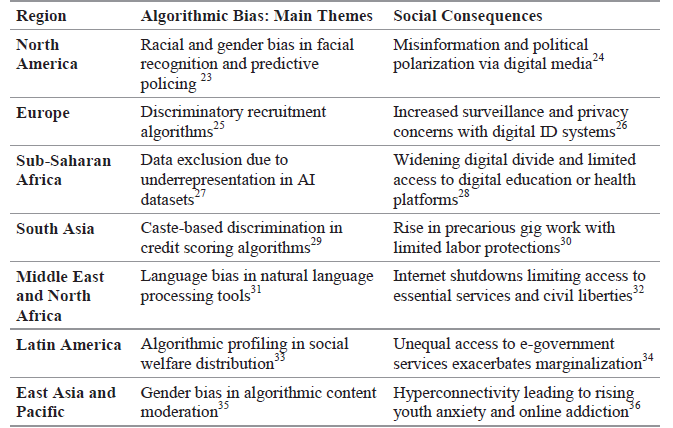
Although the level of digital transformation experienced in the world creates new economic opportunities, these benefits are unequal, and vulnerable populations often face increased insecurity.20 Digital transformation influences identity, relationships, and political engagement on a social level. Social media platforms and digital communication reshape how individuals interact and contribute to polarization, disinformation, and surveillance capitalism.21 Surveillance capitalism as mentioned here refers to the harvesting of personal data without consent or explicit awareness of an individual to generate data for economic purposes.22 The rationale behind such action is to influence behavior and generate predictive insights that can be commodified. For example, data misuse in political campaigns as seen in the Cambridge Analytica scandal illustrates how digital tools can manipulate public opinion globally. Other social consequences of AI technologies and digital transformation prominent in different regions are presented in Table 1.
Table 1: Consequences of AI Technologies
Source: Created by the author
As observed in Table 1, there are different algorithmic biases that tend to deliberately or inadvertently result in social consequences from AI technologies in the context of human communication. Furthermore, it is observed in the Western world that the shift toward digital public services can exclude populations lacking digital literacy or access to technology, especially the elderly and marginalized, creating barriers to essential services such as healthcare, banking, and social support.37 In summary, while digital transformation drives innovation and global connectivity, it also reinforces inequalities, alters labor and political structures, and raises urgent ethical and governance questions worldwide.
AI Technologies in Intercultural Communication
The impact of AI usage on intercultural communication is multifaceted, offering both opportunities and challenges, both are briefly reviewed in this section.
Enhanced Language Translation and Real-Time Communication: AI-powered tools such as Google Translate and real-time speech recognition systems facilitate communication across language barriers, making intercultural dialogue more accessible and efficient.38 These technologies help in overcoming linguistic differences and promote inclusivity in multicultural settings.
Standardization of Communication Norms: AI often relies on training data from dominant cultures (usually Western), which can unintentionally standardize communication styles and norms. This may lead to suppressing culturally diverse ways of expressing ideas or emotions.39
Bias in Communication Technologies: AI tools may carry algorithmic biases that reflect cultural assumptions embedded in their training data. These biases can misinterpret, stereotype, or marginalize certain cultural expressions, harming intercultural communication and reinforcing systemic inequalities.40
Loss of Cultural Nuance and Context: AI systems may struggle with understanding cultural subtleties, metaphors, humor, or indirect communication styles, leading to miscommunication or cultural insensitivity.41 This limits their effectiveness in sensitive intercultural contexts such as diplomacy, humanitarian work, or education.
Opportunities for Cultural Preservation and Exchange: Despite challenges, AI can also preserve endangered languages and cultural narratives through digitization and AI-generated storytelling, thereby enriching intercultural dialogue.42
Regardless of the dual position of AI technologies in intercultural context, the social consequences of algorithmic biases that significantly impact intercultural communication, often reinforcing inequality, misunderstanding, and exclusion in digital and real-world interactions. Some are highlighted as follows:
Marginalization of Non-Dominant Cultures: In terms of social consequences, algorithmic systems trained primarily on data from dominant cultural groups (e.g., Western, English-speaking populations) can misinterpret or ignore expressions from minority cultures. This leads to unequal representation and inhibits authentic intercultural dialogue.43
Reinforcement of Stereotypes: Biased algorithms may amplify racial, ethnic, or cultural stereotypes, for instance, in search engine results or content recommendations, shaping perceptions and attitudes between cultural groups based on misrepresentation.44 This undermines mutual respect and intercultural trust.
Erosion of Cultural Nuance in Communication Tools: AI-driven translation and communication tools often fail to recognize the subtleties of culturally specific idioms, humor, and non-verbal cues. Such oversights hinder accurate intercultural communication and may cause offence or misunderstanding.45
Discriminatory Moderation and Filtering: Content moderation algorithms on social media platforms may disproportionately flag or suppress expressions from certain cultures or languages as offensive or inappropriate due to biased training data, limiting their voices in intercultural exchanges.46
Loss of Trust in Digital Platforms: When users from marginalized groups notice consistent bias in how algorithms interpret or treat their cultural identity, it leads to disengagement or distrust in digital spaces, weakening opportunities for genuine intercultural engagement.47
As observed, though not exhaustive, social consequences abound when marginalization of non-dominant cultures, reinforcement of stereotypes, erosion of cultural nuance in communication tools, discriminatory moderation and filtering as well as loss of trust in digital platforms result from AI usage in intercultural context. Deductions from these social consequences have theoretical explanations.
Deductions and Theoretical Explanations
Evaluation of different consequences of AI technologies have revealed specific social consequences that are worth discussing and explaining using relevant theories. Algorithmic Biases and its Social Consequences may be explained using social constructionism, critical race theory (CRT) and the theory of technological determinism.
Digital transformation can create a more interconnected world. Still, it can also lead to the centralization of power in large tech companies and deepen inequalities between digital “haves” and “have-nots”
Social constructionism suggests that societal norms and biases shape how we understand and interpret reality. In the context of algorithmic biases, this theory posits that algorithms reflect the societal values and biases of the individuals or groups who design them.48 The unintended amplification of biases in algorithmic decisions can perpetuate inequality and reinforce existing social hierarchies. For example, the use of biased data in predictive policing tools, which may over-represent minority communities in crime predictions.49
However, CRT offers a more specific position in terms of law, technology and society. CRT examines how race and racism intersect with law, technology, and society. It argues that algorithmic biases are not just technical flaws but reflect systemic racial and social inequalities embedded in technology.50 CRT helps explain why biased algorithms disproportionately impact certain marginalized groups, as these systems often mirror structural inequities. An example to illustrate this is the discriminatory practices in hiring algorithms that disadvantage women and racial minorities.51 While this is a possibility, it is not always the case which is why the application of theory of technological determinism may also be applied to the social consequences of algorithmic biases. Technological determinism posits that technology shapes society and its values, rather than society shaping technology. Under this theory, the widespread implementation of biased algorithms can shape societal norms and practices, mainly when technology influences policy, employment, and social services.52 For instance, the role of algorithmic content moderation shaping freedom of speech in social media platforms, which might disproportionately silence marginalized voices.53
The combined consequences of stereotypes, erosion of cultural nuance and moderation and filtering all attest to the social consequences of digital transformation. All these may be explained through diffusion of innovations theory, network society theory and post modernism theory respectively.
Diffusion of Innovations Theory proposed by Rogers (1962), explains how new technologies spread and become adopted by society. In the case of digital transformation, it helps explain the uneven access and impact of digital technologies across regions, social groups, and sectors. This uneven diffusion can exacerbate inequalities, particularly regarding access to digital resources, education, and employment opportunities. For example, the digital divide, where rural and economically disadvantaged communities lack internet access, leads to inequality in the adoption of digital tools.
Automated systems, including translation tools and chatbots, can facilitate intercultural communication but often fail to capture the nuances of cultural differences, leading to misunderstandings
However, the network society theory by Manuel Castells’ Network Society (1996) highlights the role of communication networks (such as the internet) in reshaping power, social structures, and cultural identities. Digital transformation can create a more interconnected world. Still, it can also lead to the centralization of power in large tech companies and deepen inequalities between digital “haves” and “have-nots.” This can be observed through the power dynamics between tech giants and governments in shaping how digital policies impact global governance.54 But postmodernism offers a wider societal dimension. Postmodernism focuses on the fragmentation of society, particularly the breakdown of traditional structures and identities. Digital transformation disrupts conventional communication systems, leading to new ways of organizing information, identities, and social relations. However, it also challenges understanding cultural diversity and maintaining cohesion. For example, the shifting dynamics in media consumption and the rise of influencer culture, where traditional gatekeepers (e.g., news outlets) lose influence, giving rise to new forms of influence and information flow.
Overall, all social consequences identified and examined in this paper, including the loss of trust in digital platforms, may impact intercultural communication. These consequences can be explained or understood using communication accommodation theory (CAT), cultural dimensions theory (CDT), and face negotiation theory respectively.
CAT developed by Giles (1973), CAT explains how individuals adjust their communication styles to accommodate others in intercultural interactions. This theory helps understand how algorithmic biases in communication technologies might impact intercultural communication, as these technologies can either facilitate or hinder cultural exchange based on how they mediate communication. An example of this is the language translation tools and automated chatbots may inadvertently fail to recognize cultural nuances, leading to misunderstandings and miscommunications in intercultural contexts. Such cultural nuances allude to the relevance of cultural dimension theory.
Geert Hofstede’s CDT (1980) identifies how values in the workplace and society vary across cultures. These differences can influence how individuals from different cultural backgrounds interact with digital tools and platforms, especially in the context of digital transformation and algorithmic biases. Misalignments between these cultural values and how algorithms are designed can result in poor communication and misunderstandings in intercultural settings. For example, an algorithm designed with a Western-centric worldview may not work effectively in non-Western societies, leading to issues in cross-cultural communication on digital platforms.55 Regardless, access to digital platforms that enable people to interact and see one another are beneficial for human interactions and communication. With such degree of access comes its challenges which can be explained through the face negotiation theory.
Ting-Toomey’s (1985) Face Negotiation Theory focuses on how individuals from different cultures manage face (self-image) during communication. Digital transformation can impact face negotiation, especially in intercultural interactions, as online communication often eliminates non-verbal cues, leading to misunderstandings, particularly in intercultural settings. For instance, automated responses in customer service systems that fail to respect cultural norms of politeness and respect, resulting in frustration and damage to relationships.
Case studies in non-Western contexts, especially in developing nations, could provide insights into how local cultures and socioeconomic conditions affect digital transformation outcomes
Conclusion and Way Forward
This paper explored the social consequences of AI technologies such as algorithmic biases, digital transformation, and their impacts on intercultural communication. It has offered further insights into how emerging technological trends may impact intercultural communication in global societies using theoretical frameworks to explain these phenomena and their consequences. It is shown that while AI technologies offer opportunities, there are consequences that ought to be considered in relation to the intended goals of intercultural communication.
Algorithmic systems can reflect and amplify societal biases, reinforcing inequalities related to race, gender, and socioeconomic status.56 This creates feedback loops perpetuating discrimination in employment, law enforcement, and welfare services. The lack of diversity in tech design teams often leads to the development of systems that fail to account for the needs and experiences of marginalized groups.57 While digital transformation has increased connectivity and access to information, it has also led to a digital divide, exacerbating inequalities between regions and social groups.58 Wealthier nations and individuals benefit disproportionately from technological advancements, while poorer areas lag behind.
The rise of algorithmic governance and platform-based economies raises questions about power dynamics, surveillance, and digital sovereignty.59 Automated systems, including translation tools and chatbots, can facilitate intercultural communication but often fail to capture the nuances of cultural differences, leading to misunderstandings.60 This is particularly problematic in multicultural settings where the interpretation of social cues may vary. The removal of face-to-face interaction in digital communication also impacts how people manage their “face” (self-image) in intercultural exchanges, sometimes leading to the breakdown of trust and the mismanagement of cultural identities.61
The significant social consequences of algorithmic biases and digital transformation on intercultural communication have been highlighted in this paper. While no major project can be referenced as an example of how all social consequences from AI usage are resolved, the theoretical explanations for AI usage in intercultural context offer opportunities that can be explored and leveraged in international relations and by countries in an increasingly diverse world.
This paper has shown that substantial progress has been made in understanding these dynamics, though gaps remain in fully addressing the intersectionality of biases, regional impacts, and emotional intelligence in AI systems. Therefore, future research should focus on these areas to better understand and mitigate the adverse effects of AI and digital technologies on diverse global communities. Potential future research areas may include but are not limited to:
Intersectionality in Algorithmic Biases: Future research could focus on how different social categories intersect to amplify biases in digital systems. This could involve exploring biases in algorithmic systems that affect marginalized groups differently depending on their intersectional identities (e.g., Black women or disabled people).
Cultural Sensitivity in Digital Transformation: There is a need for more studies that address how cultural values shape the way digital tools and AI are received and used in different parts of the world. Research could explore how intercultural communication strategies can be integrated into digital tool design to ensure inclusivity.
Human-AI Interaction: Research on the relationship between AI and emotional intelligence in intercultural communication is crucial. Future studies could explore how AI systems can be designed to be more emotionally aware and culturally competent.
Policy Implications and Governance: The digital divide and issues of algorithmic governance call for more research into international policies and regulations that can bridge gaps and ensure fairness in the use of AI and digital technologies. Research could investigate the role of global governance bodies in shaping fair digital transformation and protecting cultural identities.
Regional and Contextual Variability: More focused research is needed on the impact of algorithmic biases and digital transformation in different regions. Case studies in non-Western contexts, especially in developing nations, could provide insights into how local cultures and socioeconomic conditions affect digital transformation outcomes.
Endnotes
1. Stuart Russell and Peter Norvig, Artificial Intelligence: A Modern Approach, 4th, (Hoboken, NJ: Pearson, 2021).
2. Ian Goodfellow, Yoshua Bengio, and Aaron Courville, Deep Learning, (Cambridge, MA: MIT Press, 2016).
3. Michael I. Jordan and Tom M. Mitchell, “Machine Learning: Trends, Perspectives, and Prospects,” Science, Vol. 349, No. 6245 (July 2015), pp. 255-260.
4. Virginia Eubanks, Automating Inequality: How High-Tech Tools Profile, Police, and Punish the Poor, (New York: St. Martin’s Press, 2018).
5. Jenna Burrell, “How the Machine ‘Thinks’: Understanding Opacity in Machine Learning Algorithms,” Big Data & Society, Vol. 3, No. 1 (2016), pp. 1-12.
6. Shoshana Zuboff, The Age of Surveillance Capitalism: The Fight for a Human Future at the New Frontier of Power, (New York: Public Affairs, 2019).
7. Ryan Calo, “Robotics and the Lessons of Cyberlaw,” California Law Review, Vol. 103, No. 3 (2015), pp. 513-563.
8. Calo, “Robotics and the Lessons of Cyberlaw,” pp. 513-563.
9. William B. Gudykunst, Cross-Cultural and Intercultural Communication, (Thousand Oaks, CA: Sage Publications, 2003).
10. Edward T. Hall, Beyond Culture, (New York: Anchor Books, 1976).
11. Eleni Adamopoulou and Leandros Moussiades, Chatbots: History, Technology, and Applications, (Amsterdam: Elsevier, 2020).
12. Eli Pariser, The Filter Bubble: What the Internet Is Hiding from You, (New York: Penguin Press, 2011).
13. Robert Chesney and Danielle Citron, “Deep Fakes: A Looming Challenge for Privacy, Democracy, and National Security,” California Law Review, Vol. 107, (2019), pp. 1753-1819.
14. B. Brandtzaeg and A. Følstad, “Why People Use Chatbots,” AI and Society, Vol. 32, No. 4 (2017), pp. 581-591.
15. Jeffrey Dastin, “Amazon Scraps Secret AI Recruiting Tool that Showed Bias against Women,” Reuters, (October 10, 2018), retrieved from https://www.reuters.com/article/us-amazon-com-jobs-automation-idUSKCN1MK08G.
16. Julia Angwin, Jeff Larson, Surya Mattu, and Lauren Kirchner, “Machine Bias,” ProPublica, (May 23, 2016), retrieved July 7, 2025, from https://www.propublica.org/article/machine-bias-risk-assessments-in-criminal-sentencing.
17. Safiya Umoja Noble, Algorithms of Oppression: How Search Engines Reinforce Racism, (New York: New York University Press, 2018).
18. Joy Buolamwini and Timnit Gebru, “Gender Shades: Intersectional Phenotypic Bias in Commercial Gender Classification,” Proceedings of the 1st Conference on Fairness, Accountability and Transparency, (New York: ACM, February 23-24, 2018), pp. 77-91.
19. “Digital Economy Report 2019,” United Nations Conference on Trade and Development, (2019), retrieved July 2, 2025, from https://unctad.org/publication/digital-economy-report-2019.
20. “World Employment and Social Outlook 2021: The Role of Digital Labour Platforms in Transforming the World of Work,” International Labour Organization, (2021), retrieved July 2, 2025, from https://www.ilo.org/global/research/global-reports/weso/2021/lang--en/index.htm.
21. Shoshana Zuboff, The Age of Surveillance Capitalism: The Fight for a Human Future at the New Frontier of Power.
22. Zuboff, The Age of Surveillance Capitalism: The Fight for a Human Future at the New Frontier of Power.
23. Buolamwini and Gebru, “Gender Shades: Intersectional Phenotypic Bias in Commercial Gender Classification,” pp. 77-91.
24. Zuboff, The Age of Surveillance Capitalism: The Fight for a Human Future at the New Frontier of Power.
25. Eubanks, Automating Inequality: How High-Tech Tools Profile, Police, and Punish the Poor.
26. “White Paper on Artificial Intelligence: A European Approach to Excellence and Trust,” European Commission, (February 19, 2020), retrieved July 2, 2025, from https://ec.europa.eu/info/sites/default/files/commission-white-paper-artificial-intelligence-feb2020_en.pdf.
27. “UNESCO Recommendation on the Ethics of Artificial Intelligence,” UNESCO, (November 23, 2021), retrieved July 2, 2025, from https://unesdoc.unesco.org/ark:/48223/pf0000380455.locale=en.
28. “World Development Report 2021: Data for Better Lives,” World Bank, (2021), from https://www.worldbank.org/en/publication/world-development-report-2021.
29. Shakir Mohamed, Marie Ponomareva, and Catherine D’Ignazio, “The Case for a Critical Approach to Fairness in AI,” Proceedings of the 2020 Conference on Fairness, Accountability, and Transparency, (New York: ACM, 2020), pp. 317-328.
30. “World Employment and Social Outlook 2021: The Role of Digital Labour Platforms in Transforming the World of Work,” International Labour Organization.
31. Emily M. Bender, Timnit Gebru, Major Angelina McMillan, and Shmargaret Shmitchell, “On the Dangers of Stochastic Parrots: Can Large Language Models Be Too Big?” Proceedings of the 2021 ACM Conference on Fairness, Accountability, and Transparency, (New York: ACM, March 2021), pp. 610-623.
32. “Shrinking Space: Internet Shutdowns in 2019,” Access Now, (March 2, 2020), from https://www.accessnow.org/cms/assets/uploads/2020/02/Shrinking-Space-Internet-Shutdowns-in-2019_Access-Now.pdf.
33. Eubanks, Automating Inequality: How High-Tech Tools Profile, Police, and Punish the Poor.
34. “Digital Panorama of Latin America and the Caribbean 2020,” Economic Commission for Latin America and the Caribbean (CEPAL), (2020), retrieved from https://repositorio.cepal.org/handle/11362/46369.
35. “UNESCO Recommendation on the Ethics of Artificial Intelligence,” UNESCO UNESDOC Digital Library, retrieved from https://unesdoc.unesco.org/ark:/48223/pf0000380455.locale=en.
36. Yolanda R. Reid, et al., “Children and Adolescents and Digital Media,” Pediatrics, Vol. 138, No. 5 (November 2016).
37. Jan Van Dijk, The Digital Divide, (Medford, MA: Polity Press, 2020).
38. Jiasheng Jia, Shikai Zhang, Zihan Liu, Jiajun Shen, Xiaotao Zeng, and Jichang Li, “The Application of AI in Medical Imaging: A Review,” Computational and Mathematical Methods in Medicine, Vol. 2021, (2021), pp. 1-14.
39. Agarwal, Dhruv, Mor Naaman, and Aditya Vashistha. “Ai suggestions homogenize writing toward western styles and diminish cultural nuances.” In Proceedings of the 2025 CHI Conference on Human Factors in Computing Systems, pp. 1-21. 2025.
40. Kate Crawford, Atlas of AI: Power, Politics, and the Planetary Costs of Artificial Intelligence, (New Haven: Yale University Press, 2021).
41. Hany Elnahla, “Fairness in Algorithmic Decision-Making for Social Good,” unpublished Ph.D. thesis, University of Cambridge, 2020.
42. Will Douglas Heaven, “Why It’s Time to Regulate the Algorithms that Sort Us into Groups,” MIT Technology Review, (September 1, 2020), from https://www.technologyreview.com/2020/09/01/1007804/regulating-algorithmic-sorting-bias/.
43. Safiya Umoja Noble, Algorithms of Oppression: How Search Engines Reinforce Racism.
44. Virginia, Automating Inequality: How High-Tech Tools Profile, Police, and Punish the Poor.
45. Ninareh Mehrabi, Fred Morstatter, Nripsuta Saxena, Kristina Lerman, and Aram Galstyan, “A Survey on Bias and Fairness in Machine Learning,” ACM Computing Surveys, Vol. 54, No. 6 (July 2021), pp. 1-35.
46. Robert Gorwa, Sophia Lorenz, and Axel Bruns, “The Platforms Are in Crisis: An Introduction to the Special Issue,” New Media and Society, Vol. 22, No. 9 (September 2020), pp. 1603-1609.
47. Ruha Benjamin, Race after Technology: Abolitionist Tools for the New Jim Code, (Medford: Polity Press, 2019).
48. Peter L. Berger and Thomas Luckmann, The Social Construction of Reality: A Treatise in the Sociology of Knowledge, (Garden City, NY: Doubleday, 1966).
49. Cathy O’Neil, Weapons of Math Destruction: How Big Data Increases Inequality and Threatens Democracy, (New York: Crown, 2016).
50. Benjamin, Race After Technology: Abolitionist Tools for the New Jim Code.
51. Eubanks, Automating Inequality: How High-Tech Tools Profile, Police, and Punish the Poor.
52. Langdon Winner, The Whale and the Reactor: A Search for Limits in an Age of High Technology, (Chicago: University of Chicago Press, 1986).
53. Gorwa, Lorenz, and Bruns, “The Platforms Are in Crisis: An Introduction to the Special Issue.”
54. Manuel Castells, The Rise of the Network Society, (Malden, MA: Blackwell Publishers, 1996).
55. Geert Hofstede, Culture’s Consequences: International Differences in Work-Related Values, (Beverly Hills, CA: Sage Publications, 1980).
56. Benjamin, Race After Technology: Abolitionist Tools for the New Jim Code; Eubanks, Automating Inequality: How High-Tech Tools Profile, Police, and Punish the Poor.
57. Noble, Algorithms of Oppression: How Search Engines Reinforce Racism.
58. Manuel Castells, The Rise of the Network Society, (Malden, MA: Blackwell Publishers, 1996).
59. Gorwa, Lorenz, and Axel, “The Platforms Are in Crisis: An Introduction to the Special Issue.”
60. Hofstede, Culture’s Consequences: International Differences in Work-Related Values.
61. Stella Ting-Toomey, “Toward a Theory of Conflict and Culture,” International and Intercultural Communication Annual, Vol. 9, (1985), pp. 71-86.
