

For the great enemy of truth is very often not the lie—deliberate, contrived, and dishonest—but the myth—persistent, persuasive, and unrealistic. Too often we hold fast to the clichés of our forebears. We subject all facts to a prefabricated set of interpretations. We enjoy the comfort of opinion without the discomfort of thought.1
Introduction
Popular literature, film, and media have a tremendous impact on readers and viewers of all ages and all walks of life. This influence is quite pervasive in political echelons as it may command policy decisions. For instance, in the US, President Ronald Regan was an admirer of Tom Clancy, an American novelist, who was invited to lecture to the Pentagon, CIA, and White House staff. President Bill Clinton, in his 1992 election campaign, spoke of his admiration for Walter Mosley’s novels.2 Similarly, British Prime Minster Stanley Baldwin was an avid reader of the works of John Buchan, while President John F. Kennedy was one of Ian Fleming’s faithful readers. The validation sought in the fictional works by some politicians, presidents, and leaders shows how popular fiction can be put to effective use by harnessing general thought patterns en masse.
At the same time, many works may be cited as references for exhibiting different degrees of Islamophobia. Novels like At Risk (2004) by the former head of MI5 Stella Rimington, and Congressman Peter T. King’s novel Vale of Tears (2004) on Muslim terrorism stand as recent examples.3 It may, therefore, be deduced that art, literature, and popular media have far more influence than we realize on political decisions made by the leaders who matter to the world.
With this context, we may argue that while in the short-term memory of our media age, Islamophobia may have ostensibly started after 9/11, it was a nascent presence long before that.4 Phrases like the “elephant in the room” is Islam or “Eurabia, … Europe will be overrun by Islam,”5 as this Islamophobia has come to be called today, have been there long enough. Many believe that the war on terror, if examined objectively, may even be seen as the “war of terror.”6 Therefore, this paper seeks to study the objective truths of history in the context of Palestine and Kashmir that have been problematized in the celluloid world of the late 20th century. I contend that, like the Egyptian and Greek mythological dragon of Ouroboros, who continually devours its tail and has a cyclical existence with no outcome till eternity, some seminal mediatic depictions about the two regions of Palestine and Kashmir have revealed a similar cycle for about three-quarters of a century. However, these Ouroboros are now met with their celluloid laocoön,7 depicting reality in the third decade of the present century. In the context of this paper, we may understand laocoön as the countercriticism of the narrative built in the media depictions such as in the selected films of this study.
This research traces the trajectory of the selected mediatic depictions in our recent history and studies what shape it has acquired in our postmodern times. The exploration also weighs the existence of reality, truth, or post-truth and their implications in the propagandized rhetoric of right-wing media. The paper discusses some decolonial approaches that may aid in finding truthful answers amidst these post-truth complexities. It specifically analyzes how there has been a strategic attempt to challenge historical facts related to Palestine and Kashmir, which has caused Islamophobia, besides other perils for human existence. Addressing this issue is crucial for the survival of humanity, as this research emphasizes the importance of understanding the roots of Islamophobia in these debates for any future policymaking.
Theoretical Underpinnings for Epistemic Inquiry
In today’s rapid information age, settler colonialism in Palestine and neo-settler colonialism in Indian-held Kashmir are undeniable realities. This inquiry seeks answers to contemporary issues in Palestine and Indian-held Kashmir, considering the views of scholars, citizens, and historians who argue that attempts to colonize Jews and Indians have been unsuccessful over the past two to three centuries. Following this reasoning, the paper posits that if such colonization attempts have failed for Jews and Indians, they may also fail for Palestinians and Kashmiris. Additionally, it examines whether colonization efforts by Israelis in Palestine and by India in Kashmir will ultimately fail, as all colonizing efforts tend to be unsuccessful.
Therefore, studying some cinematic depictions of Palestine and Kashmir, this paper argues that the appropriation of land, culture, and resources, marginalization, and erasure meted out to the Palestinians and Kashmiris is beyond the hegemonic strategies of imperialism, colonialism, despotism, and even fascism. This colonial imperialism and despotic fascism, which may be neologized as “implonialism,” extends the general perception of the colonialisms, imperialisms, despotic, and/or fascist rules the world has been witnessing for centuries.8 Implonialism, therefore, is not only colonial imperialism but implies dominant traces of despotism and fascism. I argue that implonialism may serve as a lens to critique the phenomena posing a threat to the well-
being and existence of postcolonial spaces such as Palestine, Kashmir, and other flash points in our world.
This colonial imperialism and despotic fascism, which may be neologized as “implonialism,” extends the general perception of the colonialisms, imperialisms, despotic, and/or fascist rules the world has been witnessing for centuries
We may observe that throughout human history, one form or the other of implonialism has thrived on several lies. In this age, critics like McIntyre see these lies as post-truth. He defines post-truth as “a form of ideological supremacy, whereby its practitioners are trying to compel someone to believe in something whether there is good evidence for it or not.”9 The essence of post-truth politics, as per McIntyre, lies in manipulating facts to shape public perception and discourse, regardless of the factual accuracy of the information being presented. In other words, these post-truths jeopardize the actual truths. McIntyre also believes these post-truths are academic hair-splitting, which sometimes tends to cherry-pick “obscenely high standards of doubt towards facts that they don’t want to believe, alongside complete credulity toward any facts that fit with their agenda.”10 We may like to ask whether these post-truths are ethical and supported by historical truths or are the usual baseless narratives presented by the colonizers, imperialists, despots, and fascists. Within this framework, this paper seeks to navigate the complexities of the post-truth of implonialism by examining its manifestations in media portrayals of Palestine and Kashmir, highlighting how these representations contribute to a broader narrative of implonialism.
In the backdrop of popularized terms like ‘Islamofascism’ by the Bush Administration, stereotyping of all Muslims as fascists and calling it Islamic terrorism, or “good Muslim/bad Muslim” binaries or “good Islam/bad Islam” dichotomies, this paper also takes its cue from the theoretical lens of Islamophobia and Islamophilia. Critics see “Islamophilia, [as] a generalized affection for Islam and Muslims, [however only] as political projects.”11 Simply put, we can understand Islamophilia as an attraction to Islam or to Muslims and Islamophobia as a fear or rejection of Islam or Muslims.12 The theses points of implonialism, Al-Shaikh-Ali’s chapter “Islamophobic Discourse Masquerading as Art and Literature,” Shryock’s argument in his book, Islamophobia/Islamophilia about the limitations of a “phobic lens … that only non-Muslims can view Islam, or aspects of Islam,”13 or “an understanding of Islam as foreign and dangerous”14 are referred to as theoretical lenses to understand the dynamics that go around in the making and propagation of implonialistic mediatic narratives of cinema, film, or drama, two of which are the selected films for this study.
Furthermore, to analyze the selected films for this paper, the paper uses Catherine Belsey’s research method of textual analysis as it caters to the “context of the cultural artifact under scrutiny, the context of its production, its content and its consumption.”15 This method serves as a useful tool for analyzing the contents of this paper as it engages with the context of the production of the selected films and studies how they are rendered the status of staple cultural artifacts and presented to the world audience for mass consumption. Belsey also believes that there “is no such thing as ‘pure’ reading: interpretation always involves extra-textual Knowledge,”16 and therefore, occasionally, the paper engages with the historiographical analysis as a research method. Since “historical writing is as much a product of its time as any other historical development and can therefore serve as a lens into major trends and developments in the history of Western Civilization,”17 historiographical analysis as a research method complements the textual analysis method.
Islamophobic and Islamophilic discourses of fictional works have increasingly been translated into the digital and mediatic space
Epistemic Inferences
The debates of Islamophobia and Islamophilia, being a part of the larger canvas of colonial imperialism, despotism, and fascism, referred to in this paper as implonialism, serve as a lens to read two mediatic depictions discussed in this paper. According to Shryock, “contemporary forms of Islamophobia are shaped (or haunted) by a worldview in which Europe and the Christian world are set apart from an Oriental and Muslim world. [And,] Islamophilia are shaped (and haunted) by the same moral geography.”18 Moustafa Bayoumi, in his chapter “The God that Failed: The Neo-Orientalism of Today’s Muslim Commentators” dismantles the politics of Islamophobia and Islamophilia in the works of Ayaan Hirsi Ali, Irshad Manji, and Reza Aslan, as he believes that “Islamophobia of Hirsi Ali and Manji and the Islamophilia of Aslan share a common Orientalist heritage.”19
Islamophobic and Islamophilic discourses of fictional works have increasingly been translated into the digital and mediatic space. Dutch movie Fitna’s negative depictions were documented in a 2007 ERCI (Commission Europenne Contre Le Racisme et L’Intolrance) study of media coverage, which revealed an increase in Islamophobic incidents in the workplace and education in the Netherlands.20 This, again, is nothing new, as “during the age of empire, art and literature were extensively used to paint a derogatory image of Islam and Muslims.” The “supreme icons of the European imagination,”21 like Tasso, Ariosto, Cervantes, Marlowe, and Shakespeare, penned their biases about the heathens, i.e., Turks and Moors. Theodore Roosevelt was sent Kipling’s poem, “The White Man’s Burden,” with a note: “I send you an advance copy of a poem by Kipling which is rather poor poetry, but good sense from the expansionist standpoint.”22 This “white saviourism”23 is “[t]he legacy of The Adventures of Captain John Smith, The Lustful Turk, The Greek Slave, and The White Man’s Burden that continues today in the shape of xenophobic and Islamophobic imagery that inundates the contents and covers of many modern, mass-produced titles of popular fiction.”24 These are, therefore, “political strategies” used as “a renewable legacy”25 in today’s mediatic world.
Through studying the visual texts of Exodus and Bharat Ek Khoj, we can understand that Islamophobia and Islamophilia are the post-truths that have generated blind conformity in recent history in the context of Zionist and Hindutva movements and are fueling implonialism
Making use of these lenses to understand the historical and contemporary truths/post-truths and impressing upon the need to seek objective realities that Esposito, Shryock, and Al-Shaikh-Ali speak about, and the lens of implonialism, this paper studies the narratives and politics around films like Exodus (1960) and programs like Bharat Ek Khoj (1988).
“Exposing the tactical ignorance, malign and benign that suffuses educated opinion on all things,”26 this paper seeks some answers to questions. For instance, how can we address the baloney of Islamophobia and Islamophilia in the context of recent history, media depictions, and films about Palestine and Kashmir? Thus, the two filmic narratives selected for this study serve as the case studies for this paper.
Why Islamophobia or Islamophilia?: Propelling the Discussion Forward
Islamophobic or Islamophilic brand of narrative, with the best possible capitalistic maneuvers to influence popular social, psychological, and philosophical trends, is tantamount to sociopathic behavior. Critics believe that the “works of art and literature are not necessarily gospels of love and peace or espousers of the highest and noblest virtues but rather have been used to spread prejudice, falsehoods, stereotypes, and myths that incite people to conflict, … cultural terrorist offensive [and an] explosive mix.”27 The rationale and arguments provided for the recent genocide in Gaza after October 7, 202428 may stand as an eye-opening example for a series of Islamophobias and Islamophilic debates that have been going on in history in the context of Palestine and Kashmir. These debates are close to sociopathic behavior because “all the sociopath needs to do to win in the game is lie publicly whilst conspiring privately.”29 Therefore, using these lenses of decoloniality, we need to study movies like Exodus (1960) and programs like Bharat Ek Khoj (1988) that greatly shaped our views in recent history.
For any scientific research findings to be presented to society, a “high level of self-scrutiny” is crucial. Movies like Exodus and Bharat Ek Khoj offered a utopian form of post-truth, blending various scientific, social science, and religious truths. This occurred because there was no attempt to investigate the reasons for any “failures to disclose potential sources of bias—conflicts of interest, the source of one’s funding,” etc.30 These filmic depictions and similar Islamophobic campaigns exemplify the dictum: “Why bother with peer review when one’s opinions can be spread by intimidating the media or through public relations? And why wait for government officials to come to the ‘right’ conclusion when you can influence them with industry money?”31 Therefore, this paper posits and supports this argument in the subsequent discussions.
By navigating through the Islamophobic controversies about this ouroboros of Zionist and Hindutva apologia in the two selected films, Exodus and Bharat Ek Khoj, this study argues that rather than promoting Islamophilia (pseudo attraction towards Muslims) in their narratives, which has also fueled Islamophobia in recent history (besides other hazards), it is time to give space to historically accurate, scientific, and moral evidence. This may help seek alternative facts to decolonize the settler colonial projects that the two films entail. Through studying the visual texts of Exodus and Bharat Ek Khoj, we can understand that Islamophobia and Islamophilia are the post-truths that have generated blind conformity in recent history in the context of Zionist and Hindutva movements and are fueling implonialism (using any or all its elements of colonialism, imperialism, despotism, and fascism). The paper also explores how these filmic narratives create Islamophobia and negate the very tenets of Judaism and Hinduism.
Exodus: Religious Implications Translating onto the Screen
When the Hebrew scriptures were translated into Greek, the term used to describe the Israelites’ departure from Egypt was ‘Exodus.’ In the book Exodus: Saved for God’s Glory (2005), this event is portrayed as a tale of “two mighty nations—Israel and Egypt—led by two great men—Moses, the liberating hero, and Pharaoh, the enslaving villain.”32 According to the Quran, Jacob/Yaqoob, with his title of Israel, had his descendants called the Children of Israel, who followed Moses/Musa and Aaron/Haroon. The narrative of Exodus, one of the “best-known stories of Western Civilization,”33 is also supported by scientific and archaeological evidence, aiming to “explain the science behind the biblical story … [So that] we should be able to understand the science behind the miracles.”34
In the 2019 documentary The Exodus Decoded: History Documentary, produced and presented by Simcha Jacobovici with James Cameron as the executive producer, Jacobovici highlights the skepticism he faced from Egyptian authorities during his field research. According to Jacobovici, the Egyptians feared the Jewish narrative of returning home might be true after all. However, narratives like Jacobovici’s and the official Zionist tale immortalized in Leon Uris’s best-selling historical novel, Exodus (1958), often overlook the argument that Arabs and Palestinians are the real descendants of the Jews and that the people of Judea-Palestine were never expelled but later adopted Christianity or Islam.35 It seems that more people became Muslims than Christians because Judaism is closer to Islam than Christianity; in other words, most people became Muslims because Prophet Muhammad [ﷺ] is another prophet who recognizes all the other prophets before him.36 Shlomo Sand, in his 2009 book The Invention of the Jewish People, argues that “a good many of the Jews had earlier become Christian, and others converted to Islam afterward. But, as noted earlier, a good many continued to believe in the old rahman god.”37 Sand states further that “most of the Jews throughout the Roman Empire were not direct biological descendants of the inhabitants of Judea.”38
Despite this historical fact, Uris’ novel was celebrated by Ben Gurion as “the greatest thing ever written about Israel,” albeit with a caveat. Ben Gurion dismissed “any literary qualities this nonsense might have possessed,” considering it “one of the best pieces of Socialist-Zionist propaganda that Israel could have sought.”39 The film adaptation of Exodus, released just two years later, cemented the novel’s narrative as widely accepted by the masses. The 1960 movie Exodus became a phenomenal success, resonating with Americans and global audiences alike, while the voices of many intellectuals were largely overshadowed. The words of Edward Said and similar scholars seem to have disappeared from public awareness when they argue:
The most disturbing thing is that hardly any of the questioned Americans knew anything at all about the Palestinian story, nothing about 1948, nothing at all about Israel’s illegal 34-year military occupation. The main narrative model that dominates American thinking still seems to be Leon Uris’s 1950 novel Exodus.40
Based on this novel, the movie Exodus broke all box office records. It became a staple Islamophobic discourse because, with the production of this movie, the entire team of this mediatic depiction compelled the world to believe in something for which the evidence existed otherwise.
The film Exodus (1960) not only serves as a propagandist narrative but also features many clichéd motifs and implicit Islamophobic comments that become evident when viewed after 84 years. A brief overview of the story helps understand the implications of this narrative. Set in the 1940s, the film shows Katherine (Kitty) Fremont, a widowed American nurse, sightseeing in Cyprus. She learns about the Karolos Internment Camp for Jewish refugees. She offers to help there for a few days. Despite her initial hesitations about assisting in a ‘Jewish’ camp, she meets Karen Hansel Clement, a fourteen-year-old Jewish girl who had lost her siblings and mother in the Holocaust. Kitty quickly becomes fond of Karen and decides to take her to the safety of America. Initially, Karen is thrilled at the prospect but changes her mind when the camp’s inhabitants are offered the chance to be smuggled into British-mandated Palestine. This secret mission of smuggling the Jews into British-mandated Palestine is orchestrated by the protagonist, Ari Ben Canaan, a former decorated captain in the British Army. Utilizing his connections, Ari secures a ship to smuggle the Holocaust survivors interned in the camp. When the British authorities learn of this plan, they attempt to stop the smuggling but fail. Ari inspires the ship’s passengers to adopt a bold stance, suggesting they either blow up the ship or continue to Palestine. Kitty tries to convince Karen to go to America as they had initially planned, but Karen decides to stay, committed to finding her lost father and supporting the Jewish cause.
The 1960 movie Exodus became a phenomenal success, resonating with Americans and global audiences alike, while the voices of many intellectuals were largely overshadowed
The film unfolds various events that reveal more about the characters. The audience learns that the different lead characters are associated with two Zionist paramilitary organizations, Haganah and Irgun. Ari is affiliated with Haganah, while Ari’s uncle, Akiva, belongs to Irgun. Karen’s love interest, Dov Landau, also belongs to Irgun. Akiva, the leader of Irgun and Ari’s paternal uncle, is sentenced to be hanged following Irgun’s terrorist bombing of the King David Hotel in Jerusalem on July 22, 1946 (a real event). Ironically, the 1960s audience is fed with Islamophobia about Mohammad Amin al-Husayni, the Grand Mufti of Jerusalem, plotting to attack the fictional village Gan Dafna to massacre Jews, including children. In the movie, Gan Dafna is named after Ari’s beloved, who was kidnapped, tortured, and murdered by Arabs. The film’s blatant propaganda and post-truth are evident in many scenes throughout the movie. For instance, Kitty’s patronizing remark to Ari that she was on the ship to save the “poor and forlorn Jewish girl [Karen]” and Ari’s statement to Kitty that “almost two million Jewish children were butchered like animals”41 stand as two examples of post-truths that the film projects. These moments highlight the degree of Islamophobia in the film and are emblematic of nascent colonial imperialism with despotic and fascist agendas, which may be seen as full-blown implonialism. Even Israel’s President Ben Gurion acknowledged that while the movie lacked literary merit, it significantly advanced the Zionist cause.
Thus, while Uris’ novel Exodus (1958) adopted an unapologetically pro-Zionist stance, its cinematic adaptation in Exodus (1960) amplified this perspective, presenting what might be considered the greatest post-truth of the twentieth century. This aligns with De Haas’s commentary on Herzl’s 1896 document A Jewish State: An Attempt at a Modern Solution of the Jewish Question. De Haas, who wrote the prefaces for Herzl’s work in 1904 and 1917, pointed out that Herzl’s initially utopian idea of establishing Palestine as the Jewish homeland was seen as an “egregious blunder” but was later fervently embraced by the masses, exemplifying mindless conformity.42 The narrative of Exodus disregarded the reality that the actual descendants of Jacob/Yaqoob, the Children of Israel, were the inhabitants of Palestine, as reminded by the Holy Quran, historians like Shlomo Sand, and many others.43
Moreover, this narrative is indicative of the colonial mindset, which often cloaked their true motives for wealth, control, and power under the guise of spreading Western civilization. This is seen in using terms like ‘mandates,’ ‘protectorates,’ and ‘commonwealths’ to obscure their colonial ambitions.44 Some critics argue that since the 1970s, Muslims have gradually replaced all earlier antagonists of Western civilization as the new face of the enemy.45 Thus, this colonial and imperialistic rhetoric has a despotic and fascistic demeanor also, as exhibited by the lead character, Ari, in the movie. While in political echelons, an astute president like Ben Gurion, though knowing full well the lack of literary merit of the film, praises it because it served the Zionist cause. This speaks for the disregard of ground realities by the people in power and how they gloss over any truths for their unjust interests. Their demeanor, therefore, is a manifestation of implonialism, as such a stance has all the factors of colonialism, imperialism, despotic, and even fascistic mindset and is fueled by Islamophobia and Islamophilia.
This multipronged effort to construct the Jewish narrative through the novel, the movie, political validation, and effective propaganda not only exemplifies post-truths but also elevates these endeavors beyond mere colonial and imperialistic maneuvers. Throughout the movie, there is an implicit mediatic despotism, particularly embodied in the character of Ari. The narrative also exhibits fascist tendencies, with Ari brazenly engaging in terrorism against their British benefactors. Given the magnitude of the damage they inflict, this despotism and fascism can be described as “implonialism.”46 This term implies an inherent self-destructive tendency that is environmentally unsustainable in the long run and may implode to its own and the environment’s ruin.47 These self-destructive tendencies are validated by historical events, such as the European suppression of the Jewish Question and colonialism in India, which ultimately led to the Nuremberg trials and the British withdrawal from India.
In some dialogues of Exodus (1960), the obfuscations and rhetorical nonsense become more apparent, leading us to the focus of the next section of our research. For instance, early in the movie, during a tea-time conversation with British General Sutherland, Kitty muses about her future plans, mentioning she might go to “India… the Vale of Kashmir… probably the most beautiful spot on earth.”48 While it is true that Kashmir is one of the most beautiful places on earth, this passing comment by Kitty carries implications of Orientalist leanings and Islamophilia. Romanticizing this part of the world is nothing new, as Doctor Faustus had also spoken similar words: “I’ll have them fly to India for gold, / Ransack the ocean for orient pearl.”49 This leads us to discussions about the Vale of Kashmir and the Islamophobia/Islamophilia that has been capitalized in the cinematic realm around 28 years after Exodus.
Bharat Ek Khoj: Mediatic Islamophobia / Islamophilia
Political Zionism succeeded because the Israeli colonial-national imagination had been, quite resourcefully, also “directly tied to the media.”50 In the previous section, we examined how the Jewish colonial national imagination presented in Exodus influenced the global consciousness. This section explores how a theory is constructed, validated as authentic, and disseminated among India’s general populace and worldwide.
The recent consecration of the Ram Temple in Ayodhya, under the pretext of reclaiming “lost Hindu temples currently under Muslim possession,” ignited a renewed communal frenzy on social media in India
The recent consecration of the Ram Temple in Ayodhya, under the pretext of reclaiming “lost Hindu temples currently under Muslim possession,” ignited a renewed communal frenzy on social media in India.51 This pattern of Islamophobia is not new. The 1992 demolition of the Babri Masjid, justified by claims that it was built on the birthplace of Rama, serves as a recent historical example. Iftikhar Gilani discusses how Congress and socialists have aided Hindutva, arguing that the demolition of the Babri Masjid in 1992, the subsequent excavation of its rubble for a Hindu temple, and the construction and inauguration of the Ram Temple brought billions of dollars to the Bharatiya Janata Party (BJP) government.52 This entire enterprise was heavily funded with international aid, often used for projects that shape or support national imaginaries.53 Thus, it is an implonialism with a heavy leaning on Islamophobic rhetoric.
Although it is not widely known that Balbir Singh, one of the demolishers of the Babri Masjid, embraced Islam in 199354 (just a year after the desecration of the Babri Masjid), vigilantism against the Muslim population is a growing problem in India. Cinematic depictions often act as catalysts for this widespread phobia. Contemporary films like The X Files and Article 370, as part of this trend, fall into the category of “a spate of crude political films.”55 Critics argue that while such films “keep the base of bigotry energized and strengthen old prejudices,”56 they are funded and promoted on a global scale. Just as Exodus (1960) was considered a political victory despite being labeled “nonsense” by Israeli Prime Minister Ben Gurion,57 films like Article 370 (2024) can be seen as political babble, continuing a long history of similar ventures in Indian cinema.58
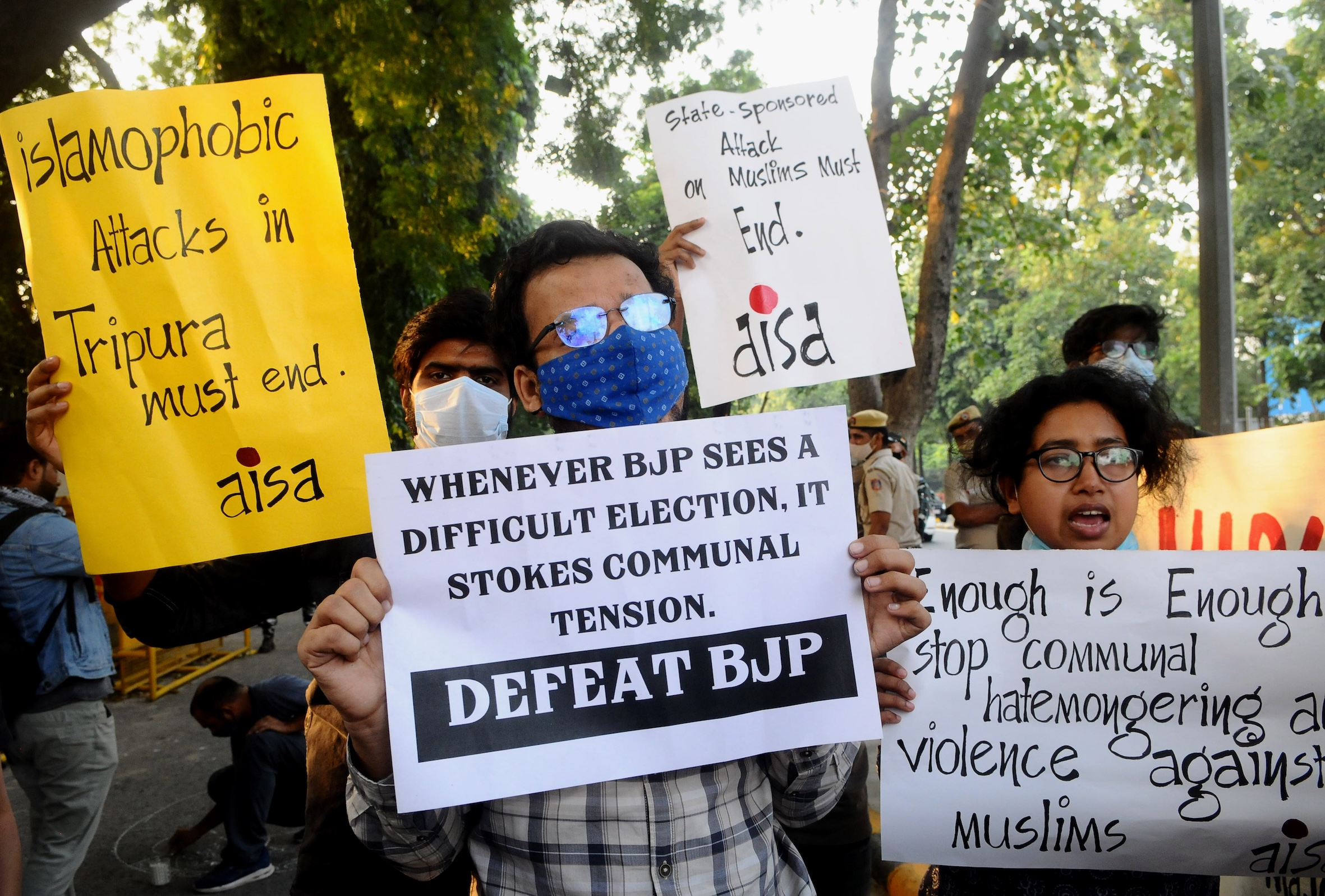
Tensions rose in India’s Tripura state after “radical Hindutva mobs” vandalized mosques, homes, and shops belonging to Muslims, prompting students at Jawaharlal Nehru University in New Delhi to protest the violence. IMTIYAZ KHAN / AA
However, the origins of this political enterprise can be traced back to the state-sponsored program Bharat Ek Khoj, which aired in 1988 on Doordarshan, India’s national broadcasting organization. This program was ostensibly based on Jawaharlal Nehru’s 1946 book The Discovery of India, written during his imprisonment in the Ahmedabad jail from 1942 to 1945. Meanwhile, Nehru’s prison companion, Maulana Azad, also wrote his book Ghubar-e-Khatir during the same period. Still, it did not achieve the global recognition and fame of The Discovery of India. The disparity in recognition was not due to the merit or subject matter of the books but rather the strategic effectiveness of tying certain propaganda directly to the media, as mentioned by el-Haj.59
Bharat Ek Khoj was a program that claimed to provide a cinematic exploration into the history of India, searching for a harmonious “unity amidst diversity”60 or “unity in diversity.”61 However, it can be seen as a highly charged narrative aimed at achieving political objectives, which it accomplished. There are some remarkable examples of Islamophilia, where the narrative of the book, though apparently advocating for unity amidst diversity of religions in India, and not speaking directly about Islam, relies heavily on the Hinduization of the land and its people. It is, therefore, contrary to the claim of the book and its video production discussed here. At the beginning of his book, Nehru provides a disclaimer about all religions, stating that “Hinduism or Islam or Buddhism or Christianity, did not attract me [because they] seemed to be closely associated with superstitious practices and dogmatic beliefs.”62 Despite this disclaimer, the book and its televised depiction exhibit religious overtones of Hinduism. In the program, Bharat Ek Khoj, the character of Nehru claims that the “Indus Valley Civilization was specifically Indian and forms the basis of modern Indian culture,”63 aligning this civilization with Hindu religious nuances. The program’s thrust is based on the narrative constructed in The Discovery of India.
In the book, Nehru views this land as embodying “a very perfect adjustment of human life to a specific environment that can only have resulted from years of patient effort.” He asserts that life in this land is “specifically Indian and forms the basis of modern Indian culture.”64 He quotes Professor Childe to validate that the Indus Valley Civilization is essentially Indian with the phrase: “The Indus or Sifidhu, from which our country came to be called India.”65 Some critics believe Nehru echoes the tropes of “colonial Indologists of yore,”66 while others say that Nehru appears influenced by the colonizers’ mindset when he is described as “muttering in English in his sleep”67 while writing his book.
Nevertheless, The Discovery of India can be viewed as an attempt to provide an alternate episteme to the colonizers’ narrative. In some respects, it serves as an excellent counter-narrative to British accounts of this region. However, the selective presentation of facts reveals the biases in both the book and the program Khoj. For example, while the book and its cinematic adaptation discuss the Brahmins extensively, they largely ignore the actual inhabitants of the land, the Dravidians (who were mostly relegated to the category of Shudras or the Untouchable class). Similarly, the book details the “raid”68 of Iranian ruler Nader Shah and his exploits in the Delhi Sultanate in a negative light while discussing the mutiny of 1857 and the heroism of Mangal Pandey with a positive note in the program.69 However, it omits any mention of the hero of the Pothohar Plateau, Raja Nadir Khan Mandala, who rose against British colonial rule in 1853, five years before 1857. His name has been erased from History70 and may be seen as a classic example of Islamophobia. Nehru argues that:
Hinduism, as a faith, is vague, amorphous, many-sided, all things to all men. It is hardly possible to define it, or indeed to say definitely whether it is a religion or not, in the usual sense of the word; [that it would be] entirely misleading to refer to Indian culture as Hindu culture; [and that] this culture was greatly influenced by the impact of Islam, and yet it remained basically and distinctively Indian.71
However, he also contradicts these objective realities with his assertive statements, writing that “taken as a whole, their religion is so characteristically Indian as hardly to be distinguished from still living Hinduism.”72 This ambivalence translates into the program Bharat Ek Khoj, which predominantly portrays Hinduism as the sole reality, overlooking the significant influence of Buddhism and Islam in this region. This selective representation reflects a tendency to cherry-pick realities to align with the political agendas of such cinematic productions.
Bharat Ek Khoj was a program that claimed to provide a cinematic exploration into the history of India, searching for a harmonious “unity amidst diversity” or “unity in diversity.” However, it can be seen as a highly charged narrative aimed at achieving political objectives, which it accomplished
In all earnestness, the objective thrust that may be found in Nehru’s book is absent in the celluloid depiction of Khoj, which appeals to the general Indian public. There is no mention of the “captivating Indian tradition” of King Shakiravarti Farmad from South India, who is said to have witnessed the miraculous splitting of the moon performed by Prophet Muhammad in Makkah.73 This 6th-7th century king is notably absent from Khoj. King Farmad’s thorough research into the new prophet in Arabia before embracing Islam is not highlighted, despite similar patterns of conversion found both before and after his time. For example, Emperor Ashoka converted to Buddhism, which was initially considered a heretical religion by Brahmin priests. Ashoka made “peaceful missionary efforts in India and foreign countries”74 to spread Buddhism. Similarly, in the fourteenth century, the Buddhist Prince Rinchana, known as a “seeker of truth,” converted to Islam after his efforts to become a Hindu were met with skepticism by Brahmin clerics who were unsure which caste to assign to him.75
Ashoka, however, does appear in Khoj, particularly in the Epilogue, displaying remorse and a quest for guidance from the Buddhist monk Tissa, as depicted in The Discovery of India. Yet, the subsequent scenes featuring the “reformers” Kabir, a Muslim disciple of the Hindu saint Ramanand, and Akbar’s declaration of Deen e Ilahi,76 reveal a pronounced tendency of Islamophobia and Islamophilia presenting Indian life as predominantly influenced by Hinduism. Here, it is Islamophilia leading to Islamophobia because Islam, and especially Akbar’s Deen e Ilahi is always portrayed as heavily influenced by Hinduism, which is true because, besides other factors, his wife was a Hindu. Therefore, this narrative about Akbar has always been portrayed as a patronizing stance towards Islam—that only this version of Islam (per se) should be promoted. If today, it is argued that the BJP aims to mold the masses’ thinking to emphasize psychological supremacy aligned with its ideological foundations, we can trace the roots of this endeavor to programs like Bharat Ek Khoj and other contemporary cinematic portrayals. The seeds of such Islamophobic ideological mind-mapping can be sourced from these depictions.
The resolution of conflicts in Palestine and Kashmir is intrinsically linked to dismantling Islamophobic attitudes and policies that have historically marginalized and oppressed Muslim communities
Nehru asserts that “[t]he message of the Gita is not sectarian or addressed to any particular school of thought. It is universal in its approach for everyone, Brahmin or outcaste: ‘All paths lead to Me.’”77 He also cautions that India’s greatest challenges come not from neighboring realms but from those who think in sectarian terms, which he believed would be detrimental to this melting pot of diverse cultures and religions.78 However, programs like Khoj, with its dominant motif of Hinduizing the entire realm, were embraced with more fervor than perhaps the original intent of the program.
Conclusion: Decolonial Approaches to Combat Islamophobia
The examination of Islamophobia in this study is not just limited to media portrayals but extends to the broader socio-political narratives that influence public opinion and policy decisions. The research underscores the urgency of addressing Islamophobia to foster a more inclusive and just global society. It argues that the resolution of conflicts in Palestine and Kashmir is intrinsically linked to dismantling Islamophobic attitudes and policies that have historically marginalized and oppressed Muslim communities. The paper, therefore, argues that in the context of the current geopolitical climate, decolonial perspectives offer vital insights into understanding and combating the persistent issue of Islamophobia and Islamophilia.
The concept of implonialism introduced in this paper serves as a decolonial critical framework for analyzing contemporary colonial, imperialistic, despotic, and fascist practices of Islamophobia and Islamophilia, offering a fresh perspective on the ongoing struggles in postcolonial regions and beyond
This paper emphasizes the necessity of decolonial approaches to unpack the layers of historical and contemporary biases that perpetuate negative stereotypes and misrepresentations of Muslims, particularly concerning the conflicts in Palestine and Kashmir. By deconstructing these biases, the paper calls for a nuanced and truthful depiction of these regions and their peoples. The analysis of the selected media portrayals of Palestine and Kashmir, highlights the implications of these representations on public perception and policymaking. Thus, by integrating decolonial perspectives, the study sheds light on the pervasive issue of Islamophobia and Islamophilia. Investigating the impact of these phenomena for a global audience, the paper concludes that it is a brand of implonialism that has traces of mediatic colonialism, imperialism, despotism, and fascism. It calls for a reevaluation of existing narratives and encourages the adoption of more equitable and truthful approaches to understanding and addressing the complexities of Palestine and Kashmir.
Lastly, as critics may argue, adopting equitable and truthful approaches is a means of “decolonizing history, … a metonymy (pars pro toto) – [which] aims to challenge the ways in which the many different modes of modern domination have shaped the writing of history.”79 Therefore, the concept of implonialism introduced in this paper serves as a decolonial critical framework for analyzing contemporary colonial, imperialistic, despotic, and fascist practices of Islamophobia and Islamophilia, offering a fresh perspective on the ongoing struggles in postcolonial regions and beyond.
Endnotes
1. John F. Kennedy, “Kennedy Library and Museum Rededication Film (1993): Source of Quotation, “We Enjoy the Comfort of Opinion,” John F. Kennedy Presidential Library and Museum, (June 11, 1962), retrieved July 22, 2024, from https://www.jfklibrary.org/about-us/about-the-jfk-library/kennedy-library-fast-facts/rededication-film-quote.
2. Anas Al-Shaikh-Ali, “Islamophobic Discourse Masquerading as Art and Literature: Combating Myth through Progressive Education,” in John L. Esposito and İbrahim Kalın (eds.), Islamophobia the Challenge of Pluralism in the 21st Century, (New York: Oxford University Press, 2011), p. 158.
3. Al-Shaikh-Ali, “Islamophobic Discourse Masquerading as Art and Literature: Combating Myth through Progressive Education,” p. 159.
4. Andrew Shryock, “Introduction: Islam as an Object of Fear and Affection,” in Andrew Shryock (ed.), Islamophobia / Islamophilia: Beyond the Politics of Enemy and Friend, (Bloomington and Indianapolis: Indiana University Press, 2010), p. 1; John L. Esposito, “Introduction,” in Esposito and Kalın (eds.), Islamophobia the Challenge of Pluralism in the 21st Century, p. 23.
5. Esposito and Kalın, ““Introduction,” in John L. Esposito and İbrahim Kalın (eds.), Islamophobia the Challenge of Pluralism in the 21st Century, (New York: Oxford University Press, 2011), p. xxiv, xxv.
6. Rabia Aamir, “Global War on Terror (?) or Colonial Imperialism: An Eco-Postcolonial Historiographic Study for Peace and Justice of Kashmir,” Pakistan Journal of History and Culture (PJHC), Vol. 42, No. 2 (2021), pp. 161-179.
7. Laocoön is a figure in Greek and Roman mythology and the Epic Cycle. Laocoön is a Trojan priest. He and his two young sons are attacked by giant serpents, sent by the gods when Laocoön argued against bringing the Trojan horse into the city. The above explanation about Laocoön is given on Wikipedia at “Laocoön,” Wikipedia, (September 27, 2013), retrieved February 2, 2025, from https://en.wikipedia.org/wiki/Laoco%C3%B6n#:~:text=Laoco%C3%B6n%20is%20a%20Trojan%20priest,His%20Sons%20in%20the%20Vatican. Therefore, laocoön becomes a symbol of someone who is punished for speaking truth to the power.
8. Rabia Aamir, Environmental Ethics: Life Narratives from Kashmir and Palestine, (Lahore: Vanguard Books, 2023).
9. Lee McIntyre, Post-Truth, (Cambridge: Massachusetts Institute of Technology, 2018), p. 13; Rabia Aamir, “Decolonizing Post-Truths in Mediatic Encounters for Farha (2021) and Half Widow (2017),” Journal of Research in Humanities, 60, No. 2 (2024), pp. 25-46.
10. McIntyre, Post-Truth, 11; Aamir, “Decolonizing Post-Truths,” p. 27.
11. Shryock, “Introduction: Islam as an Object of Fear and Affection,” pp. 9-11.
12. Sally Howell, “Competing for Muslims: New Strategies for Urban Renewal in Detroit,” in Shryock (ed.), Islamophobia / Islamophilia, p. 211.
13. Shryock, “Introduction: Islam as an Object of Fear and Affection,” p. 11.
14. Jocelyne Cesari, “Islamophobia in the West: A Comparison between Europe and the United States,” in John L. Esposito and İbrahim Kalın (eds.), Islamophobia the Challenge of Pluralism in the 21st Century, (New York: Oxford University Press, 2011), p.35.
15. Gabriele Griffin, “Research Methods for English Studies: An Introduction,” in Gabriele Griffin, (Research Methods for English Studies, (Edinburgh: Edinburgh University Press, 2013), p. 12.
16. Catherine Belsey, “Textual Analysis as a Research,” in Griffin (ed.), Research Methods for English Studies,), pp. 160-163.
17. Eileen Ka and May Cheng, Historiography: An Introductory Guide, 1st, (London: Continuum International Publishing Group, 2012), pp. 1-3.
18. Shryock, “Introduction: Islam as an Object of Fear and Affection,” p. 12.
19. Shryock, “Introduction: Islam as an Object of Fear and Affection,” p. 13.
20. Esposito and Kalın, “Introduction,” p. xxviii.
21. Al-Shaikh-Ali, “Islamophobic Discourse Masquerading as Art and Literature: Combating Myth through Progressive Education,” pp. 145-146.
22. Al-Shaikh-Ali, “Islamophobic Discourse Masquerading as Art and Literature: Combating Myth through Progressive Education,” p. 149.
23. Jo Adetunji, “Decolonising Ireland’s Education System Remains Vital Despite the Country’s Wealth and Privilege” The Conversation, (March 4, 2025), retrieved March 5, 2025, from https://theconversation.com/decolonising-irelands-education-system-remains-vital-despite-the-countrys-wealth-and-privilege-251186.
24. Al-Shaikh-Ali, “Islamophobic Discourse Masquerading as Art and Literature: Combating Myth through Progressive Education,” p. 157.
25. Al-Shaikh-Ali, “Islamophobic Discourse Masquerading as Art and Literature: Combating Myth through Progressive Education,” p. 145.
26. Shryock, “Introduction: Islam as an Object of Fear and Affection,” p. 21.
27. Al-Shaikh-Ali, “Islamophobic Discourse Masquerading as Art and Literature: Combating Myth through Progressive Education,” p. 147.
28. Sami Al-Arian, “Palestine and the Arab Regional Order: What Changed after Operation Al-Aqsa Flood?,” Insight Turkey, 26. No. 2 (2024), pp. 21-34.
29. Tim Foyle, “On the Psychology of the Conspiracy Denier,” Off-Guardian, (March 12, 2021), retrieved January 11, 2023, from https://off-guardian.org/2021/03/12/on-the-psychology-of-the-conspiracy-denier/?fbclid=IwAR19wj3Gs8fKBw76lmIOF5ZT7G8Qa6bH0sFd1Q-AcdMvh2geFQE36X30UJE; Aamir, “Decolonizing Post-Truths,” p. 30.
30. McIntyre, Post-Truth, 18.
31. McIntyre, Post-Truth, 22-25.
32. Philip Graham Ryken and R. Kent Hughes, Exodus: Saved for God’s Glory, (Illinois: Crossway Books, 2005), p. 17.
33. Barbara J. Sivertsen, The Parting of the Sea: How Volcanoes, Earthquakes, and Plagues Shaped the Story of Exodus, (Oxford: Princeton University Press, 2009), p. 13.
34. “The Exodus Decoded: History Documentary,” Top Box TV, retrieved November 9, 2024, from https://www.youtube.com/watch?v=DqLsYonjvRY&rco=1.
35. Norman G. Finkelstein, Beyond Chutzpah: On the Misuse of Anti-Semitism and the Abuse of History, (Berkeley: University of California Press, 2008), p. 2.
35. Aamir, Environmental Ethics: Life Narratives from Kashmir and Palestine, 55.
37. Shlomo Sand, The Invention of the Jewish People, translated by Yael Lotan, (London: Verso, 2010), pp. 196-197.
38. Sand, The Invention of the Jewish People, p. 86.
39. Robert Fisk, “If the Nobel Peace Prize Can Be Handed to Obama, Why Not Hand It to the Israeli Defence Force?,” Independent, (August 11, 2014), retrieved October 7, 2024, https://www.independent.co.uk/voices/comment/if-the-nobel-peace-prize-can-be-handed-to-obama-why-not-hand-it-to-the-israeli-defence-force-9660158.html.
40. Edward Said, “Propaganda and War,” Al-Ahram Weekly, (August 30, 2001), retrieved November 9, 2024, from https://web.archive.org/web/20131023214355/http://weekly.ahram.org.eg/2001/549/op9.htm.
41. “Exodus,” Movie Con, retrieved November 1, 2024, from https://www.youtube.com/watch?v=4TpJLB9Xh3s.
42. Aamir, Environmental Ethics: Life Narratives from Kashmir and Palestine, 44; Aamir, “Decolonizing Post-Truths,” p. 28.
43. For details, see works of some historians not mentioned in this paper like: Ilan Pappe, The Biggest Prison on Earth: A History of the Occupied Territories, (London: Oneworld Publications2017); Ilan Pappe, “A Brief History of Israel’s Incremental Genocide,” in Noam Chomsky and Ilan Pappe (eds.), On Palestine, (Chicago, Illinois: Haymarket Books, 2015); Ilan Pappe, The Idea of Israel: A History of Power and Knowledge, (London:New York: Verso, 2014); Joseph Massad, The Persistence of Palestinian Questions: Essays on Zionism and the Palestinians, (New York: Routledge, 2006); Walid Khalidi, From Haven to Conquest: Readings in Zionism and the Palestine Problem Until 1948, (Washington: Institute of Palestinian Studies, 1971); Rashid Khalidi, Sowing Crisis: The Cold War and American Dominance in the Middle East, (Boston, Massachusetts: Beacon Press, 2009), Rashid Khalidi, The Iron Cage: The Story of the Palestinian Struggle for Statehood, (Boston, Massachusetts: Beacon Press, 2007); Rashid Khalidi, Resurrecting Empire: Western Footprints and America’s Perilous Path in the Middle East, (Boston, Massachusetts: Beacon Press-2004); Rashid Khalidi, Brokers of Deceit How the US Has Undermined Peace in the Middle East, (Boston, Massachusetts: Beacon Press-2013); Rashid Khalidi, The Hundred Years’ War on Palestine: A History of Settler Colonialism and Resistance 1917-2017, (Boston, Massachusetts: Metropolitan Books, 2020); Salman Abu Sitta, The Palestinian Naqba: The Register of Depopulated Localities in Palestine, (London: The Palestinian Return Center, 2000); “Salman Abu Sitta: The Geography of Occupation,” AlternateFocus, retrieved on December 15, 2018, from https://www.youtube.com/watch?v=EJrW-BhgMx0.
44. Sami al-Arian, “Gaza War an Extension of Israel’s Settler-Colonial Project in Palestine,” TRT World, (July 1, 2021), retrieved March 8, 2024, from https://www.trtworld.com/opinion/gaza-war-an-extension-of-israels-settler-colonial-project-in-palestine-16888251.
45. Al-Shaikh-Ali, “Islamophobic Discourse Masquerading as Art and Literature: Combating Myth through Progressive Education,” p. 158.
46. Aamir, Environmental Ethics: Life Narratives from Kashmir and Palestine, 176.
47. Aamir, Environmental Ethics: Life Narratives from Kashmir and Palestine, 393.
48. “Exodus,” Movie Con, retrieved November 1, 2024, from https://www.youtube.com/watch?v=4TpJLB9Xh3s.
49. Christopher Marlowe, Doctor Faustus, (New York: Routledge, 2005), p. 52.
50. Nadia Abu El-Haj, Facts on the Ground: Archaeological Practice and Territorial Self-Fashioning in Israeli Society,(Chicago and London: The University of Chicago Press, 2001), pp. 130-131; Aamir, Environmental Ethics: Life Narratives from Kashmir and Palestine, 346.
51. Shakir Mir, “How Kashmir’s Medieval Persian ‘Tarikhs’ Were Mined for Modern Politics,” The Wire, (March 11, 2024), retrieved March 13, 2024, from https://thewire.in/history/how-kashmirs-medieval-persian-tarikhs-were-mined-for-modern-politics.
52. Iftikhar Gilani, “Indian Politics: How Congress and Socialists Aided Hindutva,” The Wire, (April 10, 2024), retrieved April 18, 2024, from https://thewireurdu.com/104206/politics-congress-socialists-hindutva/.
53. Aamir, Environmental Ethics: Life Narratives from Kashmir and Palestine, 345.
54. Aamir, Environmental Ethics: Life Narratives from Kashmir and Palestine, 170.
55. Rammanohar Reddy, “Ae Watan Mere Watan Tells a Fine India Story,” The Wire, (April 3, 2024), retrieved April 3, 2024, from https://thewire.in/film/ae-watan-mere-watan-tells-a-fine-india-story.
56. Reddy, “Ae Watan Mere Watan Tells a Fine India Story.”
57. Fisk, “If the Nobel Peace Prize Can Be Handed to Obama, Why Not Hand It to the Israeli Defence Force?” Independent.
58. Ashis Nandy, “Introduction: Indian Popular Cinema as a Slum’s Eye View of Politics,” in Ashis Nandy (ed.), The Secret Politics of Our Desires: Innocence, Culpability and Indian Popular Cinema,(Lucknow: Zed Books, 1999), pp. 1-18; Ashis Nandy, The Intimate Enemy: Loss and Recovery of Self under Colonialism, (Delhi: Oxford University Press: Bombay Calcutta Madras, 1983).
59. Nadia Abu El-Haj, Facts on the Ground: Archaeological Practice and Territorial Self-Fashioning in Israeli Society,(Chicago and London: The University of Chicago Press, 2001), pp. 130-131; Aamir, Environmental Ethics: Life Narratives from Kashmir and Palestine, 346.
60. Jawaharlal Nehru, Discovery of India, (Delhi, Oxford, New York: Oxford University Press, 1989), p. 562.
61. “Bharat Ek Khoj 53: Epilogue,” Prasar Bharati Archives, retrieved October 4, 2024, from https://www.youtube.com/watch?v=QbrEhKuqo7E.
62. Nehru, Discovery of India, p. 26.
63. “Bharat Ek Khoj | Episode-1 | Bharat Mata Ki Jai,” Prasar Bharati Archives, retrieved October 4, 2024, from https://www.youtube.com/watch?v=ymoKnBGSFGM.
64. Nehru, Discovery of India, p. 50.
65. Nehru, Discovery of India, p. 51.
66. Shakir Mir, “How Kashmir’s Medieval Persian ‘Tarikhs’ Were Mined for Modern Politics,” The Wire, (March 11, 2024), retrieved March 13, 2024, from https://thewire.in/history/how-kashmirs-medieval-persian-tarikhs-were-mined-for-modern-politics.
67. Aamir, Environmental Ethics: Life Narratives from Kashmir and Palestine, 78.
68. Nehru, Discovery of India, p. 150.
69. “Bharat Ek Khoj 53: Epilogue,” Prasar Bharati Archives, retrieved October 4, 2024, from https://www.youtube.com/watch?v=QbrEhKuqo7E.
70. Sajjad Azhar, “Raja Nadir Khan Mandala: A Freedom Fighter Whose Name Was Obliterated from History,” Independent Urdu,(April 19, 2024), retrieved April 22, 2024, from https://www.independenturdu.com/node/166131.
71. Nehru, Discovery of India, p. 49.
72. Nehru, Discovery of India, p. 47.
73. “The Miraculous Life of Prophet Muhammad: The first Islamic AI documentary,” TrueWahrheit, retrieved March 10, 2024, from https://www.youtube.com/watch?v=1FlFPYG3I0M; “Did an Indian king claim to witness the moon split?” Skeptics, (2017), retrieved from https://skeptics.stackexchange.com/questions/34553/did-an-indian-king-claim-to-witness-the-moon-split; “Chajrawatu Farmas King of Malabar, India,” Books and E-Books On Muslim History and Civilization, retrieved March 5, 2025, from https://www.cyberistan.org/islamic/farmas.html.
74. Nehru, Discovery of India, p. 72.
75. Aamir, Environmental Ethics: Life Narratives from Kashmir and Palestine,170-173.
76. “Bharat Ek Khoj 53: Epilogue,” Prasar Bharati Archives, retrieved October 4, 2024, from https://www.youtube.com/watch?v=QbrEhKuqo7E.
77. Nehru, Discovery of India, p. 102.
78. Iftikhar Gilani, “Indian Politics: How Congress and Socialists Aided Hindutva,” The Wire, (April 10, 2024), retrieved April 18, 2024, from https://thewireurdu.com/104206/politics-congress-socialists-hindutva/.
79. Boaventura de Souza Santos, “Twelve Theses on Decolonizing History,” NUML Journal of Critical Inquiry (JCI), Vol. 22, No. 1 (June 2024), pp. 1-26.
