

Introduction
The European Union (EU) was established with the understanding that transcending the nation-state structure was essential for fostering peace in Europe following World War II. EU integration thus has neutralized the traditional paradigm predicated on the sovereign nation-state by transferring the national sovereign rights of its member states to supranational EU structures in certain areas. Consequently, the EU has emerged as a sui generis international organization, characterized as less than a state and more than an international organization.
Robert Cooper conceptualizes the EU’s unique structure as the most developed example of the postmodern system. Cooper also argues that EU member states have gained the characteristics of a postmodern state allowing economic, social, and political areas, as well as security to be regulated according to the principle of mutual intervention. Accordingly, the distinction between domestic and foreign policy is blurred, voluntary mutual intervention and approval are accepted, the use of force in resolving disputes is rejected, and security is built on transparency, mutual openness, and interdependence.1
The EU’s foreign policy agenda, which is determined by values and norms shared by its member states and is based on spreading and supporting these values, may partly differentiate the union from other actors of international relations that have similar goals. However, the EU’s sui generis structure achieves these goals through the rule of law instead of power politics. It redefines the sovereignty of the state (post-modern state or post-Westphalian state), and uses civilian instruments to make it different from other actors –states and international organizations in the classical sense.2
That is why, in his speech in Luxembourg on September 9, 1985, former European Commission President Jacques Delors described the European Community as an unidentified political object (UPO).3 The unique structure of the EU also manifests itself in its foreign and security policy-making and its perception as an international actor. Likewise, the multilevel and transnational political system of the bloc makes it different from other international actors.4 Therefore, compared to other states (that is, actors with a Westphalian understanding of sovereignty and unitary foreign policy), the EU’s foreign policy is determined by three different subsystems.
Brian White explained European foreign policy by dividing it into three subsystems: community foreign policy, union foreign policy, and national (member state) foreign policy. Community foreign policy refers to the foreign policy of the European Community. Union foreign policy refers to the political dimension of European foreign policy –coordination of the foreign policies of the EU member states. National foreign policy refers to the foreign policies of the EU member states. While the first pillar of the Maastricht Treaty (1993), the main pillar of the European Community, focuses more on economic issues such as trade and development relations with third countries, the second pillar, the Common Foreign and Security Policy (CFSP), focuses on political issues, especially foreign and security policies. The communication between these three subsystems shapes the EU’s foreign policy.5
With the abolition of the three-pillar structure with the Lisbon Treaty, the foreign policies of the community and the union were united. After this unification, two subsystems, namely the union foreign policy and national (member states) foreign policies, still maintain their place in the foreign policy-making of the union. The inconsistencies and lack of coordinated actions that sometimes emerge in the EU’s foreign policy formulation originate from this structure.
The need to eradicate disparities among member states in foreign and security policy and to enhance the EU’s coherence in international affairs has been identified as a focal point since the 1970s
The need to eradicate disparities among member states in foreign and security policy and to enhance the EU’s coherence in international affairs has been identified as a focal point since the 1970s. The Davignon report prepared by Belgian Minister of Foreign Affairs Etienne Davignon in 1970 highlighted for the first time that member states conflicting with each other on foreign policy issues for their own interests undermined the European Communities (EC) effectiveness in international issues. The objective of the Davignon report was to facilitate consensus among EC member states on international issues through regular consultations; to promote solidarity and collaboration in foreign policy and security practices, and to enhance cohesion within the community by adopting common positions.
Since October 1970, member states of the EC commenced collaboration and consultation on significant international issues. The European Political Cooperation (EPC), which was formalized for this purpose, was incorporated into the community framework through the Single European Act (SEA) in 1987. With the SEA, the EU sought to enhance its influence by facilitating coordinated actions among 12 member states in the realm of international relations, thereby positioning the EU as a formidable power on the global stage. As Jacques Delors, President of the European Community Commission, stated in 1988, the EC has adopted a logic to develop the necessary strategies for a “united Europe” that will “both properly assume its responsibilities in the world and maintain its existence in the worldwide competitive environment.”6 The EPC was superseded by the CFSP with the Maastricht Treaty in 1992. These institutional capacity-building efforts have stimulated the Europeanization of the national foreign policies of EU member states since the 1990s.
Given this brief introduction about the sui generis nature of the EU and the EU foreign and security policy, the following parts of this study assess the Europeanization of national foreign policies of both the EU member states and candidate states for a broader understanding of Türkiye-EU relations from the perspective of CFSP alignment. In this context, the study examines the CFSP alignment of Türkiye with the EU by comparing the effects of accession negotiations with transactional cooperation in EU-Türkiye relations.
The Europeanization of national foreign policy of the EU member states has stagnated, particularly during economic crises, as seen in the 2008 eurozone crisis
Europeanization, De-Europeanization, and Renationalization
Europeanization has gained popularity in European studies since the 1990s. It was used as a term that refers to “a process of structural change affecting actors and institutions, ideas and interests.”7 Europeanization, in broad terms, is articulated by Radaelli as follows: “A process of constructing, diffusing, and institutionalizing formal and informal rules, procedures, policy paradigms, methodologies, and shared beliefs and norms that are initially established and solidified in the formulation of EU public policy and politics, subsequently integrated into the framework of domestic discourses, identities, political structures, and public policies.”8
The Europeanization of national foreign policy is characterized as a transformation in the construction of national foreign policies, the definition and pursuit of professional roles, and the subsequent internalization of norms and expectations that emerge from a multifaceted system of collective European policymaking.9 In the 1990s, internal and external crises influenced the dynamics of the Europeanization of national foreign policy of EU member states. The EU deviated from its goals of maintaining a common position and action throughout the Yugoslav Civil War and the Iraq War. The rift between Atlanticist and Europeanist perspectives among EU member states resulted in the de-Europeanization of foreign policy in certain member states during the 2003 Iraq War. The war in Iraq led to a short disruption in collaboration with the CFSP.10
Müller, Pomorska, and Tonra explain the de-Europeanization of national foreign policy as follows:
De-Europeanization relates to situations where EU foreign policy making runs against the grain of certain Member States’ declared values and interests; where Member States are less willing to engage in collective foreign-policy making at the EU-level, prioritizing other multilateral frameworks or (unilateral) national actions; and where the results of that policy making are, on occasion, explicitly undermined by Member State practice … Such behavior may emerge from within the Union’s foreign policy process and institutions, it may be conducted unilaterally by member states in other multilateral fora (such as the UN), or it may arise in bilateral or minilateral relations with third parties.11
The CFSP has encountered several external and internal challenges since its beginning, resulting in de-Europeanization. Challenges include the 2008 eurozone crisis, the ascent of populism and democratic decline in Central and Eastern EU member states; geopolitical rivalries exemplified by China’s Belt and Road Initiative, Russia’s assertive policies, and shifts in U.S. foreign policy; and the economic repercussions of the COVID-19 pandemic. Similar to the 1990s, these issues prompted the renationalization of EU foreign and security policy, undermining unity among EU member states and resulting in intergovernmental bargaining, unilateral responses, or solutions outside the EU’s framework.12
The Europeanization of national foreign policy of the EU member states has stagnated, particularly during economic crises, as seen in the 2008 eurozone crisis. Economic considerations and geopolitical factors significantly influenced the de-Europeanization and renationalization of the foreign policies of EU member states, therefore reversing the trend of Europeanization. The 2008 eurozone crisis triggered the renationalization of Greek and Portuguese foreign policy toward China.13 The impact of China’s involvement in the “16+1” process and the Belt and Road Initiative on Greece, Portugal, and Italy is mostly evident in political spheres, particularly with issues such as the South China Sea dispute and human rights matters.14
Nonetheless, not all crises resulted in de-Europeanization; rather, certain crises prompted the Europeanization of national foreign policy. Brexit, for instance, diminished the influence of Atlanticists inside the EU, facilitated more integration in defense, and resulted in the activation of the Permanent Structured Cooperation (PESCO) in 2017. Moreover, Russia’s invasion of Ukraine in February 2022 catalyzed increased Europeanization, enhancing cooperative dynamics among EU member states and facilitating robust coordination between EU member states and EU institutions. The Russian threat that was shared at both national and EU levels facilitated concerted action inside the EU. Hence, the EU responded to Russia’s invasion of Ukraine with coherence and launched sanctions, mobilized funding for Ukraine, for the first time in its history delivered weapons to a country under attack, and opened its border to Ukrainian refugees, overcoming their divisions on this issue.15
Contrary to predictions, the prior renationalization of foreign policy in EU member states and the escalating de-Europeanization of EU foreign policy, which resulted in inactivity or incoherence, did not persist.16 However, this does not mean that Europeanization of the national foreign policy of the EU member states is a linear process. Despite a significant level of coherence at the EU level in responding to Russia, Orban initiated a “peace mission” to address the Russia-Ukraine war, visiting Kyiv, Moscow, Beijing, and Palm Beach when Hungary took over the EU Council’s rotating presidency for July 1, 2024, through January 1, 2025. This action has been characterized by the EU as controversial in relation to the EU’s common position on Russia. The EU foreign policy is vulnerable to the storm of the new era described as the return of geopolitics. Although it is well equipped with the Lisbon Treaty, which provides a crucial contribution to upgrading EU foreign policy through its instruments and institutional capacity, a large component of it remains based on intergovernmental cooperation.17
Türkiye and the EU: Europeanization of Turkish Foreign Policy
Türkiye’s relationship with the EC started with its application for association with the European Economic Community (EEC) in 1959. This relationship continued with an association agreement (Ankara Agreement) signed in 1963. The Ankara Agreement constitutes the legal basis of the association between Türkiye and the EEC. As stated clearly in Article 28 of the Ankara Agreement, the ultimate goal of Türkiye-EEC relations was determined as the country’s full membership in the community.18 In 1970, an additional protocol that set a timetable for the establishment of a customs union was signed between the parties. However, Türkiye unilaterally froze the Ankara Agreement by implementing the self-protection clause in 1978. After the 1980 military coup in Türkiye, the EEC suspended the Ankara Agreement in 1982. Revitalization of Türkiye-EEC relations was started after the civil authority was re-established in Türkiye in 1983, and import-substitution policies were abandoned from 1984 on.19
Türkiye and the EU drifted apart with the end of the Cold War. At the time, there was no reason or stimulus factor for changing Turkish foreign policy to align with the EU’s. Besides this, the foreign policy or international relations understandings of the two sides were based on different theoretical/philosophical foundations in the 1990s. While the EU was trying to establish a “security community” in the European hinterland based on the idealist philosophy of international relations, or a “Kantian world order,” Türkiye tried to establish a “security state” in the Eurasian hinterland based on the realist philosophy of international relations, a “Hobbesian world order.”20 Türkiye aimed to create a national and international security environment within itself and in the Middle East, the Balkans, the Caucasus, Central Asia, and the Mediterranean regions based on values such as a militarily strong and effective state, and a stable and unitary state-society order. The EU, on the other hand, aimed to create an “EU” in Europe and surrounding regions based on a security system built on values such as democracy, human rights, rule of law, market economy, and pluralistic cultural and social order.
Rather than pursuing membership, Türkiye shifted its focus to the primary objective of the Ankara Agreement, which was the establishment of a customs union between Türkiye and the EU
European integration as a dynamic process continued to change through a deepening and widening path after the Cold War. The EU defined the conditions for membership at the Copenhagen Summit in 1993. The EU started to change the societies and politics of Central and Eastern European countries (CEEC) that sought to join the union through “conditionality” known as the Copenhagen Criteria.21 The accession process of CEECs pushed Türkiye toward the bottom of the EC’s agenda. Türkiye’s Europeanization process, initiated under the framework of the association agreement, fell short in comparison to the more substantial progress achieved through candidate status following the Helsinki Summit in 1999. The influence of EU-Türkiye relations, based on the Ankara Agreement rather than a full membership perspective, had almost no effects on Turkish foreign policy. Türkiye and its European neighbors faced a series of mutual accusations regarding issues, including the Imia/Kardak Rocks dispute between Türkiye and Greece in the Aegean Sea, as well as the support provided by certain EU member states to the PKK terrorist organization during the 1990s.
Rather than pursuing membership, Türkiye shifted its focus to the primary objective of the Ankara Agreement, which was the establishment of a customs union between Türkiye and the EU. During that period, the EU’s conditions associated with the customs union played a pivotal role in facilitating Türkiye’s advancement in significant reforms. Consequently, Türkiye and the EU redefined the parameters of their relationship by reaching an agreement to establish a customs union in 1995.22
When it comes to the Europeanization of Turkish foreign policy, real changes have occurred since 1999. Although the concept of Europeanization is generally considered unique to EU member states, it can be applied to candidate states since they are subject to the same pressure of adaptation to EU policies as current members.23 A major responsibility of a candidate state is to adopt EU policies, institutions, norms, and values to preserve its candidate status. The credibility of the EU perspective and clear delineation of the timing of EU rewards in response to the candidate state’s fulfillment of EU criteria facilitates a successful adoption of EU norms, legislation, and policies.24
When the EU declared Türkiye as a candidate country at the Helsinki Summit in 1999, this development marked a turning point in Türkiye-EU relations in general. A credible membership perspective thus provided a powerful stimulus for Türkiye’s Europeanization process. Türkiye accelerated its efforts to meet the conditions to become a member of the EU between 1999-2005 through reform packages and constitutional amendments.25 The first important step in the Europeanization process was the constitutional amendments made in October 2001. In the 2000 agenda, a new condition was presented for accession: establishing good neighborly relations.26 As a part of this process, Türkiye supported the Annan Peace Plan for Cyprus. Although the Annan plan could not be implemented due to Greek Cypriots rejecting it in a referendum, Türkiye’s foreign policy in line with the EU was key to “getting” a date for starting full membership negotiations on December 17, 2004, and ultimately “starting” them on October 3, 2005. The strong expectation of EU membership in this period facilitated Europeanization. Democratization pressure originating from the EU found support at the national level, radical reforms were made, and significant alignment in the field of foreign and security policy with the EU was achieved. As a result of this, accession negotiations between Türkiye and the EU officially began in 2005.
Stability in neighboring countries facilitated the Europeanization of Turkish foreign policy and its alignment with the EU’s CFSP. This lasted until the Arab Spring
With the start of negotiations between Türkiye and the EU in 2005, the European Commission introduced “technical criteria” for the opening and closing of the negotiation headings known as “chapters.” However, the last negotiation chapter was opened in June 2016; since then no chapter has been opened and closed. The negotiation process has been de facto frozen. The political tensions between Türkiye and the EU primarily arise from divergent international threat assessments and corresponding actions observed in Libya, Syria, and the Eastern Mediterranean. In Türkiye, the West faces criticism for its hesitance to assist Ankara in addressing threats from internal and external terrorism, including the PYD, the YPG, and FETÖ, as well as for backing certain EU member states, such as Greece and the Greek Cypriot administration, whose policies disregard the rights of the island’s Turkish side.27
There were attempts to revive Türkiye-EU relations, such as the outline for EU-Türkiye political, economic, and trade relations prepared by EU High Representative Josep Borell and Commissioner for Neighborhood and Enlargement Olivér Varhelyi in 2023 and subsequent summits held in 2024 to discuss the report. Although the conclusion on Türkiye by the Special European Council held in Brussels on April 17-18, 2024, emphasized that the EU has a strategic interest in developing a cooperative and mutually beneficial relationship with the country, progress in Türkiye-EU relations has been reduced to resolving the Cyprus issue.
CFSP Alignment between Türkiye and the EU (2005-2024)
The efforts of EU member states to create an effective common foreign policy that started with establishing a Common Foreign and Security Policy in 1993 have gained a different dimension with the preparation of the security strategies as of 2003 and led to greater Europeanization of both member state and candidate state foreign policies. Türkiye, as a candidate country for the EU, achieved a greater alignment with the bloc on security and foreign policy issues between 2006 and 2010. Türkiye aligned itself with the EU sanctions, restrictive measures, statements, declarations, and demarches. At that time, there was a regular enhanced political dialogue established as part of the accession strategy with Türkiye. In the period between 2003 and 2006, Türkiye followed a foreign policy compatible with the EU. In 2007, Türkiye had aligned itself with 45 out of the 46 CFSP declarations. This means that CFSP alignment was 98 percent. Ankara supported EU foreign policies on Iraq, Iran, the Middle East peace process, and European neighborhood policy. The administration capacity of the Turkish Ministry of Foreign Affairs was compatible with the EU’s CFSP structures. Türkiye had a political director and officials performing the tasks of European correspondents.28
Regular political dialogue between Türkiye and the EU continued to cover international issues of common interests on Iraq, Iran, the South Caucasus, and the Middle East peace process. Türkiye welcomed the Commission’s 2007 communication on the Black Sea synergy and expressed its willingness to see a more active role of the EU in Black Sea regional cooperation. Within the framework of the European Security and Defense Policy (ESDP), Türkiye continued to contribute to the EU-led military and police missions. In 2008, Türkiye aligned itself with 109 out of 124 declarations, and 99 out of 128 declarations in 2009.29 So, the alignment rate was around 88 percent in 2008 and 77 percent in 2009. Türkiye’s alignment with the EU’s CFSP has persisted, reaching a level of 74 percent in 2010 (Graph 1). Türkiye sought dialogue and consultation with the EU on various foreign policy issues. Through its “zero problems with neighbors” policy Türkiye made efforts to normalize relations with its neighboring countries such as Greece and Armenia, Iraq, including the Kurdish regional government, and Syria, and contributed substantially to the CSDP activities.30
Stability in neighboring countries facilitated the Europeanization of Turkish foreign policy and its alignment with the EU’s CFSP. This lasted until the Arab Spring, which began in 2011 and adversely affected the stability of its neighboring countries and their relations with Türkiye. De-Europeanization, defined as a weakening of the appeal and influencing power of EU institutions, policies, norms, and values, has become prevalent in the Turkish case since 2011. Parallel to the dim prospects of EU membership, overall Turkish alignment with CFSP declarations decreased when compared to earlier periods, and Türkiye did not align with the EU restrictive measures on Iran, Libya, or Syria. CFSP alignment became 48 percent in 2011.
The growing divergence of Türkiye from the EU’s CFSP can largely be attributed to its geographic location and the increasing number of conflicts that led to direct threats from its neighboring countries, which are engaged in wars on its north and south and along its borders
Stagnation in Türkiye-EU relations also led Türkiye to seek alternatives. Economic factors and the rise of Türkiye as a trading state with the goal of expanding its commercial ties, Turkish foreign policy began to become more active in its wider neighborhood. Türkiye applied to the Shanghai Cooperation Organization (SCO) to become a dialogue partner in 2011. Türkiye strengthened its relations with Russia, continued to strengthen its relations with Asian countries, and developed its relations with South American countries. It made efforts to normalize its relations with its neighboring countries, such as Iraq, including the Kurdish regional government.31 Although the political dialogue with the EU on the CFSP intensified significantly, also given Türkiye’s influential regional role in supporting reforms in North Africa, Türkiye did not align itself in particular with declarations and Council decisions on Syria, Iran, Libya, Tunisia, Egypt and Bahrain and its CFSP alignment became 53 percent in 2012.32 Türkiye’s CFSP alignment was affected by its approach to the EU during the second half of 2012 when the Greek Cypriot Administration held the Presidency of the Council of the EU. Türkiye halted its relations with the EU body during the Greek Cypriot presidency and did not align with any EU declaration or statement in the framework of international organizations. As a result, Türkiye’s CFSP alignment rate fell to 46 percent in 2013.33
The percentage of Türkiye’s alignment with EU declarations and Council decisions fell to 29 percent in 2014 due to Türkiye’s balanced foreign policy that allows it to maintain relations with Ukraine and Russia. Although Ankara voted in favor of the UN General Assembly resolution on the territorial integrity of Ukraine, Türkiye did not align with the Council decisions, including EU restrictive measures, on Russia’s illegal annexation of Crimea. Türkiye has denounced and refused to acknowledge the annexation of Crimea by Russia, while also demonstrating a specific concern for the security of the Crimean Tatars. As a result, a series of high-level visits with Russia took place. Concurrently, Türkiye upheld amicable relations with Ukraine. Türkiye has also expressed its support for Ukraine’s endeavors to strengthen its partnership with the European Union. Amid this path, Türkiye’s CFSP alignment rate was 40 percent in 2015. 34
Türkiye also continued to provide extensive humanitarian assistance to Syrian refugees. Ankara stepped up its involvement in the coalition against ISIS and launched the cross-border military ground operation Euphrates Shield in northern Syria to clear the border areas of the terrorist group. Türkiye aligned itself when invited with 18 out of 41 EU declarations and Council decisions regarding CFSP between September 2015 and September 2016. Its CFSP alignment was 44 percent in 2016 and high-level dialogue took place to discuss foreign policy issues.35
Although Türkiye voiced support for the overall objectives in the 2016 global strategy for the EU’s foreign and security policy, Türkiye aligned itself, when invited, with 10 out of 64 EU declarations and Council decisions during the reporting period. The CFSP alignment rate decreased sharply to 16 percent in 2018. Turkish participation in EM Ukraine and EULEX Kosovo was suspended after Turkish staff was withdrawn following the attempted coup of 2016. In 2017, Türkiye announced the completion of the Euphrates Shield cross-border military ground operation in northern Syria. In 2018, Türkiye launched Operation Olive Branch in the northern Syrian enclave of Afrin to root out the PYD/YPG, which Ankara regards as a wing of the PKK terrorist organization. Since 2016, Türkiye has participated in the Astana talks together with Russia and Iran, became a co-guarantor of the cease-fire, and contributed to the creation of de-escalation zones.36
In 2019, Türkiye aligned with 19 out of 91 relevant high-representative declarations on behalf of the EU and Council decisions, representing an alignment rate of around 21 percent. Türkiye continued to increase its engagement in Libya.37 In response to Türkiye’s exploration activities in the Eastern Mediterranean, the Council decided in 2019 to halt negotiations with Türkiye on the Comprehensive Air Transport Agreement, cancel the EU-Türkiye Association Council and EU-Türkiye high-level dialogues, approve lowering pre-accession assistance to Türkiye for 2020, and ask the European Investment Bank to examine its lending activities in Türkiye. The EU’s negative actions, such as sanctions on Türkiye, had a detrimental effect on Turkish-EU ties generally and the Europeanization of Turkish foreign policy specifically.38 CFSP alignment remained at the low level of 14 percent in 2021 compared to 11 percent in 2020 and 21 percent in 2019.39
Türkiye’s increasingly independent and proactive foreign policy continued to contradict EU aims under the CFSP, notably due to its support for military action in the Caucasus, Syria, and Iraq. These circumstances can be attributed, in part, to the lack of high-level political dialogue between Türkiye and the EU since 2019. Besides this, the growing divergence of Türkiye from the EU’s CFSP can largely be attributed to its geographic location and the increasing number of conflicts that led to direct threats from its neighboring countries, which are engaged in wars on its north and south and along its borders. In comparison to the EU, Türkiye is more susceptible due to its geographic proximity to these conflict zones. Ankara was compelled to take proactive measures, either through the use of its military and/or through diplomacy, to stop wars and prevent negative repercussions of wars and conflicts on Türkiye by developing its relations with disputing parties in these countries.
The increasing number of wars and conflicts in its neighboring countries and their direct impacts on Türkiye also played an important role in the renationalization of Turkish foreign policy that led to less or non-alignment with the EU’s CFSP
The EU also condemned the reopening of Varosha in Cyprus. With no progress on the Cyprus issue, the informal talks in April 2021 failed to pave the way for the resumption of formal negotiations. In 2021, the European Council recalled the EU’s strategic interest in the development of a cooperative and mutually beneficial relationship with Türkiye and expressed its willingness to engage with Türkiye in a “phased, proportionate, and reversible manner” in a number of areas of common interest, provided Türkiye meets the established conditions outlined in previous European Council conclusions and the de-escalation in the Eastern Mediterranean is maintained.40
There was backsliding in political dialogue on the CFSP due to the absence of a credible EU membership perspective, which had worked to stimulate the Europeanization of Turkish foreign policy. Moreover, the lack of political dialogue since 2019, coupled with the absence of a stimulus factor or reward since 2011, has estranged Türkiye from the EU and led to the de-Europeanization of Turkish foreign policy. Türkiye chose to adopt an independent and proactive foreign policy that prioritizes its interests over those of the EU, resulting in Türkiye’s interests colliding with the EU priorities under the CFSP. The increasing number of wars and conflicts in its neighboring countries and their direct impacts on Türkiye also played an important role in the renationalization of Turkish foreign policy that led to less or non-alignment with the EU’s CFSP. As highlighted in the EU reports, Türkiye’s support for military actions in the Caucasus, Syria, and Iraq, for instance, collided with the EU’s interests in these regions.41
Though relations between the EU and Türkiye had seen an improvement since December 2020 as a result of the cessation of drilling activities by Türkiye in the Eastern Mediterranean, restrictive measures were prolonged for an additional year until November 12, 2022. In 2022, Türkiye’s CFSP alignment rate reached a new all-time low of 7 percent.42 In 2023, the Türkiye report of the European Commission emphasized that the country is an active and significant actor in foreign policy, an important element in the context of the EU-Türkiye relationship. Türkiye maintained a very low alignment rate of 10 percent with relevant high-representative statements on behalf of the EU and relevant Council decisions.43 The following chart indicates the CFSP alignment between Türkiye and the EU (2005-2024). In comparison to the years there was a regularly enhanced political dialogue established as part of the accession strategy with Türkiye, Ankara’s alignment with the EU’s CFSP has steadily declined in recent years.
Graph 1: CFSP Alignment Rate between the EU and Türkiye
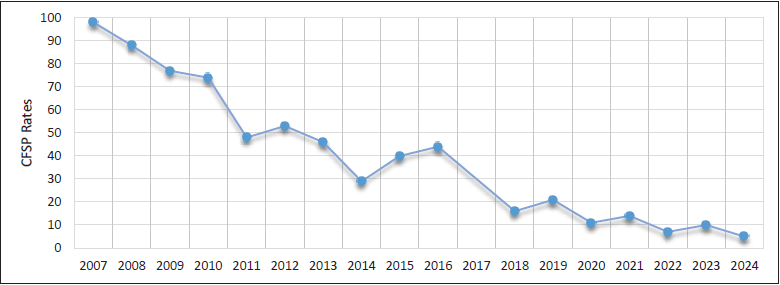
Source: Created by the author with data from the Türkiye Progress Reports (2006-2024).
In 2023, Türkiye’s independent and proactive foreign policy diverged significantly from EU priorities, resulting in a low alignment rate of 10 percent with EU high-representative statements and Council decisions. This trend continued in 2024, with Türkiye’s alignment rate further decreasing to 5 percent as of September 30.44 The EU’s Türkiye 2024 Report highlighted persistent divergences, particularly Türkiye’s lack of alignment with EU sanctions on Russia and its stance on Hamas, which is designated as a terrorist organization by the EU.45 These divergent views and approaches in foreign and security policy have sometimes resulted in tensions between Türkiye and the EU, remaining a significant factor in EU-Türkiye relations.
An evaluation of official statements made by Turkish officials on the progress reports reveals the lack of influence the bloc’s criticism had on Ankara. The Foreign Ministry’s statements, in particular, about CFSP-related topics in the reports confirm this argument. The Ministry pointed out that the bloc had “once again exposed its narrow-minded and biased stance towards Türkiye” and that “the common interests of the EU are sacrificed for the interest of certain member states, nor do they forge a constructive agenda. With this approach, the EU has regrettably once more proved that it cannot properly read the change in the international system.”46 Further statements regarding other reports point out the criticism as “another example of the EU’s lack of strategic vision on Türkiye and global developments.” Likewise, the Turkish officials added: “Türkiye insists on its opposition to the EU approach that links progress in Türkiye-EU relations to the Cyprus issue. It is necessary to abandon an understanding that reduces these multifaceted relations to the Cyprus issue. Such a mentality cannot make a positive and constructive contribution to the problem, nor to the other regional and global issues.”47
To sum up, we have witnessed a de-Europeanization process whereby the EU’s normative, legal, and political impact on Turkish foreign and security policy has diminished since 2010, culminating in its lowest point in 2024. Meanwhile, Türkiye has continued to advance and broaden its bilateral and regional relations with states and organizations in Asia, Africa, and Central/Latin America. BRICS offered Türkiye a partner country status in 2024. This does not, however, imply that Türkiye has abandoned its strategic goal of joining the EU as a full member. On the contrary, Turkish officials consistently expressed their desire to join the EU whenever possible, arguing that new global developments and challenges present an opportunity for both sides to reassess Türkiye-EU relations.
Everlasting candidate status with the lack of a full membership perspective for the foreseeable future triggered the de-Europeanization of Turkish foreign policy and led Türkiye to estrangement from the Europeanization process
Conclusion
The EU is a sui generis organization that has its own set of distinguished features. The EU’s Common Foreign and Security Policy established in 1993 and strengthened by subsequent treaties is among one of these distinguished features of the bloc. Europeanization, which emerged as a new concept in EU studies in the 1990s, is a process of domestic adaptation in the conduct of foreign policy as a result of current and prospective EU membership.48 The driving force behind the Europeanization process of national foreign and security policy in the EU member states stems from the interaction between national and union levels, operating under the principle of voluntarism. Compared to other policy areas that have strong supranational structures, the EU’s ability to influence its member states in the area of foreign and security policy is still much weaker. That is why, the Europeanization of the national foreign policy of the EU member states is not a linear process. When it comes to the Europeanization of the foreign policy of candidate states, it is based on conditionality and a major motivating factor is a credible EU membership perspective. As a result, the Europeanization of the foreign policy of candidate states that are not part of the decision-making process at the EU level is harder than the Europeanization of national foreign policies of the EU member states.
The EU’s invitation to Türkiye for high-level meetings on security and defense along with efforts to rebuild trust through informal talks about Cyprus are noteworthy developments and are the result of a changing world
In the Turkish case, there is no linear Europeanization of Turkish foreign policy. Although the institutional framework was established through the association agreement between Türkiye and the EU in 1963, Türkiye and the EU drifted apart at the end of the Cold War, leaving little room for CFSP alignment between Türkiye and the EU in the 1990s. At that time, Turkish foreign policy based on realpolitik was state-centered, with a focus on military security and power building. It was also skeptical of the EU’s policies and resisted the bloc’s calls for reform and change until 1999 when it was designated as a candidate state for the EU.
When there was a credible EU membership perspective at the beginning of the 2000s, the EU had an impact on Turkish foreign policy, moving the country out of a Hobbesian world towards a Kantian one.49 The reward of EU membership exerted strong pressure for change. Hence, the credible EU membership perspective attained in 1999 not only served to accelerate the reform process in all fields to comply with acquis communitaire in Türkiye but also led to the Europeanization of Turkish foreign policy. Türkiye as a candidate state tried to fit its domestic and foreign policy with the EU. Not only the Europeanization of Turkish foreign policy but also the de-securitization of internal threats led to the most dramatic change in Türkiye’s foreign policy, namely the shift from hard power to soft power.
Despite increasing convergences with the EU foreign policy between 2006-2010, the absence of certainty in EU membership led to a loss of credibility of the EU for Türkiye. The Turkish side lost its motivation to pursue the harmonization and integration process. Other reasons led to the drift of Turkish foreign policy away from the EU, such as the EU 2008 financial crisis, the attractiveness of other economic alternatives and organizations, and growing threats and the necessity to take proactive measures due to conflicts in its neighboring countries. As of 2010 onwards, Türkiye has diverged from the EU path in terms of foreign policy alignment, which has gradually led to the de-Europeanization of Turkish foreign policy. The absence of the need or obligation to attain alignment with the EU reversed the Europeanization process in the Turkish case.
Transactional relations between Türkiye and the EU emerged at that time as a result of the waning prospect of full membership, but transactional relations did not result in any tangible progress in the areas that were intended to be developed. Today, Turkish citizens are encountering an increasing number of challenges in obtaining a Schengen visa, despite the EU’s commitment to liberalizing visas if Türkiye meets the criteria outlined in the refugee deal signed in 2016.50 The EU maintained its discriminatory policies, not allowing Türkiye, a NATO ally and an EU candidate country, the opportunity to participate in EU-led defense initiatives such as PESCO or the European Defense Agency (EDA) despite prior commitments made during the integration of the Western European Union (WEU) into the EU.51 Despite the necessity to modernize and update the customs union between Türkiye and the EU, the EU lacks the motivation to accomplish this objective. Despite all these stagnations in relations, the EU continues its expectations from Türkiye to align itself with the EU’s CFSP. All these indicators reveal the fact that transactional relations between Türkiye and the EU failed to advance relations in areas where cooperation is needed.
The transformation of EU-Türkiye relations from accession negotiations with a credible membership perspective to a transactional relationship reinforced the perception that Türkiye will not be able to become a full member of the EU in the foreseeable future. Everlasting candidate status with the lack of a full membership perspective for the foreseeable future triggered the de-Europeanization of Turkish foreign policy and led Türkiye to estrangement from the Europeanization process. Parallel to the de-Europeanization and renationalization of Turkish foreign policy that led to less or non-alignment with the CFSP of the EU, we have witnessed more active and independent foreign policies aiming to develop and strengthen its relations with the countries of Africa, Asia, and Latin America and other regional organizations such as African Union, the Shanghai Cooperation Organization, BRICS, etc.
The return of geopolitical rivalries and the changing international environment have also changed Turkish foreign policy from “soft power” to “hard power” when necessary. At the same time, with its proactive and independent Turkish foreign policy, it found more opportunities to play a mediator role through relationships it developed with several states and actors in international relations and resolved crises between conflicting parties. Türkiye became the founder of the “Mediation for Peace” initiative with Finland at the UN in 2010 and the “Group of Friends Mediation” at the OSCE in 2014. Türkiye actively worked in recent years for the resolution of many conflicts in the world. The most recent example is the agreement reached in Ankara-mediated peace talks between Somalia and Ethiopia to solve the conflict between the two nations.52
In this changing world, there is an increasing need to reassess priorities and seize every opportunity to revitalize EU-Türkiye relations more than ever. The growing divergence of the U.S. new administration’s foreign and security policy from its trans-Atlantic allies has compelled the EU and the UK to make new decisions and hold new talks on several issues. There are attempts to revive the EU-Türkiye relations focusing on areas that constitute major obstacles in the EU-Türkiye relations, such as the Cyprus issue. In this context, informal talks regarding the island were held in Geneva on March 17-18, 2025. It is early to say that these talks will pave the way for the resumption of formal negotiations and lift the Cyprus blockage on any decision to improve Türkiye-EU relations. Yet, the EU’s invitation to Türkiye for high-level meetings on security and defense along with efforts to rebuild trust through informal talks about Cyprus are noteworthy developments and are the result of a changing world. The most important point is whether these developments will evolve into a strong political will to revive relations that may eventually restart accession negotiations, stimulating a reform process, or will they remain transactional relations without any tangible result?
Today’s reality is that the legal basis of Türkiye-EU relations, namely accession negotiations, is practically blocked. This deadlock paved the way for Türkiye to develop its relations with several regional groupings. Nonetheless, this did not alter the fact that both Türkiye and the EU need one another to address the crises and difficulties more than before. The restart of accession negotiations requires a strong political will and commitment from both the candidate state and member states, which has been absent since 2016. Strong political will also is needed to update and modernize the customs union between Türkiye and the EU. When there were mutual incriminations between Türkiye and the EU in the 1990s, this deadlock was surpassed by the establishment of a customs union between Türkiye and the EU that paved the way for developing their relations on many fields, stimulating a democratic reform process in Türkiye and eventually starting accession negotiations. Today, similar strong political will and commitment from both sides can end the current deadlock. Otherwise, the continuation of the current policy just extends the deadlock without yielding any positive outcomes for either side.
Endnotes
1. Robert Cooper, The Postmodern State and the World Order, (Londra: Demos, 2000).
2. Aylin Ünver Noi, Değişen Dünyada AB ve Türkiye: Strateji Belgeleri Üzerinden bir Değerlendirme, (İstanbul: SETA, 2024).
3. “Speech by Jacques Delors (9 September 1985),” eu, (October 20, 2012), retrieved December 18, 2019 from www.cvce.eu/content/publication/2001/10/19/423d6913-b4e2-4395-9157-fe70b3ca8521/publishable_en.pdf.
4. Andrew Moravcsik, The Choice for Europe: Social Purpose and State Power from Messina to Maastricht, (Ithaca and New York: Cornell University Press, 1998), p. 1.
5. Brian White, Understanding European Foreign Policy, (New York: Palgrave, 2001).
6. İbrahim S. Canbolat, Avrupa Birliği ve Türkiye: Uluslarüstü Sistemle Ortaklık, (Bursa: Alfa, 2011), p. 130.
7. Kevin Featherstone and Claudio M. Radaelli, The Politics of Europeanization, (Oxford: Oxford University Press, 2003).
8. Claudio M. Radelli, “Whither Europeanization? Concept Stretching and Substantive Change,” European Integration Online Papers, Vol. 4, No. 8 (July 2000), retrieved from http://eiop.or.at/eiop/texte/2000-008a.htm.
9. Ben Tonra, “Europeanization,” inKnud Erik Jorgensen, Aasne Kalland Aarstad, Edith Drieskens, Katie Laatikainen, and Ben Tonra (eds.), SAGE Handbook of European Foreign Policy, (London: SAGE Publications, 2015), pp. 183-196.
10. Christopher Hill, “Renationalizing or Regrouping? EU Foreign Policy since 11 September 2001,”Journal of Common Market Studies, Vol. 42, No. 1 (March 2004), pp. 143-163.
11. Patrick Müller, Karolina Pomorska, and Ben Tonra, “The Domestic Challenge to EU Foreign Policy-making: From Europeanization to de-Europeanization?”Journal of European Integration, 43, No. 5 (July 2021), pp. 519-534.
12. Adrian Hyde-Price, “Normative Power Europe: A Realist Critique,”Journal of European Public Policy, Vol. 13, No. 2 (August, 2006), pp. 217-234.
13. Antonio Raimundo, Stelios Stavridis, and Charalambos Tsardanidis, “The Eurozone Crisis’ Impact: A de-Europeanization of Greek and Portuguese Foreign Policies?”Journal of European Integration, Vol. 43, No. 5 (July 2021), pp. 535-550.
14. Michael Smith, “De-Europeanization in European Foreign Policy-making: Assessing an Exploratory Research Agenda,” Journal of European Integration, Vol. 43, No. 5 (July 2021), pp. 637-649.
15. Stefan Lehne, “Making EU Foreign Policy Fit for a Geopolitical World,” Carnegie Europe, (April 14, 2022), retrieved from https://carnegieendowment.org/research/2022/04/making-eu-foreign-policy-fit-for-a-geopolitical-world?lang=en¢er=europe.
16. Ana E. Juncos, Marianna Lovato, and Karolina Pomorska, “Coordinative Europeanization and Russia’s War of Aggression: How Crises Shape Europeanization Dynamics in EU Foreign Policy,” Comparative European Politics, Vol. 23, No. 1 (July 2024).
17. Lehne, “Making EU Foreign Policy Fit for a Geopolitical World,” Carnegie Europe.
18. “Türkiye-Avrupa Birliği İlişkilerinin Tarihçesi,” Avrupa Birliği Başkanlığı, (August 9, 2020), retrieved February 2, 2025, from https://www.ab.gov.tr/p.php?e=111.
19. “Türkiye-Avrupa Birliği İlişkilerinin Tarihçesi,” Avrupa Birliği Başkanlığı.
20. “History of EU-Türkiye Relations,” Republic of Türkiye Ministry Foreign Affairs Directorate for EU Affairs, (August 8, 2024), retrieved February 2, 2025, from https://www.ab.gov.tr/111_en.html.
21. “Enlargement of the European Union,” Republic of Türkiye Ministry Foreign Affairs Directorate for EU Affairs, retrieved from https://www.ab.gov.tr/enlargement_109_en.html.
22. Daniel Hamilton, “The North Atlantic Marketplace,” in Daniel S. Hamilton, Aylin Ünver Noi, and Serdar Altay (eds.), Turkey in the North Atlantic Marketplace, (Washington D.C.: Centre for Transatlantic Relations, 2017).
23. Özlem Terzi, “Europeanization of Foreign Policy and Candidate Countries: A Comparative Study of Greek and Turkish Cases,” Politique Européenne, No. 17 (Fall 2005), pp. 113-136.
24. Yonca Özer and Çigdem Nas, “Introduction,” in Yonca Özer and Çigdem Nas (eds.), Turkey and the European Union: Process of Europeanisation, (Aldershot: Ashgate, 2013), p. 49.
25. Aylin Ünver Noi, “Challenges of Democracy in Turkey,” in Aylin Ünver Noi and Sasha Toperich (eds.), Challenges of Democracy in the European Union and Its Neighbors, (Washington D.C.: Center for Transatlantic Relations, 2016).
26. “Enlargement of the European Union,” Republic of Türkiye Ministry Foreign Affairs Directorate for EU Affairs.
27. Aylin Ünver Noi, Değişen Dünyada AB ve Türkiye: Strateji Belgeleri üzerinden Bir Değerlendirme, (İstanbul: SETA, 2024).
28. “Turkey 2007 Progress Report,” Commission of the European Communities, (2007), retrieved from https://www.ab.gov.tr/files/ab_iliskileri/tur_en_realitons/progress/turkey_progress_report_2007.pdf.
29. “Turkey 2008 Progress Report,” Commission of the European Communities, (November 5, 2008), retrieved from https://www.ab.gov.tr/files/AB_Iliskileri/Tur_En_Realitons/Progress/turkey_progress_report_2008.pdf; “Turkey 2009 Progress Report,” Commission of the European Communities, (October 14, 2009).
30. “Turkey 2010 Progress Report,” European Commission, (November 9, 2010), retrieved from https://eur-lex.europa.eu/LexUriServ/LexUriServ.do?uri=SEC:2010:1327:FIN:EN:PDF.
31. “Turkey 2011 Progress Report,” European Commission, (October 12, 2011), retrieved from https://www.ab.gov.tr/files/ardb/evt/2_turkiye_ab_iliskileri/2_2_adaylik_sureci/2_2_1_duzenli_ilerleme_raporlari/turkiye_ilerleme_rap_2011_eng.pdf.
32. “Turkey 2012 Progress Report,” European Commission, (October 10, 2012), retrieved from https://www.ab.gov.tr/files/tr_rapport_2012_en.pdf.
33. “Turkey 2013 Progress Report,” European Commission, (October 16, 2013), retrieved from https://www.ab.gov.tr/files/2013%20ilerleme%20raporu/tr_rapport_2013_en.pdf.
34. “Turkey 2015 Progress Report,” European Commission, (November 10, 2015), retrieved from https://www.ab.gov.tr/files/5%20Ekim/2015_turkey_report.pdf.
35. “Turkey 2016 Report,” European Commission, (November 9, 2016), retrieved from https://www.ab.gov.tr/files/pub/2016_progress_report_en.pdf.
36. “Turkey 2018 Report,” European Commission, (April 17, 2018), retrieved from https://www.ab.gov.tr/siteimages/kapbtablolar/20180417-turkey-report.pdf.
37. “Turkey 2019 Report,” European Commission, (May 19, 2019), retrieved from https://www.ab.gov.tr/siteimages/resimler/20190529-turkey-report(1).pdf.
38. “Turkey 2020 Report,” European Commission, (October 6, 2020), retrieved from https://www.ab.gov.tr/siteimages/trkiye_raporustrateji_belgesi_2020/turkey_report_2020.pdf.
39. “Turkey 2021 Report,” European Commission, (October 19, 2021), retrieved from https://www.ab.gov.tr/siteimages/birimler/kpb/turkey-report-2021-v2.pdf.
40. “Turkey 2021 Report,” European Commission.
41. “Turkey 2021 Report,” European Commission.
42. “Turkey 2022 Report,” European Commission, (October 12, 2022), retrieved from https://www.ab.gov.tr/siteimages/resimler/Türkiye%20Report%202022%20(1)(2).pdf.
43. “Turkey 2023 Report,” European Commission, (November 8, 2023), retrieved from https://www.ab.gov.tr/siteimages/resimler/Türkiye%20Report%202023.pdf.
44. “Türkiye 2024 Report,” European Commission, (October 30, 2024), retrieved from https://neighbourhood-enlargement.ec.europa.eu/document/download/8010c4db-6ef8-4c85-aa06-814408921c89_en?filename=Türkiye%20Report%202024.pdf.
45. “Türkiye 2024 Report,” European Commission.
46. “Turkey Reacts to Poor EU Marks in Accession Progress Report,” Ekathimerini, (December 14, 2022), retrieved March 12, 2025, from https://www.ekathimerini.com/news/1200236/turkey-reacts-to-poor-eu-marks-in-accession-progress-report/.
47. “No: 63, 18 April 2024, Regarding the Conclusions of the Extraordinary European Council of 17-18 April 2024,” Republic of Türkiye Ministry of Foreign Affairs, retrieved from https://www.mfa.gov.tr/no_-63_-17-18-nisan-2024-tarihli-ab-devlet-ve-hukumet-baskanlari-ozel-zirvesi-sonuclari-hk.en.mfa.
48. Özlem Terzi, “Europeanization of Foreign Policy and Candidate Countries: A Comparative Study of Greek and Turkish Cases,” Politique Européenne, No. 17 (Fall 2005), pp. 113-136.
49. Kemal Kirişçi, “Turkey’s Foreign Policy in Turbulent Times,” Institute of Security Studies-Chaillot Papers, No. 92 (September 2006), p. 103.
50. “Implementation of Türkiye-EU Agreement of 18 March 2016,” Republic of Türkiye Ministry of Foreign Affairs, retrieved from https://www.mfa.gov.tr/implementation-of-turkiye_eu-agreement-of-18-march-2016.en.mfa.
51. “The European Union Common Security and Defence Policy (CSDP) and NATO-EU Strategic Cooperation,” Republic of Türkiye Ministry of Foreign Affairs, retrieved from https://www.mfa.gov.tr/iii_-turkiye_s-views-on-current-nato-issues.en.mfa.
52. Esra Tekin, “Ethiopia, Somalia Reach Agreement Ankara-mediated Peace Talks: Turkish President,” Anadolu Agency, (December 12, 2024), retrieved from https://www.aa.com.tr/en/africa/ethiopia-somalia-reach-agreement-in-ankara-mediated-peace-talks-turkish-president/3422113.
