

Introduction
The Middle East and North Africa, a region predominantly populated by various nations with different faiths, the majority of whom being Muslims, has had a different landscape in political, economic, and social terms since the demise of the Ottoman Empire after the First World War. More than 20 countries were founded, particularly after the British Empire and France withdrew from their mandates in the region. While all states’ populations consist of a Muslim majority, Israel is an exception as it is both ethnically and religiously Jewish. Besides, sectarian fragmentations are conspicuous in Middle Eastern states. Thus, the region is divided into various religious, sectarian, sub-sectarian, ethnic, and ideological fragments, which make it more fragile.
Due to the above complex spectrum, the Middle East has become a domain of conflicts and wars during the post-Ottoman era. One could witness an intra-state civil war or an inter-state war or an intervention by great powers any time in the last 100 years. The world audience witnessed the Israeli occupation of Palestine, the oppression of local people by authoritarian regimes, sectarian contentions between Sunni and Shiite groups, the Arab Spring, the Iraqi invasion by America, the Kuwaiti invasion by Iraq, the Iran-Iraq war, the Qatari blockade, the murder of several authoritarian leaders, the oppression of minorities by the central government, and many other conflicts in the last decades. Few other regions in the world have gone through so many clashes happening at the same time. As for other parts of Ottoman basin, e.g. the Balkans and the Caucasus, the situation was not different from the Middle East, but given that the region is a hub for the biggest hydrocarbon resources and the place of holy cities and temples, conflicts were/are almost always there and open-ended.
The basic reasons, namely oil (worldly) or religion (spiritual), actually cause war almost anywhere in the world, but since the Middle East has more oil reserves and the three heavenly religions were born in the region, conflicts are inevitable there. However, history testifies that the Ottoman State did not allow the aforementioned conflicts. There was indeed peace in Ottoman-controlled regions for centuries. It is said that peace in Palestine was ensured by only a corporal during the Ottoman era. In this vein, this study argues that what causes trouble is basically the absence of Pax Ottomana, which for centuries brought stability to territories where different ethnic and religious groups lived. This study asserts that a great power that can control the region with its economic but particularly military strength can assure peace in the Middle East, provided that some crucial conditions exist. For example, the principal state should be local and have experience in steering, mediating, and even coercing nations. Yet, it should not be colonialist nor an occupier, dreaming of creating a larger state through subduing other states. On the contrary, it should gain the respect of other states, which can trust it and voluntarily accept its leadership. In such a scenario, the principal state is not the absolute decision-maker but only the leader who acts as per the consent of other states.
A great power that can control the region with its economic but particularly military strength can assure peace in the Middle East, provided that some crucial conditions exist
This study also argues that besides its Ottoman backdrop and imperial legacy, Türkiye’s investments in the defense industry, which have started to pay off, may spontaneously help subvention the country to have a more influential role in the former Ottoman basin for regional issues. While the Ottoman Empire exerted its rule with the combination of hard and soft powers and maintained order, Türkiye can also follow the paths of its predecessor with an indigenous defense industry by combining hard and soft powers. It may happen naturally because almost all regional states have existential security problems, which need a strong military. Türkiye can meet the military needs of its friends by supplying them with advanced weapons, which may end up with a new but limited Turkish leadership, culminating in a small-scale Pax Turka. The study does not claim that Pax Turka will prevail in every part of the region, nor does it claim Türkiye will do it by force. Rather, dependency and sometimes direct involvement in conflicts may realize this goal.
If solidified, the small-scale Pax Turka may contribute to ingraining peace in the region; thus, states can enjoy a stable regional system that will positively affect the international system. However, the destabilizer regional states like Israel and non-regional powers’ attitude toward Pax Turka will be the basic factor for the continuation of the entente.
Finally, the uniqueness of this article is that while concerning articles about Turkish foreign policy explain how the Turkish defense industry and military power affect the region, they do not name the output, which this study calls the small-scale Pax Turka. For example, Hakan Fidan, the incumbent Turkish Foreign Minister, says in his related article that one objective of Turkish foreign policy in the “Century of Türkiye” is to establish peace and security in the region and gives examples of conflicts in which Ankara was the peacemaker.1 This article contributes to discussions on the term Pax Turka and tries to strengthen its conceptualization.
Pax Imperia
Human beings have commonly been at war with each other throughout history. There are few periods when people lived in peace and prosperity. In ancient times, peace was defined with the word pax, meaning “a period in history marked by the absence of major wars, usually imposed by a predominant nation.”2 A state of peace was usually ensured by a hegemonic power that suppressed dissident groups. Such peace achieved by a hegemonic power is called pax imperia or pax imperium.3 In this definition, peace can be domestic, regional, or global, and it lasts a long time. Thus, theoretically, there needs to be a superpower that can manage to maintain a state of peace (pax) by its strength.4 According to Huntington, “a superpower has to stand for an idea with appeal beyond its borders.”5 For Brooks and Wohlforth, it is the ability to operate globally.6 On the other hand, Moravcsik argues that a superpower must get involved in security issues such as war and peace.7 Also, Champion and Leung correctly argue that the superpower must afford to cover the expenses of superpowerhood.8 Finally, Shiraev and Gibson add soft power and internal stability as other criteria to be a superpower.9 Among all peace periods, the Roman Empire’s approximately 200-year-long peaceful era between 27 BC and 180 AD is the first and the most prominent one in history. Called Pax Romana, the Roman Empire sustained peace, order, stability, and prosperity not only in Europe but also other areas surrounding the Mediterranean in the mentioned era. There were allegedly no periods without war, which were longer than Pax Romana years. The five Roman emperors ruling vast territories during the period ensured peace through the decentralization of power, military strength, a well-functioning political system, and a renowned justice system called Roman Law. When Roman history is analyzed, it can be inferred that Romans institutionalized their power to benefit from it subtly. Instead of oppressing people, rulers opted for giving their subjects basic rights and freedom so as to remove all excuses for likely rebellions.10
A real global Pax Americana can be alleged only for the period starting from the collapse of the Soviet Union since the U.S. remained as the sole superpower. The world is supposed to be living in American Peace at the moment
In addition to Pax Romana, there are other proposed peace periods mentioned in the literature, such as Pax Britannica, Pax Europaea, Pax Hispanica, Pax Incaica, Pax Khazarica, Pax Mongolica, Pax Sinica, Pax Sovietica, Pax Ottomana, and Pax Americana. Since the United States is the sole superpower (though it is not as powerful as before and may soon lose this title) for the moment, it is worth mentioning Pax Americana as it is the supposed peace period of the current time. Plus, if realized in the region, the limited Pax Turka will be implemented at the same time as global Pax Americana.
The beginning of American peace started when the American Civil War ended in 1865.11 The then Union enforced its rules on states and provided security to them, also culminating in economic growth. While forming today’s United States of America, the American administration created a sphere of influence on the American continent as well. Since the British Empire was happy with American dominance in the Western sphere, an approval that helped Britons to stop European intervention, Washington could also expand its hegemony into the Pacific and Oceania. Following an isolationist foreign policy continuing until the early 20th century, the U.S. became a global hegemonic power after the British Empire and other European great powers, as well as Japan, lost power with the two world wars. However, the U.S. had to share power with the Soviet Union, another superpower of the time, during the Cold War. Therefore, a real global Pax Americana can be alleged only for the period starting from the collapse of the Soviet Union since the U.S. remained as the sole superpower. The world is supposed to be living in American Peace at the moment.12 For this purpose, the structure and expansion of NATO came to the agenda.13
However, to what extent American power enabled a peaceful environment should be questioned. When America began to appear on the world scene, the American continent was not of much interest to European powers. On the contrary, they were withdrawing from South America as a result of independence wars. In addition, the western hemisphere was relatively calmer when compared to the eastern hemisphere, where regions like the Middle East were located. Therefore, establishing Pax Americana in the American continent (and Southeast Asia) was relatively easier. On the other hand, slavery was prevalent in American social life, a policy abandoning the basic rights of millions of people just because of their skin.
Moreover, when America became the most powerful state and began to globalize its ‘peace’ after the Second World War, the Soviet bloc balanced them. Thus, it will not be wrong to say that it was the global balance of power ensuring the pax. However, the post-Cold War period indeed created an environment to show how realistic Pax Americana was. The U.S. could suppress Serbian aggression in Bosnia-Herzegovina and Kosovo in the 1990s, though acting after more than 100.000 people were killed. Yet, at the beginning of the new millennium, it invaded Afghanistan and Iraq, respectively, due to the September 11 attacks. The invasion of Taliban-controlled Afghanistan can be partly justified as it hosted Osama Bin Laden, but Saddam Hussain’s Iraq had nothing to do with the September 11 attacks. What is more, neither pax nor democratia were brought to invaded countries. Hence, what the U.S. was enforcing was not Pax Americana but perhaps Bellum Americana.14 This belligerence has recently been showing its face in Palestine, where Israel has intensified its massacre of the Gazan people with the unlimited support of the U.S. In current circumstances, it is hard to believe that there exists a peaceful world run by the U.S. However, the American administration still deserves some praise as it could stop German and Japanese aggressions permanently after defeating them together with its allies. Both countries have been subdued due to strict American control over them.
As a finding after analysis of the concept of pax, one aspect of Paxs is the use of force. In other words, not carrot but stick is usually used to bring states into line.15 Military operations are frequently conducted to bow heads of dissident states down. Numerous military interventions, coup d’états, and uprisings have been either perpetrated or sponsored by the hegemon to perpetuate its ‘peace.’ It can be argued that the strategy was not to stop war but to make war for peace. Hard power is the most influential tool in the hands of the hegemon. In line with this argument, it can be said that efforts to solidify peace did not lure subject states but forced them to accept the terms of the hegemon. A second aspect is that global peace is almost impossible, as no country can exert its power in all parts of the world due to the multipolar nature of the world.16 It can be said that the world is too big to be controlled by a single state. Perhaps this is why hard power is used as a tool to force states to accept the great power’s terms. This fact also reveals that peace is hardly possible without hard power. Yet, since the use of hard power as the only means to ensure peace creates new problems, peace does not become perpetual and ends when the hegemon weakens.
In fact, the European Union (EU) is a unique example proving that peace is possible with less hard power, at least regionally. Called Pax Europaea, the peace period in Europe started after the Second World War with the formation of the EU. There have been no major conflicts since then. The peaceful environment was not affected by the threat posed by the Soviet bloc, nor was it distorted by the end of the Cold War. Peace was upheld even during the dissolution of Yugoslavia and the Russian invasion of Ukraine in 2022. While the basic reason for such a long and continuing peace was the continent’s exhaustion with wars, the other vital factor was the American control of Europeans via NATO. With the emergence of the transatlantic military alliance, European countries felt safe, none of the states thought of behaving aggressively, and German aggression was put under control.17 In addition, since more unification (from economy to social affairs) boosted economic growth and prosperity, EU member states voluntarily preserved the peaceful status quo and even gave some concessions from their sovereignty.
Is the same success possible in the Middle East under the leadership of Türkiye? Before that, will there ever be Pax Turka? If so, with which means can Türkiye achieve it? As responses to the said questions, this study argues in the next two sections that although the Turkish state is not strong enough economically, its defense industry and partly military-based foreign policy can create a pax in the region. It is not because Türkiye will use force, but regional countries will most probably ask the leadership of Ankara. The next sections discuss why and how this assertion might be possible.
Pax Ottomana
Pax Turka can be deemed the new and contemporary version of Pax Ottomana though there are huge differences. The term Pax Ottomana refers to the peace and tolerance the Ottoman Empire ensured on its territories spreading over the Balkans, the Middle East, North Africa, East Europe, the Caucasus, and Western Iran. The Ottoman administration brought stability to its provinces, where Muslims, non-Muslims, and various ethnic groups lived in peace. The Ottomans applied their unique Millet System, which meant ruling communities according to their religious identity.18 In this system, Christians, Jews, and Muslims were different millets (nations), and they all had exclusive rules. Non-Muslims were called Dhimmis, who were protected on the condition that they pay tax and recognize Ottoman sovereignty.19
Besides faith-based tolerance, Ottomans did not intervene in the private lives of ethnic groups regardless of being Muslim or non-Muslim. In addition to enjoying basic rights, non-Muslims could become members of the parliament and even take positions in the cabinet though starting from late 19th century.20 Many ethnic groups that were once Ottoman subjects were not forced to become Muslims, nor were they prohibited from speaking their native languages. They were also speaking their language. If this was not the case, the Turkish language would be being spoken in remnant countries of the Ottoman Empire. For example, Algerians, Macedonians, Greeks, and other nations do not know Turkish now since it was never made mandatory by the Ottomans.
One should note that nationalist movements that abandoned empires were a product of the French Revolution. Thus, if there were no secessionist uprisings, Pax Ottomana and perhaps the Ottoman Empire itself would still exist
If the very same countries’ colonial period is compared with the Ottoman era, the difference can be well comprehended. For instance, some countries, such as Algeria, Tunisia, and Egypt, were under Ottoman, British, and French rule before gaining their independence. While the populations of said countries speak French or English neatly since colonial languages were official languages even after the colonial period, they do not speak Turkish as Turks did not force them to speak their language. It was this Ottoman-granted freedom that did not provoke them to rebel against the Ottoman administration until the 19th century. One should note that nationalist movements that abandoned empires were a product of the French Revolution. Thus, if there were no secessionist uprisings, Pax Ottomana and perhaps the Ottoman Empire itself would still exist.
Moreover, Pax Ottomana had enabled the superpower to form its international system, where it was the sole decision maker. During that time, in the 15th, 16th, and 17th centuries, the Ottomans upheld peace domestically and in territories surrounding the Empire. It is undeniable that the Ottoman military strength was the decisive factor for the Ottoman peace, but there would hardly be revolts internationally, even if it was relatively weaker, as, at least until the beginning of national movements, millets had already had basic rights.
Pax Turka
Although Pax Turka is a to-be-realized peace atmosphere, and it is difficult to draw a pattern for it, this research argues that, though partly, it is still prone to being concrete in the upcoming years. Above all, Pax Turka is different from others since it is in the making. The debate here is whether it can ever be completed and functions as claimed. This study asserts that it is likely that it may eventually be materialized by not only Türkiye but also Türkiye’s friends, particularly those in close proximity and the Middle East.
Before all, it should be noted that Türkiye is neither a superpower nor a great power. It has the 17th biggest economy with 2023 statistics and a population of 85 million.21 It is quite active in its foreign policy and generally acts independently in the region. Such specifications make it a middle power, whose features this study argues as a considerable population of over 50 million, self-reliant in military terms, and an economy having a rank in the top 10 in GDP (PPP) terms.
However, it can be argued that Türkiye can still act like a great power because its historical friends located in the Balkans, Middle East and North Africa, and the Caucasus need a strong leader among themselves, and Türkiye is the biggest country in this basin with leadership skills inherited mainly from the Ottoman Empire. States in the mentioned regions align with great powers not because their interests overlap but because the latter provides security to them. More broadly, while Central Asian Turkic countries were under the rule of Russia in the 20th century, Balkan countries were victims of their smallness. Regarding the Middle East, what pushes them towards Western states is not like-mindedness but vulnerability against external threats. It is hard to claim that small Gulf states such as Saudi Arabia, Egypt, or North African countries are happy to ally with the U.S., European states, or Russia. The never ending Palestinian issue can be an example to tasteless relations. The U.S., instead of finding a permanent solution to the conflict, relentlessly and unconditionally supports Israel’s occupation, which continuously humiliates Arab states. Thus, it is hard to say that Pax Americana functions well in the Middle East.
Türkiye is not a great power with a developed economy, but what regional states are looking for is not a rich but a militarily strong country, preferably from the region, like-minded, having a common history, traditions, and morale
As admitted above, Türkiye is not a great power with a developed economy, but what regional states are looking for is not a rich but a militarily strong country, preferably from the region, like-minded, having a common history, traditions, morale, and so on. Based on this argument, which complies with Waltz’s structural realism,22 it can be said that the missing part is an advanced military industry (and strength), which Türkiye is struggling for.
Meanwhile, this study roots Türkiye’s likely pax on liberal theory of dependence and use of hard power. It argues that where there is dependence on Turkish weapons or Turkish military involvement, a Turkish peace is more likely. In addition, factors such as friendship and cultural proximity make the landscape more fertile for the Turkish pax. The last section below gives concrete examples of the argument.
Türkiye’s Struggle for Indigenous Weapons Production
The Turkish military has been dependent on imported weapons since the proclamation of the republic in 1923. There were attempts to indigenize the defense industry in the early decades of modern Türkiye, but they all failed. Reliance on foreign arms, particularly those of the U.S., increased after becoming a NATO member in 1952.23 How dependence was harmful to state security was understood after Türkiye’s military intervention on Cyprus Island in 1974.24 The U.S. sanctioned Türkiye for the military operation, which culminated in a shortage of spare parts and new weapons. While Türkiye desperately looked for weapons from other allies, it also began to establish defense companies such as ASELSAN, ASPILSAN, ROKETSAN, and TUSAŞ. The attempt indeed worked well, as dependence was lessened. TUSAŞ even began to assemble F-16s and produce General Electric’s engines in the early 1980s. However, the fact that the majority of weapons were being imported did not change until recent years. For example, the percentage of locally made parts and weapons was 20 percent in 2002 while this ratio rose to 75 percent in 2021.25
The decision to nationalize arms production was taken in the early 2000s, at a time when the Turkish army was fighting terrorism and trying to take measures against America’s invasion of Iraq. Meanwhile, while state-owned and private companies were given subsidies to develop domestic weapons, the Turkish government continued to import advanced weapons as the struggle with terrorism required new weapons and munitions. The government also tried to have an independent foreign policy in the same years. However, the more Türkiye pursued an independent foreign policy, the more it faced undeclared sanctions from its allies.
Sanctions did not deter Türkiye but just provoked Turkish officials to further focus on indigenous production. Hence, Turkish defense companies were given funds for research and development (R&D) and production
According to open news sources, Ankara was first disturbed when America refused to sell armed drones.26 Also, it was later revealed that Israel began to lobby for non-sale of F-35s to Türkiye from 2010 onwards.27 In 2013, when Americans put forward unrealizable conditions for the sale of Patriot missiles, Türkiye decided to buy surface-to-air missiles (SAMs) from China, though it did not buy later and turned to Russia for S-400 missiles. As a result, Türkiye was removed from the F-35 joint production program in 2018. On the other hand, components needed for local production of weapons were not sold to Türkiye. For example, Germany did not sell engines to be installed on its indigenous tank Altay, while Canada stopped selling cameras for Türkiye-made armed drones. As a result, Türkiye faced intensive sanctions in terms of weapons and their spare parts, which halted local production and put Türkiye’s security in danger.
However, sanctions did not deter Türkiye but just provoked Turkish officials to further focus on indigenous production. Hence, Turkish defense companies were given funds for research and development (R&D) and production. The fruits of nationalization began to be collected from 2013 onwards with the flight of Anka UAV in 2013, while Bayraktar TB2 UAV followed in 2014. The infantry rifle MPT-76 was put into inventory in the same year. Then came ATAK helicopters, Hisar class surface-to-air missiles, corvettes and frigates, MANPADS, anti-tank launchers and missiles, armored vehicles, and so on.28 It can be seen that except for the helicopter whose engine is of American origin, the weapons mentioned are relatively easier to produce as they need smaller engines and other components. However, Turkish companies gradually enlarged the size and range of weapons over time. For example, Siper-1 surface-to-air missile with a 100 km range, TCG Anadolu LHD ship, Hürkuş light attack jet, sea-to-sea Atmaca, and air-to-ground SOM missiles have begun to be produced or ready for production in 2023. Moreover, Siper-2 SAM with a 150 km range, Tayfun (+500 km range) and Cenk (+1000 km range) ground-to-ground missiles, Hürjet trainer jet, AKYA torpedo, Gökdoğan and Bozdoğan air-to-air missiles, and so many other weapons were unveiled for the first time in 2022 and 2023. Furthermore, drone producers, namely TUSAŞ and Baykar Group, have started to test their jet-powered UCAVs.
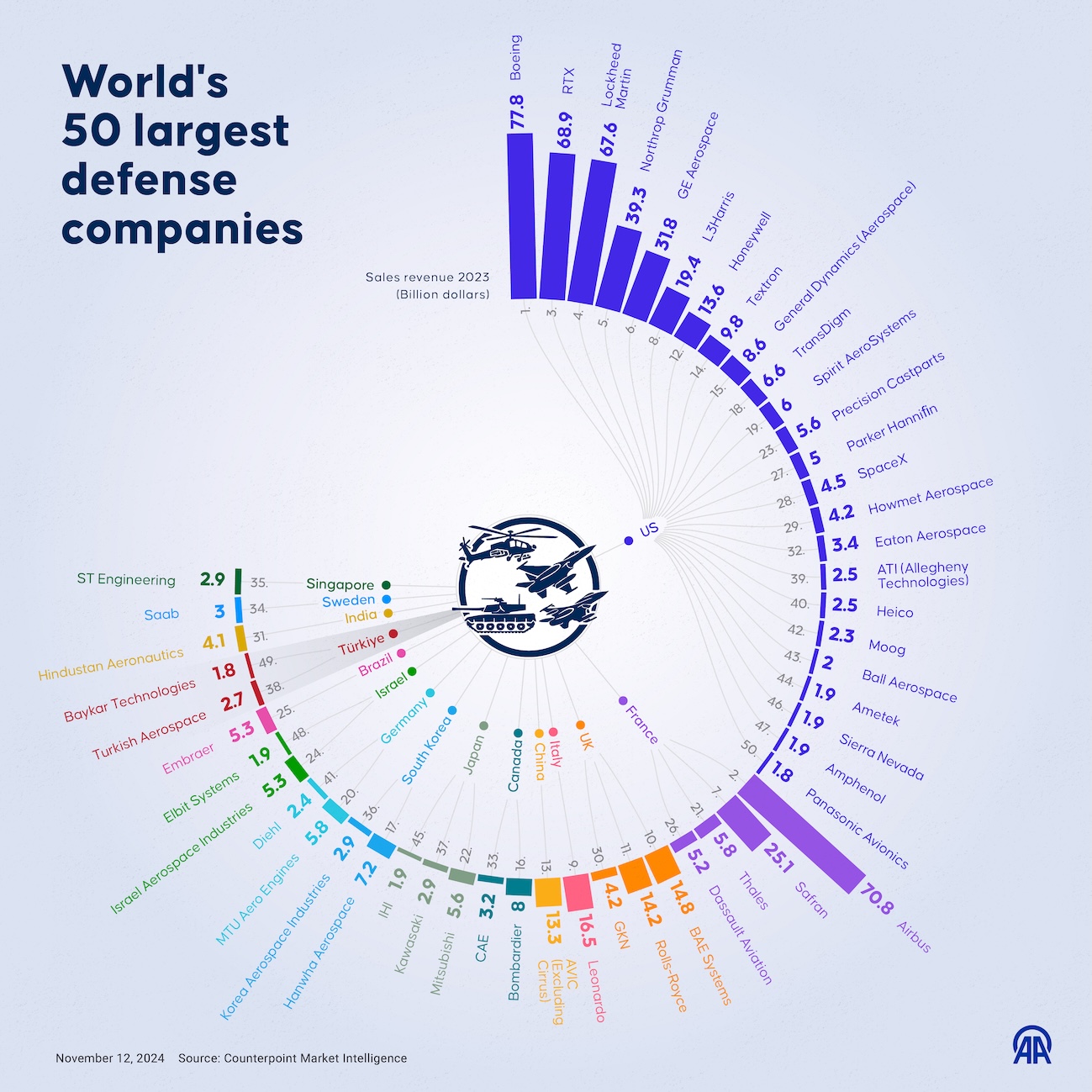
Türkiye’s national aerospace manufacturers, Turkish Aerospace Industries (TUSAŞ) and Baykar, ranked among the world’s 50 largest aerospace companies. AA
It can be seen that Türkiye produced all mid-size and mid-range advanced weapons by the end of 2023. The turn is now for most advanced weapons whose production takes time and requires more know-how and funding. A few of these weapons are in the testing process in 2024. For example, the Altay indigenous tank will be in inventory with a Korean engine in 2025 as its locally-made 1500 HP engine is still being tested.29 Regarding air forces, the 5th generation KAAN jet fighter made its maiden flight in February 2024. An indigenous engine for KAAN is under development by TEI, TUSAŞ’s subsidiary producing engines. The plan is to get KAAN flown with an indigenous engine in 2028. Finally, an aircraft carrier with a 285-meter length is in the design process.
Türkiye earned $5.5 billion from defense exports in 2023, growing 25 folds within 20 years, and it will earn more each year as new weapons will be mass-produced. Since new weapons are expensive in value, the increase in exports will be exponential. For example, while a Bayraktar TB2 UCAV’s price is around $5 million, a Hürjet trainer jet is $25 million or over, and a KAAN fighter is approximately $100 million.30 This means that a single KAAN will generate the same revenue as 20 units of Bayraktar TB2 UCAVs. Moreover, several Turkish companies have been listed in top 100 defense companies continuously in recent years.
How May the Turkish Defense Industry and Military Involvement Achieve the Small-Scale Pax Turka in the Region?
As the above brief explanation about the Turkish defense industry indicates, Türkiye produces almost any kind of weapons except for the biggest and most advanced ones. However, this study claims that their production is not a matter of “if” but “when.” If there may be no postponements for mass production dates, Türkiye will be producing fighters, mid-range ballistic missiles (MRBM), main battle tanks (MBT), and larger size aircraft carriers by 2030. Except for likely delays, there is almost no doubt about their production, as the most difficult phases have been successfully achieved.
This research asserts that Pax Turka partly exists and is expected to be (more) effective when Turkish defense companies can produce all variants of weapons, literally from 2030 onwards. The expectation is that friendly countries will choose Turkish weapons for two reasons. First, friendship is the basic reason. In addition to the fact that Arab states were founded on former Ottoman provinces, making them have a common history, they are also Muslim and have similar traditions. Also, threats they incur, such as Israel’s occupation of Palestine, Iran’s expansive foreign policy based on Shiite theology, and the foreign intervention of great powers, are the same. As for the Balkans, again, the historical backdrop and/or Islamic faith connect Türkiye and Balkan countries, literally former Yugoslavian states and Albania. Regarding Central Asia, Turkic origins and Islam unite Türkiye and countries in the region. There has been an apparent solidarity and co-action between Turkic countries in recent years, which led to a boost in activities of the Organization of Turkic States (OTS). In addition to the mentioned countries, those countries in the global south have already turned to Türkiye for weapons procurement. Many countries from Africa, South America, and Southeast Asia have already bought Turkish weapons or given orders.31
As Türkiye is the producer country, it will have an upper hand in customer states. The power generated from the production of weapons will enable Türkiye to pursue a more active foreign policy that may halt intransigence and conflicts
Second, the relationship between the underdeveloped world and the developed world is asymmetric and in favor of the latter. There is a general acceptance that from the U.S. to the EU, the Western hemisphere’s approach to the rest of the world is orientalist, biased, and arrogant, most probably because of colonial periods.32 The West’s attitude sometimes surfaces in some instances. For example, western powers unconditionally support Israel, put pressure on non-liberal states, and are usually prejudiced against Muslim countries. Therefore, relations between two sides are not based on like-mindedness, ideology, ethnicity, or common interests but because of the necessity of acquiring Western technology, including weapons. Since procuring Western weapons and getting their support are costly, conditional, and difficult, an alternative country or bloc is/will be naturally preferable. As Türkiye is very assertive in replacing western weapons producers, they will most probably favor Turkish arms because of above-mentioned commonalities.
This study assumes that since third-world countries and Türkiye’s friends will be customers of Turkish weapons, there will be dependence on the Turkish defense industry. Similar to the liberalist approach that economic dependence prevents wars, arms dependence on Türkiye may bring tranquility to surrounding regions, though not in an absolute manner. Thus, Pax Turka can be achieved because, first, Türkiye is characteristically in the same class with its neighbors in many aspects. Although it is a member of NATO and a candidate for EU membership, the West did not digest it because of its culture, religion, historical contentions, etc. For this reason, some practical requirements of its sovereignty and independence were not respected by its allies.33 When looked at from the West, Turks are generally not seen as so different from Arabs, Latinos, or Asians. It is not surprising that third-world countries have started to prefer Türkiye to buy their military equipment. Second, due to common values, the Turkish government will not probably exert sanctions, whether declared or undeclared, nor will it put forward stipulations for sales. It is like how Americans sell almost all kinds of weapons to their allies in America, Oceania, Asia, and Europe because of Judeo-Christian culture, political similarities, or ethnic proximity. Third, another compelling reason is that while Türkiye needs a market for its weapons, its friends need advanced weapons. In other words, both sides need each other.
Finally, as Türkiye is the producer country, it will have an upper hand in customer states. The power generated from the production of weapons will enable Türkiye to pursue a more active foreign policy that may halt intransigence and conflicts. It may also use its hard power to stop wars or be a side in wars, as it did in recent years. When Türkiye gets involved in a conflict through mediation or combat, it will influence the course by finding a permanent solution either by force or diplomacy or perhaps jeopardize the status of the conflict. However, the expectation is to ensure peace.
How Realistic Is Pax Turka
One can ask how Türkiye will enforce its terms in regions where conflicts have deep roots and are continuous. The implementation is twofold. First, military power strengthens the state’s diplomacy as well.34 For example, one reason that Türkiye mended relations with Saudi Arabia and the UAE (and perhaps Egypt) is the advanced weapons produced by the Turkish defense industry. Turkish companies have signed deals with their counterparts for coproduction, a move that may persist in good diplomatic relations. According to news reports, only Baykar Group made a $3.1 billion deal with Saudi Arabia in order to produce drones locally.35 Besides, the UAE also signed billions of dollars worth of deals with Turkish companies. Egypt will reportedly buy Turkish drones as well. Local production further increases dependency as it makes the host country more dependent on the technology-sharing country. In line with the liberal approach, it can be argued that dependency on Turkish weapons might help inter-state relations between aforementioned countries to further improve.
It should be noted that the U.S. does not allow Middle Eastern countries to have military superiority over Israel. For example, the Washington administration did not sell F-35s to the UAE for that reason. On the other hand, no restriction is expected on the sale of Turkish KAAN jets to the said countries. Perhaps it may be difficult to prove but given that Egypt and the UAE no longer counter Türkiye in Libya, one can think that one reason might be the above-mentioned defense cooperation.
As for the second aspect, the Turkish state also used hard power in Libya, Syria, and Karabakh, where it changed the course of the war in favor of the party it supported, particularly by its advanced UCAVs. Besides victory and the end of long-lasting clashes, parties now negotiate to meet on a common point. Military-backed Turkish foreign policy was decisive during the blockade of Qatar as well. Sending a military brigade and the basic needs of people to Qatar not only made the blockade inefficient but also deterred blockading countries, namely Saudi Arabia, the UAE, Bahrain, and Egypt, from attacking Qatar. Perhaps there were other actors and factors for the failure of the blockade, but Türkiye’s role cannot be underestimated. Besides deploying soldiers, the Turkish army had sold and sent its locally made armored vehicles, UCAVs, and warships. In case a friendly country asks for help, Türkiye has more weapons to send, though not any kind for the moment.
It is correct that Türkiye’s support of Qatar caused hostility with the blockading countries. However, what the Turkish government did during the blockade was not only to protect a friend but also to prevent other friends from making a vital mistake. In other words, it did not safeguard Qatar from thug states but friends. Perhaps this is why the blockaders mended relations with both Qatar and Türkiye quickly.
Regarding Syria, Türkiye’s relentless support to opposition groups ended up with overthrow of the Assad regime. Based on the above hypothesis, it will be surprising to see the Assad regime retake Syrian territories from opposition groups. On the other hand, Armenia will probably hesitate to reoccupy the Karabakh region of Azerbaijan. Iran’s aggression towards Azerbaijan will probably lessen. The siege of Tripoli by armed groups does not look possible. Arab states, after obtaining more advanced Turkish weapons, will avoid confronting each other. Somalia will likely enjoy stability after a long time. Given that Türkiye is currently mediating between Somalia and Ethiopia, the goal to achieve good relations between the two hostile countries might soon be accomplished. Greece will probably avoid opting to fight Türkiye and prefer to solve its problems through diplomacy since, as they admit, the balance of power between the two countries has changed in favor of Türkiye.
More concretely, Türkiye has ensured peace in the territories of Armenia, Azerbaijan, Somalia, Libya, Northwest Syria, and Qatar whether partially or entirely. Time will show how permanent the Türkiye-led peace is, but what the Turkish state has contributed to the stability of the mentioned countries cannot be underestimated. Besides, success in fighting terrorism on Turkish, Iraqi, and Syrian lands and impeding Greek aggression in the Aegean Sea are additional impacts of the Turkish defense industry.36 Overall, no war is expected in a total of approximately 4 million km2 of area, thanks to the Turkish army and its defense industry.
The scope of the peace is not big, but saving even a single human life is a success, and Türkiye should be credited for it
In addition, stopping wars means fewer deaths and displacements. Given that the number of deaths has plunged in countries where Türkiye intervened, it will not be wrong to say that a Turkish peace is effective. The scope of the peace is not big, but saving even a single human life is a success, and Türkiye should be credited for it. This study admits that the above argument is not absolute but still has a high probability. On the other hand, the study is very assertive about Türkiye’s being a producer of the most advanced weapons and its perceivable positive impact. A Turkish proverb says coercion or resistance distorts the game. This study argues that coercion through a wide range of weapons ensures peace, and in the context of Türkiye, it may create a peaceful environment called Pax Turka, though a small scale in size.
Conclusion
This study argues that a small-scale Pax Turka, which refers to a peaceful environment particularly in regions where the Ottoman Empire was the hegemon for six centuries, is not out of the question. It asserts that Türkiye can enforce a limited Pax Turka because it produces mid-range and mid-size advanced weapons while also testing the most sophisticated weapons simultaneously. It estimates that Türkiye will be producing all variants of weapons that an army needs by 2030, a date from when Ankara can exert a larger scale Pax Turka as it has already achieved to uphold peace in conflicts such as Karabakh, Libya, Qatar, and partly Syria through its existing indigenous weapons.
The more Türkiye supplies advanced weapons, the more customers might be in solidarity and cooperation with the vendor, namely Türkiye
The hypothesis this study proposes is that Turkish defense products can ensure peace in some parts of its vicinity like economic dependence does, as liberalists theorize. The more Türkiye supplies advanced weapons, the more customers might be in solidarity and cooperation with the vendor, namely Türkiye. In such a scenario, provided that Türkiye acts fairly, buyers of Turkish weapons will be more eager to listen to the Turkish government’s advice and hesitate to create problems in their region.
The study does not deny that there might be obstacles distorting the Turkish peace. However, given that Türkiye already assured entente in some conflicts, this research suggests that a stronger Turkish defense industry may do more. The analysis does not ignore that Türkiye’s fair foreign policy and the attitude of other actors will also be decisive in the realization of Pax Turka.
Endnotes
1. Hakan Fidan, “Turkish Foreign Policy at the Turn of the ‘Century of Türkiye’: Challenges, Vision, Objectives, and Transformation,” Insight Turkey, Vol. 25, No. 3 (June 2023), pp. 11-25.
2. “Pax,” com, retrieved February 12, 2024, from https://www.dictionary.com/browse/pax.
3. Stephen Ross, Conrad and Empire, (Missouri: University of Missouri Press, 2004), p. 76.
4. Robert O. Keohane, “The Theory of Hegemonic Stability and Changes in International Economic Regimes, 1967-1977,” in Ole R. Holsti (ed.), Change in the International System, (New York: Routledge, 1980), pp. 131-162.
5. Samuel Huntington, “The U.S.: Decline or Renewal?” Foreign Affairs, Vol. 67, No. 2 (1988), pp. 76-96.
6. Stephen Brooks and William Wohlforth, “The Once and Future Superpower: Why China Won’t Overtake the United States,” Foreign Affairs, 95, No. 3 (May/June 2016), pp. 91-104.
7. Andrew Moravcsik, “Make Way for the Quiet Superpower,” Newsweek, (December 22, 2007), retrieved July 7, 2024, from https://www.newsweek.com/make-way-quiet-superpower-95069.
8. Mark Champion and Adrian Leung, “Does China Have What It Takes to Be a Superpower?” Bloomberg, (August 30, 2018), retrieved July 6, 2024, from https://www.bloomberg.com/graphics/2018-china-superpower/.
9. Dennis Shiraev and Grant Gibson, “The Case for America’s Continued Superpower Status,” Cornell International Affairs Review, Vol. 2, No. 2 (2009).
10. Brent D. Shaw, “The Roman Revolution: The Pax Romana,” Klio, Vol. 105, No. 1 (2023), pp. 173-206.
11. Frederick Jackson Turner, “Significance of the Frontier,” Sage History, (June 29, 2009), retrieved January 17, 2024, from http://sagehistory.net/gildedage/documents/TurnerFT.html.
12. Paul J. Burton, “Pax Romana/Pax Americana: Views of the “New Rome” from “Old Europe,” 2000-2010,” International Journal of the Classical Tradition, Vol. 20, No. 1-2 (June 2013), pp. 15-40.
13. Recep Şehitoğlu, “NATO’nun Gelecek Sorunsalı: Transatlantik İlişkiler ve Türkiye,” in Suat Dönmez (ed.), Uluslararası Sistem, Konjonktürel Değişim ve Güvenlik Trendleri, (İstanbul: Akademi Titiz Yayınları, 2023), p. 235.
14. The term here refers to America’s continious fighting across the globe for its foreign ends.
15. Hadewych Hazelzet, “Carrots or Sticks? EU and U.S. Reactions to Human Rights Violations (1989-2000),” unpublished Ph.D. thesis, European University Institute, 2001, p. 3.
16. Megan Dee, The European Union in a Multipolar World: World Trade, Global Governance and the Case of the WTO, (Basingstoke: Palgrave Macmillan, 2015), p. 2.
17. Recep Şehitoğlu, “NATO’nun Gelecek Sorunsalı,” pp. 230-231; Erman Akıllı and Onur Balcı, “NATO Gölgesinde AB-Türkiye İlişkilerinin Güvenlik Boyutu,” in Önder Aytaç Afşar and Kürşat Kan (eds.), Avrupa Güvenliği: Tarihsel, Teorik ve Pratik Yönleriyle Avrupa Birliği ve Bölge Güvenliği, (Ankara: ORİON Kitabevi, 2022), pp. 89-119.
18. Fatih Arslan, “Pax Ottomanica: Philosophical Background of the Millet System,” Yakın Doğu Üniversitesi İslam Tetkikleri Merkezi Dergisi, Vol. 4, No. 1 (2018), pp. 109-128.
19. “What Is the Meaning of Pax Ottoman?” Osmanlı Araştırmaları Vakfı, retrieved March 2, 2024, from https://osmanli.org.tr/what-is-the-meaning-of-pax-ottoman/.
20. Feroz Ahmad A. Rustow, “İkinci Meşrutiyet Döneminde Meclisler: 1908-1918,” Güneydoğu Avrupa Araştırmaları Dergisi, No. 4-5 (1976), pp. 245-284.
21. “Dünya Bankası Türkiye,” World Bank Group, (October 25, 2024), retrieved December 20, 2024 from https://www.worldbank.org/tr/country/turkey/overview.
22. Kenneth N. Waltz, “Theory of International Politics,” (California: Addison Wesley, 1979).
23. Recep Cengiz, “NATO’ya Giriş Sürecinde Türk Amerikan İlişkileri ve Amerikan Askeri Yardımlarının Türk Silahlı Kuvvetlerine Etkisi,” unpublished Ph.D. thesis, Ankara University, 2009, p. 182.
24. Mustafa Atatorun, “Turkey’s Defence Industry Policy in Security Perspective: Defeating the National Security Dilemma,” in İbrahim Karataş (ed.), Turkey’s Security: New Threats, Indigenous Solutions and Overseas Stretch, (Ankara: Nobel, 2021), pp. 31-59.
25. “Savunma Sanayiinde Kritik Eşik: Yerlilik Oranı Ne Kadar Oldu?” CNN Türk, (December 2, 2022), retrieved March 4, 2024, from https://www.cnnturk.com/turkiye/savunma-sanayiinde-kritik-esik-yerlilik-orani-ne-kadar-oldu.
26. Umar Farooq, “How Turkey Defied the U.S. and Became a Killer Drone Power,” The Intercept, (May 14, 2019), retrieved February 8, 2024, from https://theintercept.com/2019/05/14/turkey-second-drone-age/.
27. Toi Staff, “Israel Reportedly Lobbied Washington to Drop Turkey from F-35 Program,” The Times of Israel, (August 1, 2019), retrieved March 5, 2024 from https://www.timesofisrael.com/israel-reportedly-lobbied-washington-to-drop-turkey-from-f-35-program/.
28. “Ordumuz Modern ve Milli Silahlarla Güçleniyor,” Milli Savunma, (March 5, 2024), retrieved March 5, 2024, from https://www.millisavunma.com/news/ordumuz-modern-ve-milli-silahlarla-gucleniyor/.
29. “Altay Tankı için Güney Kore’den 85 Motor,” Savunma Sanayi ST, (November 17, 2023), retrieved March 7, 2024, from https://www.savunmasanayist.com/altay-tanki-icin-guney-koreden-85-motor/.
30. Osman Erbil, “Milli Muharip Uçak Kaan’ın Fiyatı Belli Oldu,” Aydınlık, (May 8, 2023), retrieved March 6, 2024, from https://www.aydinlik.com.tr/haber/milli-muharip-ucak-kaanin-fiyati-belli-oldu-387145.
31. Paul Melly, “Afrika Ülkelerinin Türk Bayraktar İHA’larına İlgisi Neden Arttı?” BBC, (August 25, 2022), retrieved January 23, 2024, from https://www.bbc.com/turkce/articles/c3g06p0k46go.
32. Edward W. Said, Orientalism, (London: Penguin Books, 2019).
33. Mustafa Atatorun, “Türkiye-NATO İlişkilerinin Ahlaki Zeminini Kurmak,” Elektronik Sosyal Bilimler Dergisi, Vol. 22, No. 85 (2023), pp. 274-291.
34. Amy Ebitz, “The Use of Military Diplomacy in Great Power Competition,” Brookings, (February 12, 2019), retrieved January 17, 2024 from https://www.brookings.edu/articles/the-use-of-military-diplomacy-in-great-power-competition/.
35. Arda Çelik, “Suudi Arabistan’a Akıncı İhracatının Faturası Belli Oldu,” Savunma Sanayi ST, (July 25, 2023), retrieved July 17, 2024, from https://www.savunmasanayist.com/suudi-arabistana-akinci-ihracatinin-faturasi-belli-oldu/.
36. İbrahim Karataş, “The Role of Apocalyptic Prophecies in ISIS Terrorism,” Journal of College of Sharia and Islamic Studies, Vol. 39, No. 1 (2021), pp. 193-212.
