

Introduction
Numerous studies1 conducted in the ten years after 9/11 have proven that Islamophobia –a term used to describe prejudice2 toward Muslims– has become a frequent element in many countries. As a result, Muslims have been demonized3 and exposed to prejudice in many ways.4 Although the involvement of far-right organizations and sensationalist media in spreading Islamophobia has received a lot of attention, mainstream politicians have also contributed to the spread of Islamophobia.5 Scholarly research6 has demonstrated that Islamophobia, anti-Muslim racism, and stereotypes of Muslims as undesirable have been strengthened by neoliberalism in various settings, especially in the West.7 Not much is spoken about the additional effects of neoliberal ideology on how Muslim (immigrant) groups are perceived8 and (dis)integrated into environments where they are a minority.9
In the flashback, French Orientalist Etienne Dinet’s 1922 article is where the term “Islamophobia” first appeared.10 Following that, it became widely used in the 1990s to characterize prejudice toward Muslims residing in the West.11 For instance, in a 1994 study titled A Very Light Sleeper: The Persistence and Dangers of Anti-Semitism, released by Runnymede Trust,12 the first non-Muslim British confessor of Islamophobia was made.13 The phrase “Islamophobia” has been used increasingly often in the years that have followed.
Islamophobia is a real phenomenon in society,14 it is not just a theory. Muslims face a wide range of discriminatory practices worldwide, including acts of violence, word-based discrimination, and discriminatory regulations.15 The French government officially outlawed the wearing of niqabs in 2011.16 Francois Fillon, the Prime Minister of France at the time, issued a decree forbidding women from wearing headscarves in public places.17 Niqab prohibitions aside, instances of Islamophobia have even resulted in fatalities.18 The fatal shooting of three Muslim boys in Chapel Hill, California, in 2015 stunned the public.19 Muslims were once again taken aback when they learned of the massacres that occurred in two mosques in New Zealand two years later.20 In this tragic event, at least 50 people who were praying there lost their lives.21 There is a viewpoint that claims Orientalist researchers’ research is the root cause of Islamophobia.22 Instead, Orientalists employ a Western viewpoint that is motivated by a missionary mindset while studying Islam.23 This viewpoint leads to inaccurate research into Islam itself, creating the impression that Orientalist studies are the source of Islamophobia.24
According to a different viewpoint,25 the commercialization of hatred against Islam is the catalyst for the emergence of Islamophobia. The profit-driven commercialization of Islam is derived from a dislike of it.26 Western newspapers,27 news networks,28 and internet sources are instances of how commercialization exists.29 These media outlets disseminate hateful content about Islam in an effort to encourage the growth of Islamophobia.30 Islam is perceived by neoliberals as a grave threat.31 The precepts of Islam impede their ability to stay in power. As a result, neoliberals utilize phrases like “good Muslims”32 and “bad Muslims”33 to create a dichotomy against Muslims. The “nice Muslim” image paints a picture of a society that is compliant with many neoliberal narratives.34 In the meantime, the epithet “bad Muslim” denotes a lack of objectivity regarding neoliberalism. As a result, there is a bad connotation that incites hostility. This tendency ends up being the cause of the rise of Islamophobia. This study seeks to critically analyze, characterize, and explain Islamophobia in connection to the above definition, as well as how it is related to neoliberalism. The term “Islamophobia” refers to a strong dislike or bias toward Muslims, a deep fear or hate of Islam, especially as a political force, and the study of how and to what degree the media propagates. There will be sufficient presentation of additional elements that collaborate with neoliberalism to foster the expansion and development of Islamophobia. However, this research also presents how Muslims express their opinions in response to the increasingly important topic of Islamophobia.
Islamophobia Occurrence
The anti-Islamic rhetoric, which propagates the idea that Islam is violent,35 corrupt,36 dishonest,37 despotic,38 and perverted, has grown exponentially in Western Europe in recent years.39 As a result, Muslims are portrayed as radicalized,40 fanatical, primitive, archaic, and uncivilized.41 Consequently, there has been violence, prejudice, monitoring, and public profiling against the Muslim community both domestically42 and as immigrants, especially seen in the quickly spreading trends in the U.S. and the UK.43 The antipathy of the West toward Islam and Muslims is not a recent phenomenon,44 rather, its roots can be found in the Middle Ages.45 There are numerous examples and indications that the Crusades and Europe’s imperialist endeavors were significant historical crossroads between the West and Islam, encounters that resulted in exaggerated stereotypes and caricatures of a violent Islam.46
Neoliberals utilize phrases like “good Muslims” and “bad Muslims” to create a dichotomy against Muslims. The “nice Muslim” image paints a picture of a society that is compliant with many neoliberal narratives
According to Beydoun,47 Islamophobia is a master narrative that portrays Islam as the antithesis of Western culture. Latif 48 contends that the word “Islamophobia” came from the Crusades, which were religious wars fought by the Christian Latin Church in the 11th and 13th centuries against the Muslim world. Said49 draws a parallel between this speech and the defensive responses of Christian Orientals who were duped by the newly founded Islamic caliphate; however, Iqbal50 claims that it all began in 1312 when the Council of Vienna agreed to grant seats in European institutions to speakers of Oriental languages. This reminds us of the circumstances in the early 7th century, when Islam unexpectedly spread around the world, threatening European dominance, shifting the balance of power, overthrowing established empires, and creating new international standards.51 Not only did the early Muslims jeopardize the pre-Islamic Christian narrative of Christianity being declared a state religion in North Africa, Spain, and the Levant, but they also endangered their standing in the newly emerging world.52
On the other hand, Yaseen Gada53 argues that Islamophobia occurred with Pope Urban’s Crusade in 1095, which signaled the beginning of Islam’s transformation into the standard, necessary, global adversary. The socio-political climate in 11th-century Europe was extremely bleak, and the pope required an adversary to deflect rival factions54 and assert and uphold his papal dominance by bringing the Greek and Latin churches back together in the East.55 Pope Urban II skillfully turned a request to aid the Byzantine Empire in its fight against the Muslims into a chance to further his goals.56 The Muslim was shown as hostile. When referring to Islam and the Muslims as evil or an alien species invading their territories,57 Pope Urban II created and used a variety of symbolic and theological weapons to denigrate Islam and the Muslims. This similar conversation has persisted into the modern era. Today, religion and political ideology have similar roles to play.
Most of the negative portrayals of Islam throughout history have been driven by Western conceptions of Muslims as political and religious adversaries; in the current era, however, political justifications have progressively supplanted theological ones
According to Tolan,58 most of the negative portrayals of Islam throughout history have been driven by Western conceptions of Muslims as political and religious adversaries; in the current era, however, political justifications have progressively supplanted theological ones. In actuality, religious considerations were not always the primary driving forces for the Crusades.59 Furthermore, the current discourse against Islam is so potent that it has warped Western perceptions of the Muslim world60 and its culture to the point where the creative61 and ingenuity of the great Muslim minds – which a significant portion of Western scholarship still recognizes– have been obscured.62 Since historical records show that Christians were hostile to Muslims long before Pope Urban II preached the Crusades, dating back to the 7th and 9th centuries, this antagonism was rather mild. The middle of the 9th century saw a change in it.63 According to Bazian,64 rather, the Christian experience in Muslim-ruled and Orthodox Byzantium contributed to the development of a later Western anti-Islamic rhetoric that was largely unrelated to the real words, deeds, and beliefs of Muslims.65 What eventually resulted was an inflexible and enduring body of polemical and apologetic writings, defensive in character and mostly focused on demeaning Islam, deterring Christians from converting, and generally demeaning Arabization.66
Before the Crusades began in the late 11th century, Christian hostility toward Muslims had primarily lessened.67 Muslims were still mostly a homogenous experience in the eyes of the general public;68 they were neither an enemy-in-waiting nor a threat to the continued existence of Christendom.69 A significant shift started when the Crusades were launched. Pope Urban II solidified the idea that Muslims are the source of Christian hostility.70 At this historical juncture, Muslims emerged as the primary adversaries of Christianity and Christendom,71 with the Muslim world transforming into the social Antichrist and the antithetical system.72 It is shown that the creation of the idea that Muslims are an adversary, an alien and terrible race, was necessary for the Crusades to occur.73 Ironically, the Crusades brought Muslims and Christians together via cross-cultural interaction, which may have aided in the advancement of Western European culture. Penn74 continues, saying that “the history of anti-Islamic discourse, which is at the center of the European imagination, is actually the history of European history.”
According to James Carr,75 several myths about Muslims from the 7th to the 16th century portray them as heretics and unbelievers, as well as posing an existential danger to Christianity. Muslims were portrayed throughout the Crusades as being filthy and inferior,76 licentious and barbarous,77 dumb and foolish,78 grotesque and ugly,79 zealous and aggressive.80 The prevailing elites in Europe at the time used these portrayals of Islam as an existential threat and Muslims as God’s enemies to justify the Crusades and their own political goals,81 which included consolidating their own power through the development of a shared European Christian identity both at home and abroad.82 Later on in this period, the Reconquista of al-Andalus and the year 1492 in particular, are also mentioned as turning points in the historical narrative that portrayed Muslims as the “other” who needed to be eliminated from the then-emerging imagined European, “us.”83 Furthermore, individuals who fear and detest Muslims do not fit into a single type;84 rather, they support this animosity across a range of political and cultural situations and do so for a number of reasons.85 Because of its complexity and diversity of phenomena, scholars, analysts, and politicians read about the Crusades not only to piece together an account of what happened but also to consider medieval attitudes toward the Orient and the implications this had for the future of relations between Islam and Christianity.86
Study Design
The following study employed a quantitative method to analyze Carr’s87 Islamophobic and neoliberalism theory, U.S. funding sources for Islamophobic content (2009-2011), six prominent international press media analyses (2014-2017), and the latest OIC88 report analysis on Islamophobia. The number of scholarly articles addressing Islamophobia has expanded along with interest in the topic since 9/11. Nonetheless, the discipline has been dominated by theoretical expositions. The lived experiences of Islamophobia, on the other hand, have not gotten much attention. This research, which places daily accounts of anti-Muslim racism in a global perspective, offers theoretically informed assessments in acknowledgment of how critical it is to rectify this imbalance. In light of this, this study makes the case that Muslims might be actively sought after and methodically organized in nations with a large Muslim population, where neoliberal economies profit from their distinctiveness. This paper demonstrates that neoliberal restructuring has been crucial to the growth of trade relations with the Islamic world and, consequently, to the emergence of demands for Muslim expertise, service providers, and workers in both countries. It does this by drawing on conceptualizations of neoliberal utility/necessity perspectives on immigrants as well as assemblage thinking. It illustrates how Muslim identities have been methodically put together to satisfy these expectations, and it also shows how these assemblages are constrained by primarily –though not solely neoliberal logics. Ultimately, the study demonstrates how many of the assembly procedures and logics are comparable in the two contexts and probably exist elsewhere. Different local conditions cause their impacts to diverge. The results suggest that there are complicated and spatially varying relationships between neoliberal ideology and how Muslims are perceived and (dis)integrated in Muslim-minority situations, and that these relationships merit closer scholarly examination. Based on the results, this article recommends that future studies on how Muslims and the Islamic world are portrayed should pay more attention to neoliberal ideology (and how it interacts with orientalism and Islamophobia).
The Nature of Islamophobia
According to Beydoun,89 Islamophobia is an Orientalist myth that the U.S. founding fathers propagated in an effort to steal the riches of Muslims and to ethnically cleanse white people while also undermining the value of the dollar. Beydoun asserts,90 the War on Terror, which was initiated in reaction to the 9/11 terrorist attacks, is really an extension of the Crusades and permits the persecution of the 2 billion Muslims worldwide for a variety of imperial or political objectives. Carr and Hayness91 define Islamophobia as the act of excluding Muslims from the majority society, which in turn leads to acts of prejudice. Based on these two points of view, it can be said that Islamophobia is a type of racism against Islam that takes the shape of prejudice. Islamophobia exists as a genuine and observable phenomenon in society; it is not merely a theoretical concept92. Muslims worldwide face a wide range of discriminatory practices, including physical acts of violence as well as verbal abuse.93 Numerous reports about violence against Muslims as a result of Islamophobia are released each year.94 This persecution affects not just individual Muslims but also a sizable portion of the Muslim population.95 It is possible to monitor the progression of incidents of violence caused by Islamophobia by consulting reports released by various organizations.96
Islamophobia is a type of racism against Islam that takes the shape of prejudice
The United Nations is the largest international organization in the world, the OIC coming in second.97 This group releases an annual report outlining the real rise in Islamophobic discriminatory activities. In addition to the OIC, the Foundation for Political, Economic, and Social Research (SETA Founations) is another organization that disseminates reports on Islamophobia.98 SETA is a well-known non-profit research organization that conducts cutting-edge research on local, national, and global concerns. Under the term “European Islamophobia Report,” or EIR as it is frequently shortened, this organization publishes an annual report detailing the progression of incidents of Islamophobia that take place throughout Europe. The EIR was released regularly between 201599 and 2021.100 The Muslim Public Affairs Council and the Council on American-Islamic Relations (CAIR) are two other groups that concentrate on studies pertaining to Islamophobia.
There are still incidents of Islamophobia reported each year. In France, it was made illegal for educators to wear the hijab in 2003.101 On the other hand, there were no formal guidelines governing this ban. In France in 2010, there was a widespread fear about wearing the niqab.102 Furthermore, the French Parliament’s leaders in both Houses and President Nicolas Sarkozy were ardent supporters of the prohibition of the niqab. The ban is based on the belief that the niqab endangers women’s rights, public safety, and French secularism.103 The formal imposition of the ban on the wearing of niqabs in 2011 marked the culmination of events.104 French Prime Minister Francois Fillon issued an order prohibiting women from donning the headscarf in any public setting.105 Islamophobia manifests itself not just in the form of laws prohibiting the wearing of niqabs but also in other ways, including verbal abuse, physical assaults, and, in extreme circumstances, the taking of human lives.106
Islamophobia manifests itself not just in the form of laws prohibiting the wearing of niqabs but also in other ways, including verbal abuse, physical assaults, and, in extreme circumstances, the taking of human lives
The fatal shooting of three Muslim boys in Chapel Hill, California, in 2015, stunned the public. Muslims were once again taken aback when they learned of the massacres that occurred in two mosques in New Zealand two years later.107 At least 50 people who were praying there lost their lives in this tragic occurrence. During the same year, there was a lot of talk about how the Chinese government was persecuting Uyghurs.108 The Uyghurs are a minority of Turkish Muslims who reside in Northwest China, where they are native. Abuse of the Uyghur people might take the form of physical or psychological prejudice. Regarding employment prospects and educational chances, Uyghurs are treated unfairly. Furthermore, the Uyghur population is frequently persecuted.109 Uyghurs are tortured by first being forcibly arrested and then being subjected to camp abuse. The Chinese government uses the justification that the camps are for reeducation rather than torture, if foreigners inquire about them.110
Despite what the Chinese government says, there have really been a number of violent incidents in the camps when Uyghur Muslims are made to drink alcohol and eat pork against their will.111 Furthermore, the Chinese government, where the bulk of the population is communist, harbors Islamophobia, which is the cause of the discriminatory actions against the Uyghur people. As justification, authorities refer to Uyghur incarceration camps as “hospitals.”112 According to Chinese officials, there is an “Islamic disease” affecting the Uyghur population. Additionally, to avoid causing controversy abroad regarding its alleged prejudice against the Uyghur people, the Chinese government concealed the camps’ existence.113 On the other hand, the Rohingya people in Myanmar are also subjected to discrimination against Muslims.114
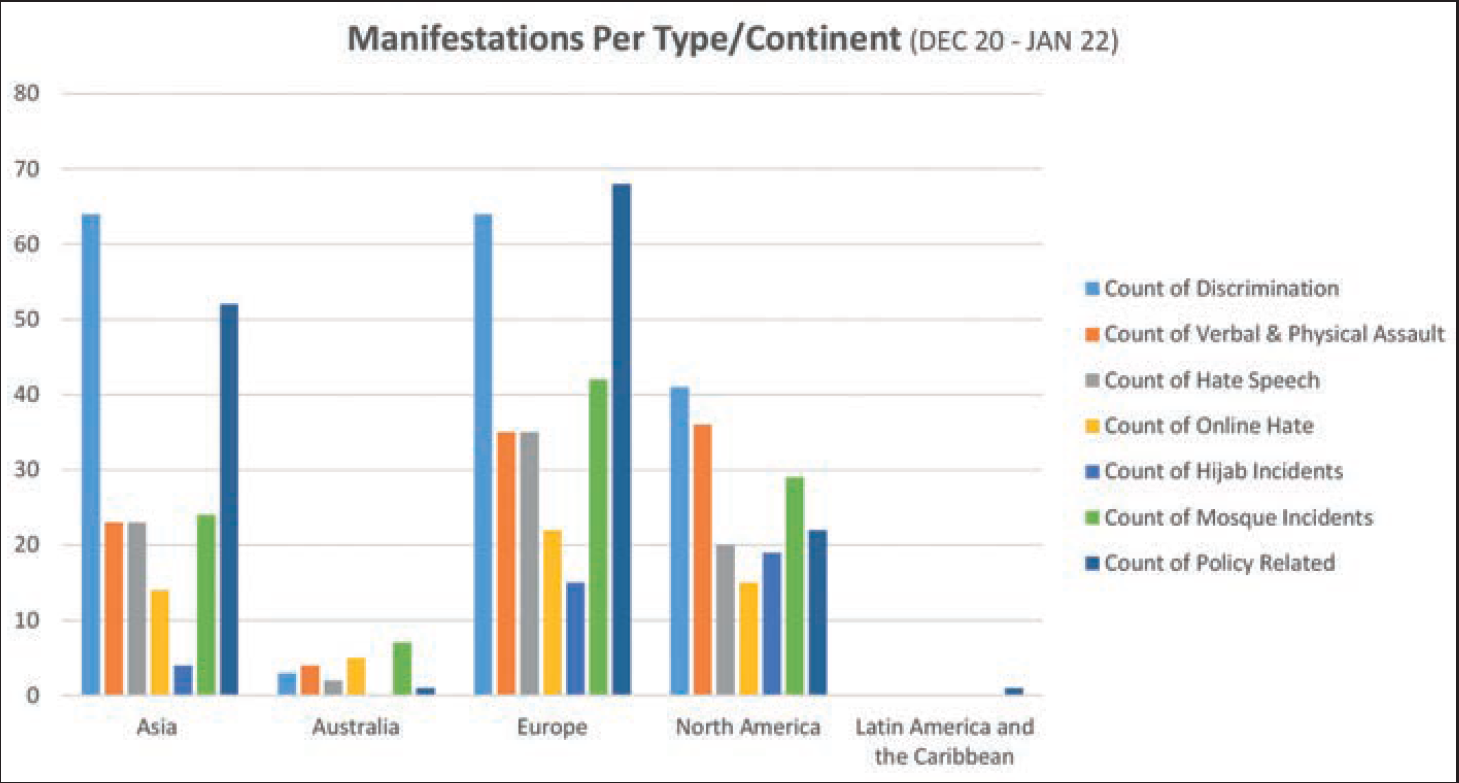
In 2018, reports of violent incidents involving Rohingya Muslims started to surface in public. An investigation by Canada discovered that the Myanmar military’s persecution of Rohingya Muslims qualified as genocidal acts. As a result, the Canadian government asked the UN to take proactive measures. According to a report released by the United Nations investigative department in the same year, Myanmar had committed genocide against the Rohingya people. When Myanmar was sued by the International Court of Justice (ICJ) in 2019 for genocide, this case was only getting started. The ICJ overwhelmingly mandated Myanmar’s government to address the Rohingya genocide issue in 2020.115 However, Islamophobic incidents persisted until 2022, as seen in Figure 1, a graphic included in The 11st OIC Report on Islamophobia: December 2020-January 2022. The graph suggests that there were a variety of Islamophobic incidents.
Figure 1: Manifestation per Type/Continent
Source: OIC116
Police personnel were the targets of prejudice, as well as acts of physical and verbal abuse.117 Instances falling under this last category have peaked in nations across Europe.118 Latin America has the lowest rate of Islamophobia incidents when compared to other continents.119 As the foregoing summary makes clear, there is no consistent pattern to Islamophobic incidents. Muslims are susceptible to prejudice and oppression at any time and wherever.120
The rising number of incidents of Islamophobia undoubtedly draws condemnation from Muslims. Rather than merely keeping quiet, Muslims actively work to counter them, and there are several ways to resist. Scholars121 work to dispel the myths about Islam and Muslims held by people who encourage Islamophobia. As part of their efforts, they have published several books and magazines to reframe people’s misconceptions about Islam.122 Apart from literary compositions, diplomatic endeavors such as those carried out by the OIC resulted in the United Nations declaring March 15 as the World Anti-Islamophobia Day.123 Because it is viewed as an illogical issue, Islamophobia is not just condemned by Muslims but also by many non-Muslims. The majority of these people are academics, authors, and researchers who oppose Islamophobia in written works as well as in spoken discourses. One such example is Karen Armstrong,124 a prolific author of books on Islam. Furthermore, James Carr argues in Experiences of Islamophobia that neoliberalism functions as a key driver in the production and normalization of Islamophobia. Building on this, Islamophobia can be understood as a broader social phenomenon that shapes attitudes across communities, while disproportionately producing harmful and unsettling consequences for Muslims.125
Approaches to Neoliberalism
Liberalism is the foundation of neoliberalism. Adam Smith126 wrote The Wealth of Nations in 1776, promoting liberalism. He believes that the greatest approach to grow a nation’s economy is to allow for unrestricted commerce and manufacturing without interference from the government. Smith127 thought that the concept of “magic hands,” or unseen hands, would bring about equilibrium on its own. Then, as a result of this independence, company freedom and competitiveness would also be greatly enhanced, leading to capital owners competing to maximize profits.128 The term “neoliberalism” first surfaced in print around 1930.129 Neoliberalism is a philosophy that aims to strengthen powerful nations, business owners, and managers, and capitalism to increase market reach.130 According to David Harvey,131 neoliberalism is a philosophy that prioritizes respect for private property systems, free markets, and free commerce as a means of ensuring individual freedom and independence. Adopting neoliberalism implies that the free market and individual liberty come first, even taking precedence over the role of the state. In addition, David Harvey’s132 research distinguishes between two designs for neoliberalism. To begin with, neoliberalism is described as an idealistic endeavor to actualize the theoretical blueprint for restructuring global capitalism. Secondly, it is possible to view neoliberalism as a political endeavor aimed at reconstructing the parameters of capital accumulation and reinstating the authority of the economic elites. In practical application, the design of neoliberalism as a political enterprise takes precedence over these two views.133 Neoliberalization has done a remarkable job of restoring,134 or in some cases, building the authority of the economic elites, as it has done in China and Russia, but it has been less successful in reviving global capital accumulation.
Neoliberalization has done a remarkable job of restoring, or in some cases, building the authority of the economic elites, as it has done in China and Russia, but it has been less successful in reviving global capital accumulation
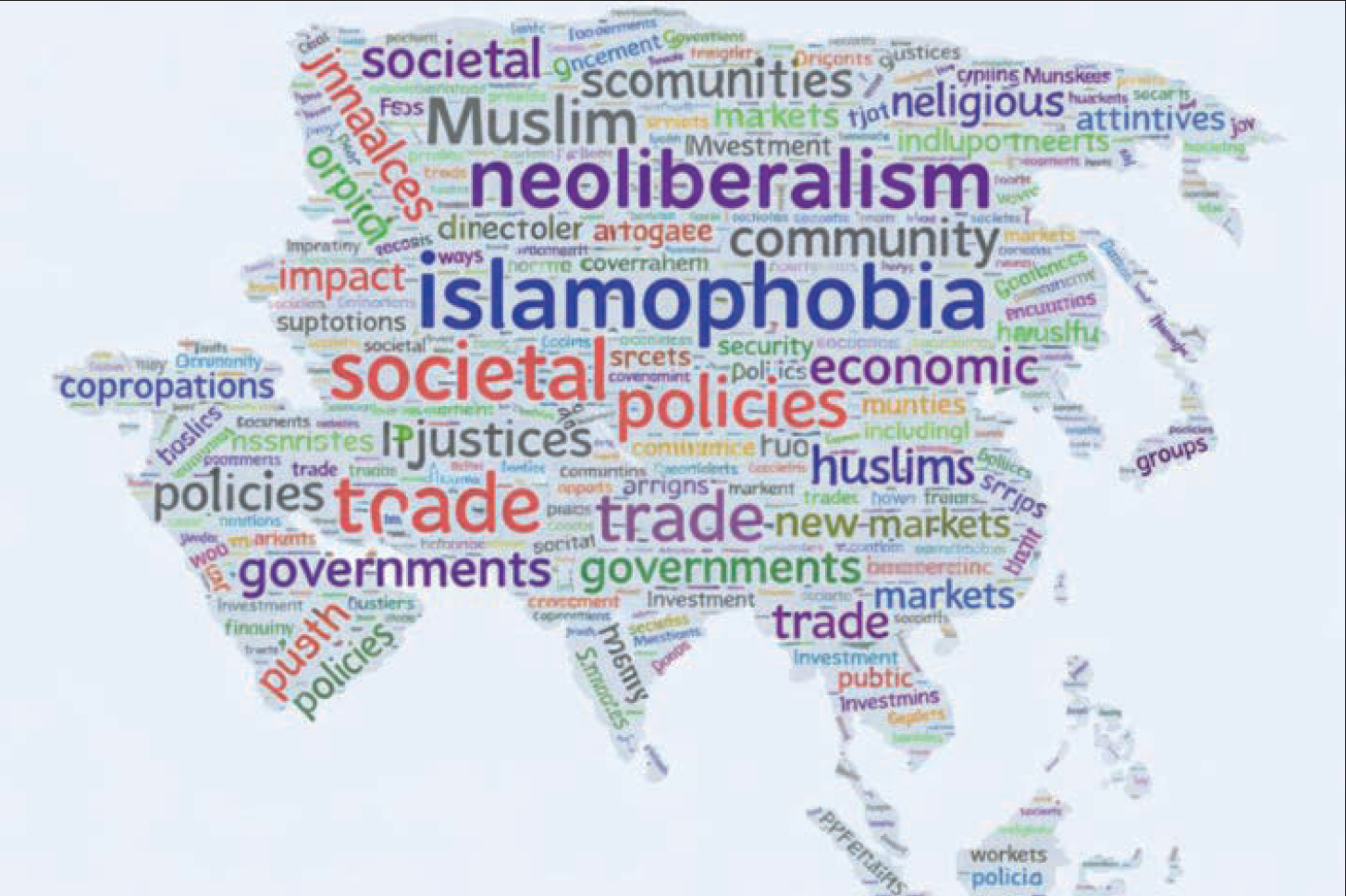
After that, David Harvey135 outlines the traits of neoliberal nations, starting with the implementation of commodification and privatization. Even now, one of the defining characteristics of neoliberalism is the privatization of public assets.136 Among the strategic businesses being privatized are those that support the interests of the general public,137 such as hospitals, schools, and national power suppliers. Public utilities have been privatized in a few neoliberalist nations, following the U.S. example.138 The transportation, social welfare, telecommunications, and water supply industries have all been impacted by privatization. A nation’s support for robust private property rights is indicated by the fact that it has privatized. Financialization is another aspect of neoliberalism that relates to privatization (see Figure 2 for the neoliberalism-societies connection). A pattern of accumulation known as financialization occurs when the profit from financial flow exceeds the profit from commerce and the production of commodities. The capital owners just think about profit and money when doing anything.139 A number of illegal tactics are taken into consideration as legitimate means of obtaining funds.140 The best method to boost economic growth, according to this perspective, is for the government to let the market function without distortion or unrestricted competition. It implies that private businesses must be exempt from government interference, regardless of the social effects that may arise.141
Figure 2: Neoliberalism’s Connections With Society
Source: Created by the author
After 1980, when the neoliberal ideology started to take shape,142 for instance, in the U.S., there was a significant financialization surge.143 This was demonstrated by the entire daily turnover of financial transactions on global markets, which peaked in 1981 at $130 billion after reaching $2.3 billion in 1983.144 The large sum was acquired in a number of ways, including by engaging in actions that were illegal in the state.145 Developing capitalist nations have engaged in debt peonage, corporate fraud, asset confiscation –a practice that entails the theft of pension funds, and other forms of fraud, which have been made worse by the collapse of equities and businesses.146 The handling and manipulation of crises is the next feature of neoliberalism. Crises are considered opportunities for neoliberals.147Crisis management is a means of raising capital. But this means of getting paid isn’t always carried out openly and honestly. They frequently deceive people by offering them attractive promises to provide them money as a guarantee for them to be exploited, but in reality, it’s just an attempt to earn gains for themselves. This is known as a “debt trap.” For instance, the International Monetary Fund (IMF)-driven148 financial liberalization could hasten the largest-ever peaceful transfer of domestic assets to foreign owners in the past 50 years worldwide, surpassing the volume of transfers from domestic owners to U.S. owners in Latin America during the 1980s or in Mexico after 1994. Neoliberalism’s inherent risk is that it will ultimately cause the wealth gap between the affluent and the poor to increase.149
Following the adoption of neoliberalism, the nation assumes the primary role in the implementation of redistributive policies
State redistribution is the fourth feature of neoliberalism.150 Following the adoption of neoliberalism, the nation assumes the primary role in the implementation of redistributive policies.151 A redistributive policy is one that controls how wealth, income, ownership, or rights are distributed from the higher to the lower class.152 For instance, tax laws have a significant impact on the announced privatization, according to neoliberals.153 The nation’s policy has to be changed if the current one impedes the flow of money. Everything that might hinder the flow of capital needs to be eliminated. A nation that adopts neoliberal ideology is shaped by these four factors.154 Upon observation, the four aforementioned traits appear to favor specific groups solely, as the state no longer has the ultimate power.155 The free market is the ultimate authority. Because neoliberalism supports the right-wing dictatorship, this is possible. Thus, it follows that everyone has the right to make their own decisions.156 The government is actually powerless to infringe upon this liberty. It is quite legitimate for the neoliberals to carry out privatization and commodification. It cannot be prohibited by the state. Similar to this, the state has no authority to become involved if neoliberals seek to control, manipulate, and redistribute.157
Connection between Islamophobia and Neoliberalism
One Irish academic who does a thorough analysis of the relationship between Islamophobia and neoliberalism is James Carr. According to Carr,158 the rise of neoliberalism has shaped how the public views Islam. He considered the discourse of Michel Foucault’s159 regime of truth to be connected to both neoliberalism and public perception. The language used by the government to shape society’s notions of reality is known as the regime of truth. Harvey’s160 assertion is consistent with James Carr’s161 explanation that neoliberalism is a political endeavor. According to Carr,162 neoliberalism is an all-encompassing political movement that views the market as the template for the government and for how society is organized as a whole. According to Arbiyanti,163 there are good reasons for the idea that neoliberalism is a political endeavor. The free market is seen by neoliberalism as the best model for how a nation should be run. The ideal situation is one in which people have the freedom to decide for themselves without interference from the state. This explains neoliberalism as a political vision that aims to administer the nation in the same manner as a free market encourages personal freedom.
Neoliberalism is characterized as a dominant ideology by James Carr. 164The philosophy of the neoliberals is to be adopted by all. According to them, the degree to which a society’s neoliberal worldview is uniform is a sign of its level of success. In the same vein, Waikar165 argues that, in order for neoliberalism to remain dominant and even grow, it must identify and criticize belief systems as ideological outsiders that require emancipation. In other words, neoliberalism must resist a constitutive other to be dominant.166 In the name of “progress and modernity,” the neoliberal drive to neo-liberalize this inferior “other” itself becomes its target.167 Neoliberalism must present itself as an ideology that is more powerful and superior to other ideologies to sustain itself and expand.168 Neoliberalism, therefore, considers other ideas to be inferior to its own. Therefore, the superior neoliberalist ideology must take the place of these lesser ideals. According to neoliberalism, society cannot be peaceful and its well-being cannot be assured without this philosophy.169 Neoliberals believe that any values that do not align with neoliberalism should be eradicated, especially those held by non-Western races worldwide. This is a result of neoliberals’ desire for mental uniformity in society.170
Islam, on the other hand, adheres to different values and ideologies from neoliberalism. According to James Carr,171 Islam is therefore seen as a threat to the advancement of neoliberalism since Muslims are seen as endangering the security and continuation of its homogeneous norms. The Runnymede Trust172 provided a clearer explanation of the belief that Islam poses a threat in 1997. According to this report,173 Islam and Muslims are portrayed as the adversary, posing a serious threat to “us” and “our liberties.” Racialized claims about the supposed historically and geographically unchangeable, monolithic nature of Muslimness, with its concomitant sexism, savagery, atavism, and woeful self-governance, are fundamental to the discursive conceptions of Muslims as the “other” (see Figure 3). These attributes are considered fundamental to Islam and, consequently, to every Muslim,174 even in the face of numerous subjective realities that exist in Muslim majority and minority countries around the world.175
Muslims are seen as adversaries of freedom under neoliberalism. This is due to the perception that Islamic doctrines have a poor political structure,176 are atavistic, repressive, and do not stress individual freedom like neoliberalism.177 In addition to wanting their ideology to spread around the world, neoliberals also want to hold onto power. One of the hallmarks of financialization, or neoliberalism, is undoubtedly the maintenance of power.178 Neoliberals themselves will become increasingly wealthy as long as this dominance is maintained. The goal of bolstering the corporate, cultural, and economic spheres is to maintain power.179 Iraq is one instance of a nation that is the subject of research on the implementation of neoliberalist ideology.180 This nation is employed as a test subject for the destruction of its political, social-economic, and cultural systems. The goal of the project is to introduce neoliberalism into many facets of its statehood. Neoliberalism’s products sustain its dominance in the commercial, cultural, and economic spheres.181 In terms of the economy, neoliberals want international banking supervision to be accessible to non-neoliberal nations. Neoliberals favor privatization and simplified international corporate regulation in the business sphere. In addition to wanting to dominate business and the economy, neoliberals also aim to impose cultural constraints through cultural cleansing.182 The term “cultural cleansing” refers to the eradication of civilizations other than Western culture, which is seen as promoting the expansion and advancement of neoliberalism.183 The attempt to reset civilizations so that everyone adopts Western customs is known as “cultural cleaning.”184 One aspect of Western culture is clothing; take the headscarf worn by Muslim women, for example.185 According to Eid,186 the hijab is seen by Westerners as an oppressive measure against women’s rights and their ability to choose how they want to be clothed. The hijab is perceived as something that undermines the unity of Western countries.187 However, a person’s religious dedication is not always expressed by donning a headscarf or hijab.188 The hijab is a means by which Muslim women can express their cultural identity,189 even if the manner in which they wear it varies depending on historical and cultural contexts.190 Being a trendy Muslim lady may be attained by combining a variety of looks and accessories; thus, dressing immodestly is not necessary. 191The traditional hijab has been transformed by Muslim women into a cutting-edge fashion statement that expresses their self-awareness.192 In the meantime, the debate over what constitutes modest Islamic attire sheds light on the individuals who adhere to religious precepts the most closely. Wearing a hijab is a way for Muslims to carry out their religious obligation.193
By restricting the Muslim identity to two extremes, a good Muslim and a terrible Muslim, those who adhere to neoliberalism perpetuate a contradiction against Muslims
There are two stages neoliberals use to scale up their efforts of cultural cleansing. First, unifying culture denotes the West’s attempt to establish a new benchmark for cultural behavior.194 Neoliberalism will undoubtedly continue to grow with the backing of this new culture.195 Neoliberals seek to establish a distinct culture that forbids the wearing of the hijab because they believe it undermines the homogeneity of the West.196 Thus, there is a notion in society that wearing a hijab infringes on a woman’s independence and liberties. The depletion of intellectuals is the second attempt at cultural cleansing.197 That is, there is a widespread belief that neoliberalism is an ideology adhered to by civilized people. Neoliberalism’s philosophy is referred to as the liberating philosophy of the civilized world.198 It implies that individuals who consider themselves to be civilized view neoliberalism as a basis. On the other hand, those who reject neoliberalism, like Muslims, for instance, will be viewed as primitive. Muslims are viewed as inferior, strange, and uncivilized because they reject neoliberalism.199
There are two broad strategies through which neoliberalism is imposed: top-down and bottom-up approaches. The top-down approach refers to the use of state power such as military intervention, political authority, or international pressure to enforce neoliberal policies from above. In contrast, the bottom-up approach involves embedding neoliberal ideas within society through local institutions, market practices, and civil society, making these policies appear natural or inevitable over time.200 The 2003 invasion of Iraq is one example of this. While there were particular justifications for the war in Iraq, several scholars contend that there were other causes.201 The implementation of neoliberalist ideology is one of them. Education stimulates the bottom line if military invasions promote the top line. The purpose of this education is to instill neoliberal principles in society, particularly in schoolchildren, through classroom instruction.202 By restricting the Muslim identity to two extremes, a good Muslim and a terrible Muslim, those who adhere to neoliberalism perpetuate a contradiction against Muslims.203 A good Muslim is someone who embodies neoliberal traits, such as being secular, liberal, not identifying as Muslim, and adhering to Western ideals and perspectives. These kinds of Muslims are said to refrain from bringing Islamic teachings and ideals to the public sphere, including in the areas of politics, commerce, and the economy. The “label” of “bad Muslims” is applied to the pious Muslims. 204Those who identify as bad Muslims are perceived as extremist Muslims who reject liberal ideals and do not embrace atheism. Those who consistently uphold Islamic law in a variety of public spheres, including politics, commerce, and economics, are considered bad Muslims. Over time, Western civilization has come to define decent Muslims based on this duality.205 As a result, there is a growing impression that good Muslims are those who blend in with society. Muslims who adhere to the tenets of Islamic teachings at all times, while dressing in a way that complies with Shariah law, will be viewed as threats.
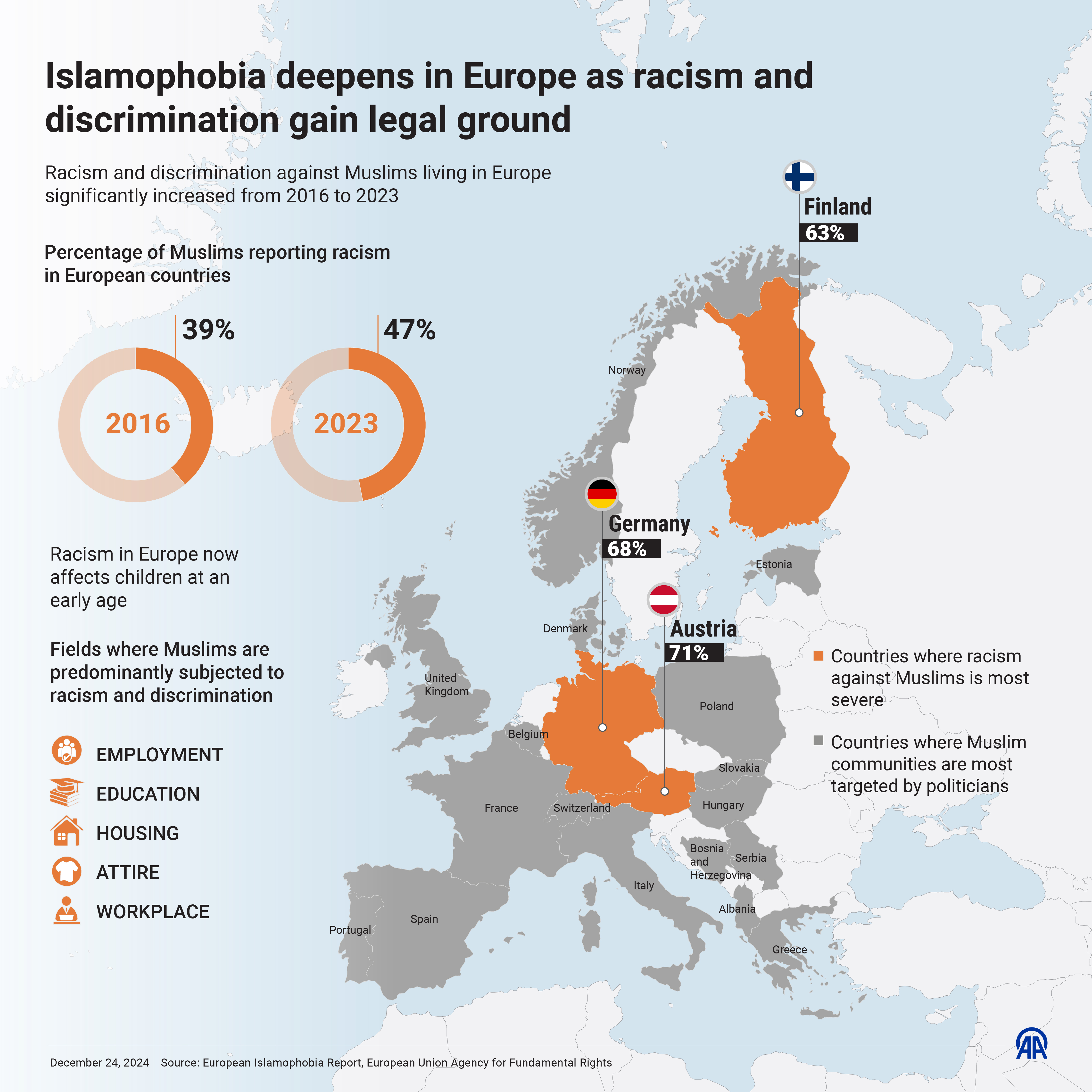
The infographic highlights the rise of Islamophobia and discrimination against Muslims in Europe from 2016 to 2023. EFNAN İPŞİR / AA
According to Mamdani,206 different perspectives on what constitutes a good Muslim and a terrible Muslim also shape how different Muslims are treated. Neoliberals then accept Muslims who are considered “decent” Muslims. Acceptance entails an invitation to collaborate. Then, decent Muslims are portrayed in the media as the ideal representation of Muslims. In the meantime, the neoliberals denigrate Muslims and hence sow discord by labeling them negatively. This unfavorable viewpoint of Muslims as evil Muslims fuels the spread of Islamophobia. Mamdani207 refutes the notion that Muslims are either “good” (secular, Westernized) or “bad” (premodern, fanatical), emphasizing that these categorizations are based on political identities rather than cultural or religious ones. The assumption that “good” Muslims can be easily distinguished from “bad” Muslims conceals a lack of political understanding of the current era.
The neoliberals denigrate Muslims and hence sow discord by labeling them negatively. This unfavorable viewpoint of Muslims as evil Muslims fuels the spread of Islamophobia
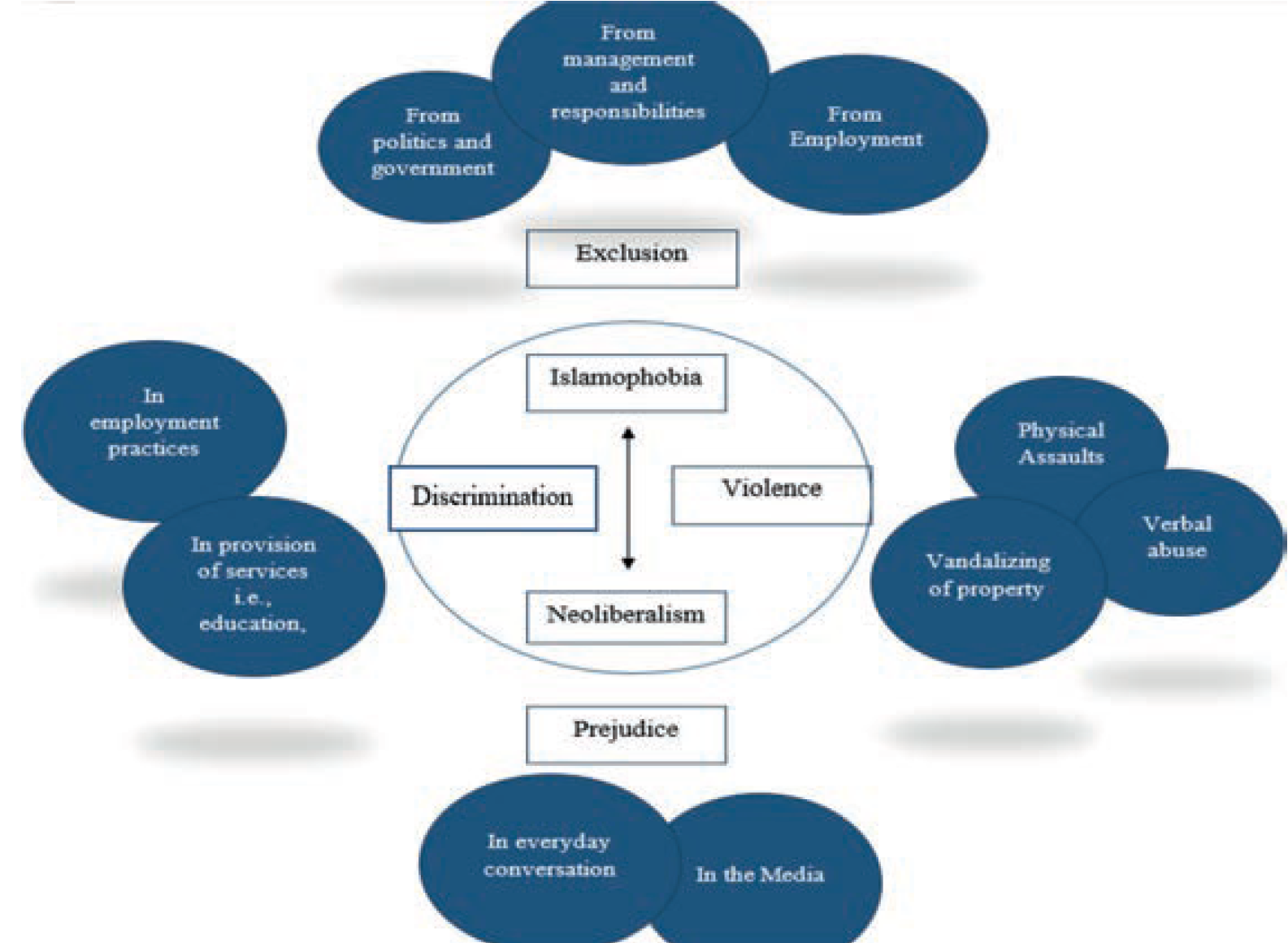
The ways that Muslims are treated differently by Western culture are evident in day-to-day interactions. 208There are several limitations associated with carrying out Islamic-related activities,209such as the ban on building mosques, the manufacturing of halal food, and the donning of Islamic attire. 210In reality, Muslim women are not allowed to wear the hijab 211in a number of European nations.212The imposition of this restriction is justified by portrayals of Muslims as oppressed by their faith and in need of assistance to be set free. 213In keeping with the prior assertion, the actions that give rise to Islamophobia are an expression of neoliberal ideology.214 To be more precise, Figure 4 illustrates how neoliberalism contributes to the spread of Islamophobia. James Carr’s215 analysis of the connection between Islamophobia and neoliberalism is interpreted in Figure 4. The idea of “good” Muslims216 and “evil” Muslims217 influences Islamophobia.218 The two labels are treated differently as a result of this classification. The term “bad Muslim” is linked to other derogatory terms that arouse popular hostility,219 such as “fanatics,”220 “opponents of liberal values,”221 and “atavist.”222 The hatred that results from this black stain subsequently shapes Islamophobia.223
Figure 4: Islamophobia and Neoliberalism
Source: Created by the author
Carr’s224 contention –along with the views of several other scholars, including Alana Lentin and Gavan Titley225– that a link exists between Islamophobia and neoliberalism is supported by this evidence. The prevailing racial groups worldwide are opposed to the neoliberal philosophy, according to the academics’ book. Consequently, neoliberals develop specific programs that exacerbate racism as a global problem.226 Kabel227 is another person who shares Carr’s viewpoint. He claims that there is a connection between Islamophobia and neoliberalism in his journal article, particularly concerning education. Students are taught in schools that Islam is a horrible faith, and as a result, the West is afraid of Islam. Waikar228 is another scholar who feels that Islamophobia and neoliberalism are connected. He claims that Western nations are actively attempting to persuade other nations to embrace neoliberalism. Thus, several other academics229 have also made the case that neoliberalism is crucial to the emergence of Islamophobia.
The media unavoidably plays a significant part in inciting hostility toward Islam
In addition to its link to neoliberalism,230 Islamophobia is associated with two other elements that facilitate its dissemination:231 the research done by Orientalists and the problem of media commercialization of Islamophobia.232 The study of the East, especially Islam, that is done by Westerners is known as Orientalism,233 and Orientalists are those from the West who study the East.234 One tactic used by the West to spread its philosophy over Muslim nations is Orientalism.235 The other two strategies are colonization and missionary work.236 According to Said,237 Orientalists conduct a dichotomy against the Arab people. When Muslims are eager to comply with requests from the West, they are referred to as good Arabs, when Muslims refuse to comply with Western requests, they are referred to as bad Arabs. This term will undoubtedly incite animosity from the general public toward Muslims, who are called terrible Arabs. Three points about all Orientalist movements are concluded by Said:238 (i) First, rather than representing the experiences and viewpoints of Eastern (Oriental) people, Orientalism predominantly represents those of Westerners; (ii) Secondly, Orientalism has led to inaccurate perceptions of Islamic and Arabic civilizations; (iii) Third, although Orientalists’ research seems impartial and objective, it frequently serves political agendas.
The commercialization of Islamophobia in the media is another problem associated with the religion.239 The media unavoidably plays a significant part in inciting hostility toward Islam.240 The media is a component of an industry that always has interests, both political and economic;241 thus, it is impossible to dispute that it is extremely uncommon to find a media that can stand freely without being influenced by specific parties’ interests.242 In the media, framing also occurs regularly,243 and the media facilitates the easier dissemination of all information.244 The dissemination of focused views on certain topics becomes more nuanced when done through the media.245 The revenue derived from the marketing of issues associated with Islamophobia is deemed significant.246 According to Bukar,247 based on Council on American-Islamic Relations (CAIR) data, the core of the American Islamophobic network brought in at least $119,662,719 in total revenue between 2008 and 2011.248 Donors who encourage Islamophobia in the community provided the funds for this amount. Daniel Pipes was one of the main sources from which Islamophobia spread. He gave $1,242,000 to the Steven Emerson Investigation Project concerning Terrorism during a three-year period through his Middle East Forum. The financial flow from David Pipes is displayed in Table 1.
Table 1: Daniel Pipes’s Donations on the Funding of Islamophobia Spread through the Middle East Forum249
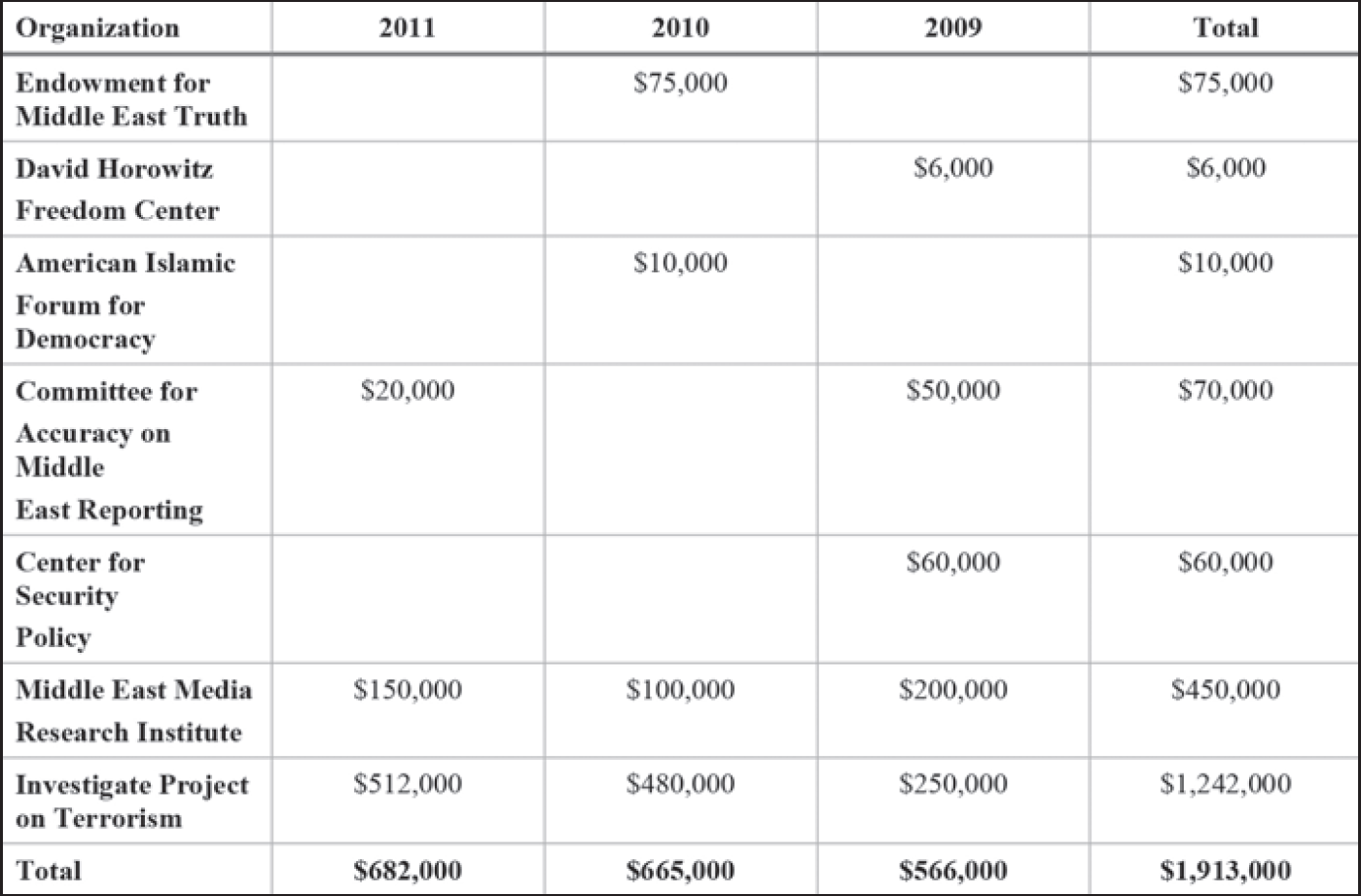
Daniel Pipes presented a variety of monetary gifts between 2009 and 2011,250 with his annual contributions consistently exceeding $500,000. In addition to Pipes, a number of well-known individuals have also become philanthropists for the Islamophobia network.251 These individuals include Aubrey Chernick, Foster Friess, Joyce, Andy Mille, and Pat Robertson.252 These individuals make financial contributions to groups that work to further inner -or outer- core Islamophobia-related struggles.
Donor money is distributed over a number of platforms in an effort to incite animosity toward Islam.253 Implementing the measures involved many activities, including publishing through websites,254 social movements,255 books,256 movies,257 and podcasts.258 Even the Securing America TV channel and other television shows helped propagate anti-Islamic sentiment.259 Likewise, a number of major television programs260 also broadcast content that includes insults directed at Muslims.261 Sensitive terms like jihad, radical Islam, extreme Islam, and Shariah are used to imply this. These phrases are often included in reporting by MSNBC, CNN, and Fox News. A recent study conducted by Latif 262 revealed how Islam and terrorism have been linked by the international press, and how Islamophobia and Muslim racial profiling may be aided by subtle print messaging. For this purpose, Latif 263 chooses the data from the editorial pages of six major international newspapers published between 2014 and 2017. Strata of 10 major global terrorist occurrences were compiled (as shown in Table 2).
Table 2: Newspapers and theImagery of Muslims In The Context ff Terrorism Crosstabulation
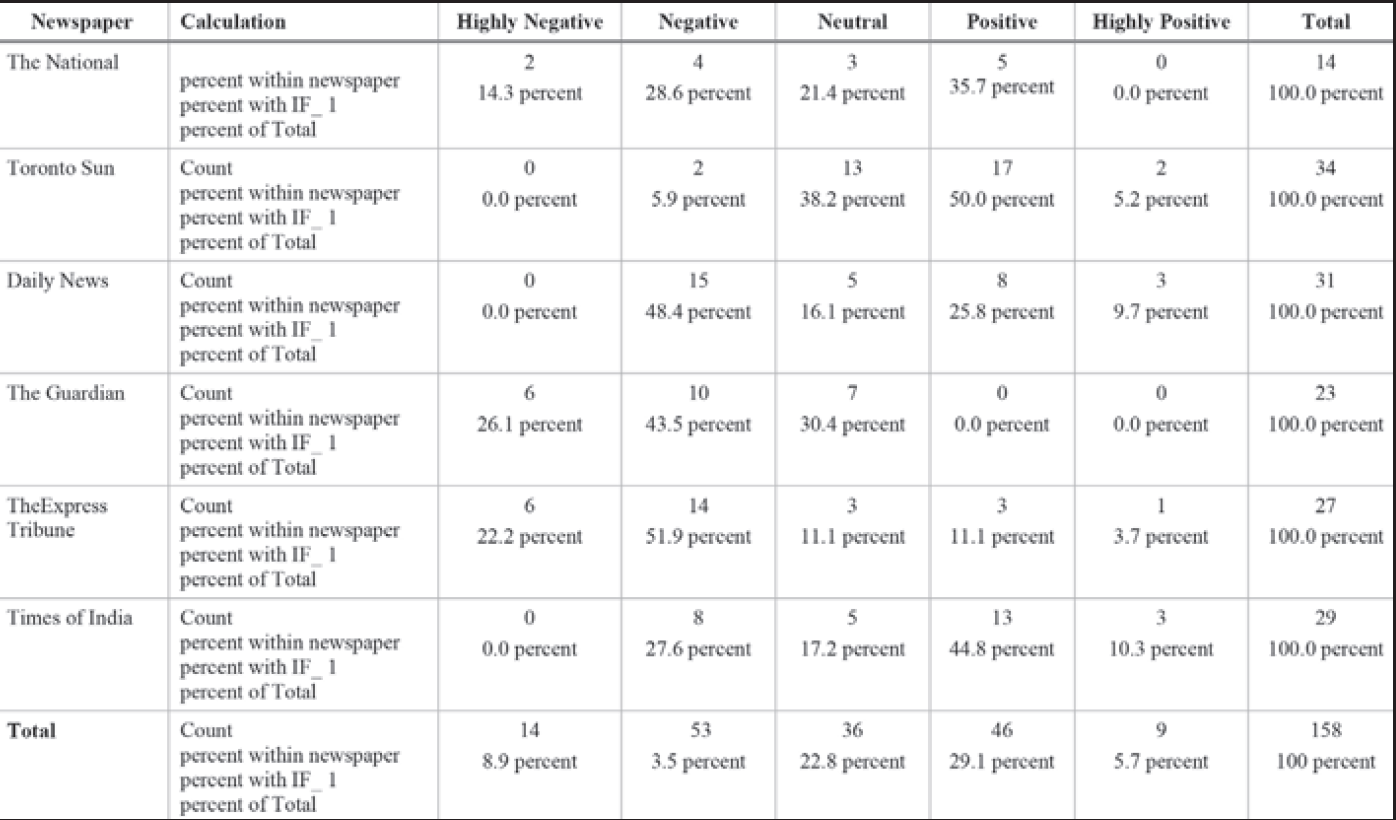
The Table lists how each newspaper has covered Islam and Muslims in relation to terrorism. In the context of terrorism, negative themes and frames against Muslims and Islam were more prevalent in The Guardian (48.4 percent), Daily News (43.5 percent), and Toronto Sun (51.9 percent). However, in the context of terrorism, neutral themes and frames disparaging Muslims and Islam were more common in TOI (21.4 percent) and Daily News (30.4 percent). In The National (44.4 percent) and Express Tribune (50 percent), positive themes were more prevalent. A previous study shows that there have been numerous and extensive attempts to spread Islamophobia. It is possible that the persistent propagation of Islamophobia in the media would lead to false perceptions about Islam. A closer look reveals that anti-Islamic sentiment has been propagating for several years. Media coverage of contentious topics may be rather powerful. Even if the news that is given frequently has bad motives, it can nonetheless affect viewers’ opinions. Consequently, if news that promotes animosity toward Islam is consistently disseminated, it will cultivate a pervasive belief throughout the society that Islam is to be despised.
Neoliberals frequently construct a binary distinction between Muslims as either good Muslims or bad Muslims in an effort to lessen prejudices against them in society
Final Thoughts and Future Directions
Neoliberalism and Islamophobia are related because Islam is seen as a threat to its principles. Neoliberals frequently construct a binary distinction between Muslims as either good Muslims or bad Muslims in an effort to lessen prejudices against them in society. Negative perceptions about those branded as bad Muslims are perpetuated, which stokes hostility. This animosity toward Muslims who are classified as such feeds into the larger problem of Islamophobia in society. Beyond its association with neoliberalism, Islamophobia is also associated with two other issues: Orientalist research and the commercialization of Islamophobia. Therefore, it’s true to say that elements of neoliberalism have a role in shaping the phenomena of Islamophobia, which is then supported by Orientalist studies and furthered by media commercialization. As previously stated, Islamophobia exists in a setting where neoliberalism is the dominant ideology of the day. To clarify, it is not maintained here that neoliberalism is the primary source of the modern Islamophobia that underlies it; to do so would be to neglect the reasons that are comparatively specific to certain contexts. However, the point being made here is that it’s critical to comprehend how Islamophobic stereotypes are created and how neoliberal thought influences them, as well as how these factors affect Muslim communities and individuals.
Muslims need to confront Islamophobia head-on as it continues to progress. Here are five actions Muslims should engage in to prevent the spread of Islamophobic ideas: educate people, become involved in politics, interact with the media, become more knowledgeable, and exercise patience. There are two approaches to understanding and learning more here. It first entails comprehending the discourse around the origins and progression of Islamophobia. Muslims need to examine this problem and develop sufficient literacy. They ought to be open to learning how the West views Islamophobia. Examining Western studies is crucial in determining the degree of Islamophobia’s expansion. The goal of learning more is to generate experts. These specialists can dispel myths regarding Islam. It is not easy, for example, to refute the assertion that the Quran is a sacred text that encourages terrorism. It takes in-depth research to find pertinent verses and formulate strong refutations.
Muslims also have a duty to teach others. It is essential to research the patterns of Islamophobia, and the findings need to be extensively shared in communities to correct the false beliefs about Islam. Muslims must also bring back the original perception of Islam as a religion associated with safety and tranquility. Publication of books and journals to educate people is one way to do this. It is also possible to combat Islamophobia in schools and via seminars that attempt to explain the real meaning of Islam. Additionally, it is crucial to post information on websites and other digital platforms that emphasizes the good features of Islam to counteract the bad picture of the religion that is spread by Western sources online. Making political donations is the third issue Muslims can do to put an end to Islamophobia. Muslim communities employ this tactic to protect their rights when the government intervenes at the regional and national levels.
Fourth, by engaging with the media, Muslims may actively help to lessen Islamophobia. Several Islamic organizations are in constant contact with local and national media channels to guarantee that Muslims are accurately portrayed in U.S. media. Furthermore, MPAC runs a specialized organization aimed at changing unfavorable opinions about Islam and Muslims in the Hollywood film business. Historically, American cinema has portrayed Islam and Muslims negatively, which has affected opinions throughout the world. Ultimately,264 exercising patience is one of the most significant things Muslims can do. The aforementioned initiatives are all based on patience and sincerity and are meant to promote a constant manner of compassion, inaction, and emotional stability. But in this case, the key to patience is knowing the tactical course of action and the sequential steps that must be taken to combat Islamophobia.
Endnotes
- Leon Moosavi, “Orientalism at Home: Islamophobia in the Representations of Islam and Muslims by the New Labour Government,” Ethnicites, Vol. 15, No. 5 (October 2015), retrieved from https://doi.org/10.1177/146879681452537, pp. 652-674; Muhammad Asad Latif, “Qatar’s Efforts to Change the Image of Muslims after 9/11: A Political and Social Research into the Perspective of FIFA World Cup 2022,” Contemporary Arab Affairs, Vol. 17, No. 3 (August 2024), retrieved from https://doi.org/10.1177/146879681452537, pp. 416-441.
- Shadia Husseini de Araújo, “Desired Muslims: Neoliberalism, Halal Food Production and the Assemblage of Muslim Expertise, Service Providers and Labour in New Zealand and Brazil,” Ethnicities, Vol. 21, No. 3 (June 2021), retrieved from https://doi.org/10.1177/1468796821998369, pp. 411-432, David Theo Goldberg, The Threat of Race: Reflections on Racial Neoliberalism, (New Jersey: Wiley-Blackwell, 2009).
- Raphael Cohen-Almagor, “In the Name of the Republic: Banning the Burqa and the Niqab,” in Raphael Cohen-Almagor (ed.), The Republic, Secularism and Security, (Cham: Springer, 2022), pp. 33-48.
- S. Jonathon O’Donnell, “Islamophobic Conspiracism and Neoliberal Subjectivity: The Inassimilable Society,” Patterns of Prejudice, Vol. 52, No. 1 (2018), retrieved from https://doi.org/10.1080/0031322X.2017.1414473, pp. 1-23.
- Antonio Perra, “The Prevent Ptrategy: Prevent, Muslim Identity, and the Normalisation of Neoliberalism,” Renewal, Vol. 26, No. 3 (2018), pp. 83-95.
- Araújo, “Desired Muslims: Neoliberalism, Halal Food Production and the Assemblage of Muslim Expertise, Service Providers and Labour in New Zealand and Brazil,” pp. 411-432; Goldberg, The Threat of Race: Reflections on Racial Neoliberalism.
- Xinyan Zhao and Mengqi Monica Zhan, “Appealing to the Heart: How Social Media Communication Characteristics Affect Users’ Liking Behavior during the Manchester Terrorist Attack,” International Journal of Communication, Vol. 13, No. 1 (August 2019), pp. 3826-3847.
- James Carr, “Islamophobia, Neoliberalism and the Muslim ‘Other,’” Insight Turkey, Vol. 23, No. 2 (Spring 2021), pp. 83-105.
- Shadia Husseini de Araújo, “Neoliberal Representations of Muslims and the Islamic World: A Discourse Analysis of Imaginative Geographies in Brazilian Local and Regional Print Media,” Journal of Ethnic and Migration Studies, Vol. 48, No. 13 (February 2020), retrieved from https://doi.org/10.1080/1369183X.2020.1727730, pp. 3280-3300.
- Muhammad Asad Latif, “The Identity of Religion Always Comes Up: The War, the Mass Media and the Reproduction of Muslim Identity in the West,” Social Network Analysis and Mining, Vol. 14, No. 201 (October 2024), retrieved from https://doi.org/10.1007/s13278-024-01354-2.
- Andrew Wheatcroft, Infidels: A History of the Conflict between Christendom and Islam, (New York: Random House, 2005).
- Kristin VandenBelt, “The Post-Setember 11 Rise of Islamophobia: Identity and the Clash of Civilization in Europe and Latin America,” Insight Turkey, Vol. 23, No. 2 (Spring 2021), retrieved from http://dx.doi.org/10.25253/99.2021232.9, pp. 145-168, retrieved from http://dx.doi.org/10.25253/99.2021232.9.
- Firas Al-khateeb, Lost Islamic History: Reclaiming Muslim Civilisation from the Past, (London: Hurst and Company, 2014).
- Khaled A. Beydoun, The New Crusades: Islamophobia and Global War against Muslims, (California: University of Califronia Press, 2023).
- Khaled A. Beydoun, American Islamophobia: Understanding the Roots and Rise of Fear, (California: University of Califronia Press, 2018).
- Ramazan Kılınç, Islamophobia and Muslims in France in Alien Citizens: The State and Religious Minorities in Turkey and France, (Cambridge: : Cambridge University Press, 2019), pp. 107-128.
- “European Islamophobia Report 2021,” Leopold Weiss Institute, (January 2022), retrieved from https://islamophobiareport.com/islamophobiareport-2021.pdf.
- Carr, “Islamophobia, Neoliberalism and the Muslim ‘Other,’” pp. 83-102.
- Beydoun, The New Crusades: Islamophobia and Global War against Muslims.
- Ali Çaksu, “Islamophobia, Chinese Style: Total Internment of Uyghur Muslims by the People’s Republic of China,” Vol. 5, No. 2 (Fall 2020), retrieved from http://dx.doi.org/10.25253/99.2021232.9, p. 177.
- Cohen-Almagor, “In the Name of the Republic: Banning the Burqa and the Niqab.”
- Muhammad Asad Latif, “The Rise of Religious Authoritarianism: Muslims, Ethno-Politics, and Racial Identity in India,” National Identities, Vol. 27, No. 3 (December 2024), retrieved from http://dx.doi.org/10.25253/99.2021232.9, pp. 215-241.
- Adis Duderija and Halim Rane, Islam and Muslims in the West, (Cham: Palgrave Macmillan, 2019); Deepa Kumar, Islamophobia and the Politics of Empire, (Chicago: Haymarket Books, 2012); David Theo Golberg, The Racial State, (Malden, Blackwell Publishers, 2002).
- Umma Farida, “Radicalism, Moderateism, and Liberalism of Islamic Boarding Schools: Tracing Islamic Thoughts and Religious Movements of Islamic Boarding Schools in the Era of Globalization,” Edukasia: Jurnal Penelitian Pendidikan Islam, Vol. 10, No. 1 (2015), pp. 145-163.
- Alex P. Schmid, “Moderate Muslims, and Islamist Terrorism: Between Denial and Resistance,” Terrorism and Counter-Terrorism Studies, Vol. 8, No. 9 (August 2017), retrieved from http://dx.doi.org/10.19165/2017.1.09; Margaretha A. van Es, Nina ter Laan, and Erik Meinema, “Beyond ‘Radical’ Versus ‘Moderate’? New Perspectives on the Politics of Moderation in Muslim Majority and Muslim Minority Settings,” Religion, Vol. 51, No. 2 (April 2021), retrieved from https://doi.org/10.1080/0048721X.2021.1865616, pp. 161-168.
- Zhao and Zhan, “Appealing to the Heart: How Social Media Communication Characteristics Affect Users’ Liking Behavior during the Manchester Terrorist Attack,” pp. 3826-3847.
- Christian von Sikorski, Jörg Matthes, Desirée Schmuck, and Alice Binder, “Muslims Are Not Terrorists: Islamic State Coverage, Journalistic Differentiation between Terrorism and Islam, Fear Reactions, and Attitudes toward Muslims,” Mass Communication and Society, Vol. 20, No. 6 (August 2017), retrieved from https://doi.org/10.1080/0048721X.2021.1865616, pp. 825-848.
- Christian von Sikorski, Jörg Matthes, and Desirée Schmuck, “The Islamic State in the News: Journalistic Differentiation of Islamist Terrorism from Islam, Terror News Proximity, and Islamophobic Attitudes,” Communication Research, Vol. 48, No. 2 (October 2018), retrieved from https://doi.org/10.1177/0093650218803276, pp. 203-232.
- Pavlos Vasilopoulos, George E. Marcus, and Martial Foucault, “Emotional Responses to the Charlie Hebdo Attacks: Addressing the Authoritarianism Puzzle,” Political Psychology, Vol. 39, No. 3 (June 2017), retrieved https://doi.org/10.1111/pops.12439. pp. 557-575.
- Rochelle Terman, “Islamophobia and Media Portrayals of Muslim Women: A Computational Text Analysis of US News Coverage,” International Studies Quarterly, Vol. 61, No. 3 (November 2017), retrieved https://doi.org/10.1111/pops.12439, pp. 489-502.
- Khadijha Tariq and Mian Abdul Hanan, “Terrorism and Racial Profiling-Islamophobia in International Press,” Journal of Islamic Thought and Civilization, Vol. 8, No. 2 (2018), retrieved from http://dx.doi.org/10.32350/jitc.82.08, pp. 127-144.
- Mahmood Mamdani, “Good Muslim, Bad Muslim: A Political Perspectives on Culture and Terrorism,” American Anthropologist, Vol. 104, No. 3 (September 2002), retrieved from https://doi.org/10.1525/aa.2002.104.3.766,
- Mahmood Mamdani, Good Muslim, Bad Muslim: America, the Cold War and Roots of Terror, (New York: Penguin Random House, 2005).
- Muhammad Kamran Sufi and Musarat Yasmin, “Racialization of Public Discourses: Portrayal of Islam and Muslims,” Heliyon, Vol. 8, No. 12 (December 2022), retrieved from http://dx.doi.org/10.1016/j.heliyon.2022.e12211; Muhammad Asad Latif, “Terrorism New Wave: The Same Style but New Ways in the Context of Online Radicalization,” Historical: Journal of History and Social Sciences, Vol. 3, No. 2 (2024), retrieved from https://doi.org/10.58355/historical.v3i2.109, pp. 169-180.
- Michael Philip Penn, When Christians First Met Muslims: A Sourcebook of the Earliest Syriac Writings on Islam, (California: University of California Press, 2015).
- Beydoun, The New Crusades: Islamophobia and Global War against Muslims.
- Carr, “Islamophobia, Neoliberalism and the Muslim ‘Other,’” pp. 83-102.
- Muhammad Asad Latif, “Political Struggle of Malaysia and Islam: Moderating and Radicalizing the State, Society, and Religion Alternately (1957-2023),” Discover Global Society, Vol. 2, No. 1 (August 2024), retrieved from https://doi.org/10.1007/s44282-024-00070-8.
- Mahnoor Malik, Sara Ahmad, and Saliha Malik, “Perception of Islamophobia: Anti-Muslim Semitism in the West,” Pakistan Journal of International Affairs, Vol. 4, No. 4 (December 2021), pp. 554-564.
- Robert Miles and Malcolm Brown, Racism, 2nd ed., (London: Routledge, 2003).
- Karim Murji and John Solomos, Introduction: Racialization in Theory and Practice, (Oxford: Oxford University Press, 2005).
- Fernando Bravo López, “Towards a Definition of Islamophobia: Approximations of the Early Twentieth Century,” Ethnic and Racial Studies, Vol. 34, No. 4 (November 2010), retrieved from https://doi.org/10.1080/01419870.2010.528440.
- Penn, When Christians First Met Muslims: A Sourcebook of the Earliest Syriac Writings on Islam.
- Muhammad Asad Latif, “Anthropomorphic of Gods with Allah Almighty and Filmography on Islamophobia in the Cinematic Way of America and India: A Critical Analysis,” Hamdard Islamicus, Vol. 46, No. 3 (September 2023), retrieved from https://doi.org/10.57144/hi.v46i3.756, pp. 49-72.
- Eboo Patel, “Foreword,” in Todd H. Green (ed.), Presumed Guilty: Why We Shouldn’t Ask Muslims to Condemn Terrorism, (Minnesota: Fortress Press, 2018), pp. 4-20.
- Laurens de Rooij, Muslim, Minorities and the Media: Discourse on Islam in the West, (New York: Routlegde, 2023), p. 192.
- Beydoun, The New Crusades: Islamophobia and Global War against Muslims.
- Beydoun, The New Crusades: Islamophobia and Global War against Muslims, p. 390.
- Edward W. Said, Orientalism, (New York: Vintage Books, 1978).
- Zafar Iqbal, Islamophobia: History, Context and Deconstruction, (New Delhi: SAGE, 2020).
- Salman Sayyid and Abdoolkarim Vakil, Thinking through Islamophobia: Global Perspectives, (Texas: Cinco Puntos Press, 2010), p. 15.
- Muhammad Asad Latif, “Make America Hate Again? Before and After Trump, There Were Differences in How Muslims and Islam Were Portrayed in American Media,” Social Identities, Vol. 30, No. 4 (July 2024), retrieved from https://doi.org/10.1080/13504630.2024.2382126, pp. 287-305.
- Mohammad Yaseen Gada, “Islamophobia and Its Historical Roots Content, Context, and Consequences,” Hamdard Islamicus, Vol. 40, No. 2 (March 2021), retrieved from https://doi.org/10.57144/hi.v40i2.149.
- Teun A. van Dijk, “New (S) Racism: A Discourse Analytical Approach,” in Simon Cottle (ed.), Ethnic Minorities and the Media: Changing Cultural Boundaries, (Buckingham: Open University Press, 2000), pp. 33-49.
- Wheatcroft, Infidels: A History of the Conflict between Christendom and Islam.
- Mervat F. Hatem, “Discourses on the ‘War on Terrorism’ in the U.S. and Its Views of the Arab, Muslim, and Gendered ‘Other,’” The Arab Studies Journal, Vol. 11/12, No. 1-2 (2004), pp. 77-97.
- Farida, “Radicalism, Moderateism, and Liberalism of Islamic Boarding Schools: Tracing Islamic Thoughts and Religious Movements of Islamic Boarding Schools in the Era of Globalization.”
- John Tolan, Saracens: Islam in the Medieval European Imagination, (New York: Columbia University Press, 2002), p. 67.
- Beydoun, The New Crusades: Islamophobia and Global War against Muslims.
- Enes Bayraklı and Farid Hafez, European Islamophobia Report 2015, (Ankara: SETA, 2016).
- Andrew Martin Fischer, “Labour Transitions and Social Inequalities in Tibet and Xinjiang: A Comparative Analysis of the Structural Foundations of Discrimination and Protest,” in Trine Brox and Ildikó Bellér-Hann (eds.), On the Fringes of the Harmonious Society: Tibetans and Uyghurs in Socialist China, (Copenhagen, Nias Press, 2014), pp. 29-68.
- Katayoun Alidadi, “The RELIGARE Report: Religion in the Context of the European Union: Engaging the Interplay between Religious Diversity and Secular Models,” in Marie-Claire Foblets, Katayoun Alidadi, and Zeynep Yanaşmayan (eds.), Belief, Law and Politics, (London: Routledge, 2016), pp. 11-50.
- Beydoun, American Islamophobia: Understanding the Roots and Rise of Fear.
- Hatem Bazian, “Islamophobia, Clash of Civilizations, and Forging a Post-Cold War Order,” Religions, Vol. 9, No. 9 (2018), retrieved from https://doi.org/10.3390/rel9090282, p. 282.
- Ramon Grosfoguel, “The Multiple Faces of Islamophobia,” Islamophobia Studies Journal, Vol. 1, No. 1 (2012), pp. 9-33; Nasar Meer, “Islamophobia and Postcolonialism: Continuity, Orientalism and Muslim Consciousness,” Patterns of Prejudice, Vol. 48, No. 5 (October 2014), pp. 500-515.
- Hatem, “Discourses on the ‘War on Terrorism’ in the U.S. and Its Views of the Arab, Muslim, and Gendered ‘Other.’”
- Beydoun, The New Crusades: Islamophobia and Global War against Muslims.
- Araújo, “Neoliberal representations of Muslims and the Islamic World: A Discourse Analysis of Imaginative Geographies in Brazilian Local and Regional Print Media.”
- Christian Joppke, “Pluralism and Pluralism: Islam and Christianity in the European Court of Human Rights,” in Jean L. Cohen and Cécile Laborde (eds.), Religion, Secularism, and Constitutional Democracy, (New York: Columbia University Press, 2016), pp. 89-111.
- Shahnawaz Muhammad Khan, Muhammad Arif Khan, and Bakhtiar Khan, “Islamophobia in West: An Analytical Study,” Global Social Sciences Review, Vol. 7, No. 1 (March 2022), pp. 279-288, retrieved from https://doi.org/10.31703/gssr.2022(VII-I).27.
- Cohen-Almagor, “In the Name of the Republic: Banning the Burqa and the Niqab.”
- Sikorski, Matthes and Schmuck, “The Islamic State in the News: Journalistic Differentiation of Islamist Terrorism from Islam, Terror News Proximity, and Islamophobic Attitudes.”
- Adam Taylor, “Banning Burqas Isn’t a Sensible Response to Terrorism,” The Washington Post, (August 12, 2016), retrieved from https://www.washingtonpost.com/news/worldviews/wp/2016/08/12/banning-burqas-isnt-a-sensible-response-to-terrorism/?utm_term=.9c535e04a27f.
- Penn, When Christians First Met Muslims: A Sourcebook of the Earliest Syriac Writings on Islam.
- Carr, “Islamophobia, Neoliberalism and the Muslim ‘Other,’” pp. 83-102.
- Beydoun, The New Crusades: Islamophobia and Global War against Muslims.
- Beydoun, American Islamophobia: Understanding the Roots and Rise of Fear.
- Carr, “Islamophobia, Neoliberalism and the Muslim ‘Other,’” pp. 83-102.
- Enes Bayraklı and Farid Hafez, European Islamophobia Report 2021, (İstanbul: Leopold Weiss Institute, 2022).
- Çaksu, “Islamophobia, Chinese Style: Total Internment of Uyghur Muslims by the People’s Republic of China.”
- Araújo, “Neoliberal Representations of Muslims and the Islamic World: A Discourse Analysis of Imaginative Geographies in Brazilian Local and Regional Print Media.”
- Al-khateeb, Lost Islamic History: Reclaiming Muslim Civilisation from the Past.
- Grosfoguel, “The Multiple Faces of Islamophobia,” pp. 9-33; Meer, “Islamophobia and Postcolonialism: Continuity, Orientalism and Muslim Consciousness,” pp. 500-515.
- Vasilopoulos, Marcus and Foucault, “Emotional Responses to the Charlie Hebdo Attacks: Addressing the Authoritarianism Puzzle,” pp. 557-575.
- Zhao and Zhan, “Appealing to the Heart: How Social Media Communication Characteristics Affect Users’ Liking Behavior During the Manchester Terrorist Attack,” pp. 3826-3847.
- Duderija and Rane, Islam and Muslims in the West: Kumar, Islamophobia and the Politics of Empire; Golberg, The Racial State.
- James Carr, Experiences of Islamophobia: Living with Racism in Neoliberal Era, (London and New York: Routledge, 2021).
- “Fourteenth OIC Report on Islamophobia,” OIC, (March 2022), retrieved April 4, 2024 from https://www.oic-oci.org/upload/islamophobia/2022/14th_Annual_Report_on_Islamophobia_March_2022.pdf.
- Beydoun, The New Crusades: Islamophobia and Global War against Muslims.
- Beydoun, American Islamophobia: Understanding the Roots and Rise of Fear.
- James Carr and Amanda Haynes, “A Clash of Racializations: The Policing of ‘Race’ and of Anti-Muslim Racism in Ireland,” Critical Sociology, (July 5, 2013), Vol. 41, No. 1, from https://doi.org/10.1177/0896920513492805.
- Grosfoguel, “The Multiple Faces of Islamophobia,” pp. 9-33; Meer, “Islamophobia and Postcolonialism: Continuity, Orientalism and Muslim Consciousness,” pp. 500-515.
- Kılınç, Islamophobia and Muslims in France, pp. 107-128.
- “Fourteenth OIC Report on Islamophobia.”
- Terman, “Islamophobia and Media Portrayals of Muslim Women: A Computational Text Analysis of US News Coverage.”
- Taylor, “Banning Burqas Isn’t a Sensible Response to Terrorism.”
- Kimberly J. Morgan, “Gender, Right-Wing Populism, and Immigrant Integration Policies in France, 1989-2012,” West European Politics, Vol. 40, No. 4 (February 2017), pp. 887-906.
- Cécile Laborde, Liberalism’s Religion, (Cambridge: Harvard University Press, 2017).
- Bayraklı and Hafez, European Islamophobia Report 2015.
- Bayraklı and Hafez, European Islamophobia Report 2021.
- Taylor, “Banning Burqas Isn’t a Sensible Response to Terrorism.”
- Kılınç, Islamophobia and Muslims in France, pp. 107-128.
- Joan Wallach Scott, The Politics of the Veil, (Princeton: Princeton University Press, 2007).
- Hana M.A.E. Van Oojien, Religious Symbols in Public Functions: Unveiling State Neutrality: A Comparative Analysis of Dutch, English and French Justifications for Limiting the Freedom of Public Officials to Display Religious Symbols, (Brusells: Intersentia, 2012).
- Cohen-Almagor, “In the Name of the Republic: Banning the Burqa and the Niqab.”
- Joppke, “Pluralism vs Pluralism: Islam and Christianity in the European Court of Human Rights,” pp. 89-111.
- Alidadi, “The RELIGARE Report: Religion in the Context of the European Union: Engaging the Interplay Between Religious Diversity and Secular Models,” pp. 11-50.
- Fischer, “Labour Transitions and Social Inequalities in Tibet and Xinjiang: A Comparative Analysis of the Structural Foundations of Discrimination and Protest,” pp. 29-68.
- Chris Hann, “Harmonious or Homogeneous? Language, Education and Social Mobility in Rural Uyghur Society,” in Trine Brox and Ildikó Bellér-Hann (eds.), On the Fringes of the Harmonious Society: Tibetans and Uyghurs in Socialist China, (Copenhagen: Nias Press, 2014), pp. 183-208.
- Çaksu, “Islamophobia, Chinese Style: Total Internment of Uyghur Muslims by the People’s Republic of China.”
- Md. Estehsam Akhter, “Ethnicity and Identity Politics Uighur Muslims of China,” Global Journal of Human Social Sciences, Vol. 19, No. 3 (November 2023), pp. 1-15.
- Fauziah Fathil, “Muslim Minority in China: A Case of Uyghur Muslims in Xinjiang,” in Noor Zahirah Mohd Sidek, Roshima Said, and Wan Norhaniza Wan Hasan (eds), Islamic Development Management, (Singapore: Springer, 2019).
- Blaine Kaltman, Under the Heel of the Dragon: Islam, Racism, Crime, and the Uighur in China, (Athens: Ohio University Press, 2014).
- Md. Jubair Alam, “The Rohingya Minority of Myanmar: Surveying Their Status and Protection in International Law,” International Journal on Minority and Group Rights, Vol. 25, No. 2 (May 2018), pp. 157-182.
- Amena Khatun, “Media, Propaganda, and the Othering Process of the Rohingyas,” in Kawser Ahmed and Md. Rafiqul Islam (eds.), Understanding the Rohingya Displacement, (Singapore: Springer, 2024).
- “Fourteenth OIC Report on Islamophobia.”
- A.K.M. Ahsan Ullah and Diotima Chattoraj, The Unheard Stories of the Rohingyas: Ethnicity, Diversity and Media, (Bristol: Bristol University Press, 2023).
- Akhter, “Ethnicity and Identity Politics Uighur Muslims of China.”
- Sikorski, Matthes, and Schmuck, “The Islamic State in the News: Journalistic Differentiation of Islamist Terrorism from Islam, Terror News Proximity, and Islamophobic Attitudes.”
- VandenBelt, “The Post-Setember 11 Rise of Islamophobia: Identity and the Clash of Civilization in Europe and Latin America.”
- Duderija and Rane, Islam and Muslims in the West; Kumar, Islamophobia and the Politics of Empire; Golberg, The Racial State.
- Rabia Aamir, “Decolonizing Post-Truths in Mediatic Encounters for Farha (2021) and Half Widow (2017),” Journal of Research in Humanities, Vol. 60, No. 2 (December 2024), pp. 25-46, retrieved from https://jrh.pu.edu.pk/index.php/Journal/article/view/346; Rabia Aamir, “Global War on Terror or Colonial Imperialism? An Eco-Postcolonial Historiographic Study for Peace and Justice of Kashmir,” Pakistan Journal of History and Culture, Vol. 7, No. 2 (2024), pp. 162-179.
- Khan, Khan and Khan, “Islamophobia in West: An Analytical Study,” pp. 279-288.
- Karen Armstrong, The Crusades and Their Impact of Today’s World, (New York: Anchor Books, 2001); Karen Armstrong, Muhammad: A Prophet for Our Times, (California: Harper One, 2006).
- James Carr, Experiences of Islamophobia: Living with Racism in the Neoliberal Era, (London: Routlegde, 2015).
- Adam Smith, The Wealth of Nations, (London: W. Strahan and T. Cadell., 1776).
- Smith, The Wealth of Nations.
- Christina Scharff, “Disarticulating Feminism: Individualization, Neoliberalism and the Othering of ‘Muslim Women,’” European Journal of Womens Studies, Vol. 18, No. 2 (May 2011), pp. 119-134.
- Arsya Amarlaily Arbiyanti, “Tracing the Links between Islamophobia and Neoliberalism,” Journal of Contemporary Study of Islam, Vol. 4, No. 2 (Autumn 2024), pp. 125-159, retrieved from https://doi.org/10.37264/jcsi.v4i2.02.
- Carr, “Islamophobia, Neoliberalism and the Muslim ‘Other,’” pp. 83-102.
- David Harvey, A Brief History of Neoliberalism, (Oxford: Oxford University Press. 2005).
- Harvey, A Brief History of Neoliberalism.
- Carr, “Islamophobia, Neoliberalism and the Muslim ‘Other,’” pp. 83-102.
- Laborde, Liberalism’s Religion.
- Harvey, A Brief History of Neoliberalism.
- James A. Fawcett, “Port Governance and Privatization in the United States: Public Ownership and Private Operation,” Research in Transportation Economics, Vol. 17, (2006), from https://doi.org/10.1177/0896920513492805, p. 208.
- Gavan Titley and Alana Lentin, The Crisis of Multiculturalism: Racism in New Liberal Age, (London: Zed Books, 2011).
- Arundhati Roy, Power Politics, (Cambridge: South End Press, 2011).
- Titley and Lentin, The Crisis of Multiculturalism: Racism in New Liberal Age.
- Laborde, Liberalism’s Religion.
- Mansour Fakih, Bebas dari Neoliberalisme (Free from Neoliberalism), (Yogyakarta: INSISTPress, 2003).
- Carr, “Islamophobia, Neoliberalism and the Muslim ‘Other,’” pp. 83-102.
- Araújo, “Neoliberal Representations of Muslims and the Islamic World: A Discourse Analysis of Imaginative Geographies in Brazilian Local and Regional Print Media.”
- Peter Dicken, Global Shift: Reshaping the Global Economic Map in the 21st Century, 4th ed., (California: SAGE Publications, 2003).
- Titley and Lentin, The Crisis of Multiculturalism: Racism in New Liberal Age.
- Scharff, “Disarticulating Feminism: Individualization, Neoliberalism and the Othering of ‘Muslim Women.’”
- Laborde, Liberalism’s Religion.
- Robert Wade and Frank Veneroso, “The Asian Crisis: The High Debt Model Versus the Wall Street-Treasury-IMF Complex,” New Left Review, No. 228, (March 1, 1998), pp. 3-23, retrieved from https://content.csbs.utah.edu/~mli/Economies%205430-6430/Wade-The%20Asian%20Crisis.pdf.
- Lawrence M. Friedman, American Law: An Introduction, 2nd ed., (Jakarta: Vintage, 2001).
- 150 Arbiyanti, “Tracing the Links between Islamophobia and Neoliberalism,” pp. 125-159.
- Fakih, Bebas dari Neoliberalisme (Free from Neoliberalism).
- Carr, “Islamophobia, Neoliberalism and the Muslim ‘Other,’” pp. 83-102.
- Titley and Lentin, The Crisis of Multiculturalism: Racism in New Liberal Age.
- O’Donnell, “Islamophobic Conspiracism and Neoliberal Subjectivity: The Inassimilable Society,” pp. 1-23.
- Laborde, Liberalism’s Religion.
- Fakih, Bebas dari Neoliberalisme (Free from Neoliberalism).
- Roy, Power Politics.
- Carr, “Islamophobia, Neoliberalism and the Muslim ‘Other,’” pp. 83-102.
- Berend Van Wijk, “Beyond the Entrepreneur Society: Foucault, Neoliberalism and the Critical Attitude,” Philosophy & Social Criticism, Vol. 48, No. 8 (June 2021), pp. 1099-1122, retrieved from https://doi.org/10.1177/01914537211017589.
- Harvey, A Brief History of Neoliberalism.
- Carr, Experiences of Islamophobia: Living with Racism in the Neoliberal Era.
- Carr, “Islamophobia, Neoliberalism and the Muslim ‘Other,’” pp. 83-102.
- Arbiyanti, “Tracing the Links between Islamophobia and Neoliberalism,” pp. 125-159.
- Carr, “Islamophobia, Neoliberalism and the Muslim ‘Other,’” pp. 83-102.
- Prashant Waikar, “Reading Islamophobia in Hegemonic Neoliberalism through a Discourse Analysis of Donald Trump’s Narratives,” Journal of Muslim Minority Affairs, Vol. 38, No. 2 (April 2018), p. 208, pp. 153-178.
- Titley and Lentin, The Crisis of Multiculturalism: Racism in New Liberal Age.
- Arbiyanti, “Tracing the Links between Islamophobia and Neoliberalism,” pp. 125-159.
- Araújo, “Desired Muslims: Neoliberalism, Halal Food Production and the Assemblage of Muslim Expertise, Service Providers and Labour in New Zealand and Brazil,” pp. 411-432; Goldberg, The Threat of Race: Reflections on Racial Neoliberalism.
- Laborde, Liberalism’s Religion.
- O’Donnell, “Islamophobic Conspiracism and Neoliberal Subjectivity: The Inassimilable Society,” pp. 1-23.
- Carr, Experiences of Islamophobia: Living with Racism in the Neoliberal Era.
- “Islamophobia: A Challenge for Us All,” The Runnymede Trust, (1997), retrieved May 8, 2024 from https://www.runnymedetrust.org/publications/islamophobia-a-challenge-for-us-all.
- “Islamophobia: A Challenge for Us All,” The Runnymede Trust.
- Farida, “Radicalism, Moderateism, and Liberalism of Islamic Boarding Schools: Tracing Islamic Thoughts and Religious Movements of Islamic Boarding Schools in the Era of Globalization.”
- Carr, “Islamophobia, Neoliberalism and the Muslim ‘Other,’” pp. 83-102.
- Arbiyanti, “Tracing the Links between Islamophobia and Neoliberalism,” pp. 125-159.
- Scharff, “Disarticulating Feminism: Individualization, Neoliberalism and the Othering of ‘Muslim Women.’”
- Murji and Solomos, Introduction: Racialization in Theory and Practice.
- Araújo, “Desired Muslims: Neoliberalism, Halal Food Production and the Assemblage of Muslim Expertise, Service Providers and Labour in New Zealand and Brazil,” pp. 411-432; Goldberg, The Threat of Race: Reflections on Racial Neoliberalism.
- Al-Khateeb, Lost Islamic History: Reclaiming Muslim Civilisation from the Past.
- Carr, “Islamophobia, Neoliberalism and the Muslim ‘Other,’” pp. 83-102.
- Arbiyanti, “Tracing the Links between Islamophobia and Neoliberalism,” pp. 125-159.
- Beydoun, American Islamophobia: Understanding the Roots and Rise of Fear.
- Bharat Ganesh, Iselin Frydenlund, and Torkel Brekke, “Flaws and Modalities of Global Islamophobia,” Ethnic and Racial Studies, Vol. 47, No. 5 (October 2023), retrieved from https://doi.org/10.1080/01419870.2023.2268192.
- VandenBelt, “The Post-Setember 11 Rise of Islamophobia: Identity and the Clash of Civilization in Europe and Latin America.”
- Mahmoud Eid, “Perceptions about Muslims in Western Societies,” in Mahmoud Eid and Karim H. Karim (eds.), Re-Imagining the Other, (New York: Palgrave Macmillan, 2014).
- Tabassum F. Ruby, “Listening to the Voices of Hijab,” Women’s Studies International Forum, Vol. 29, No. 1 (2006), pp. 54-66.
- Morgan, “Gender, Right-Wing Populism, and Immigrant Integration Policies in France, 1989-2012.”
- Araújo, “Desired Muslims: Neoliberalism, Halal Food Production and the Assemblage of Muslim Expertise, Service Providers and Labour in New Zealand and Brazil,” pp. 411-432; Goldberg, The Threat of Race: Reflections on Racial Neoliberalism.
- Sherene H. Razack, Casting Out: The Eviction of Muslims from Western Law and Politics, (Toronto: University of Toronto Press, 2008).
- Mhairi Munro, “Sensationalism Veils: The Portrayal of Muslim Women in Western News Media,” Intercultures Magazine, Vol. 2, No. 3, (2011).
- Kathleen M. Moore, “‘United We Stand:’ American Attitudes toward (Muslim) Immigration Post-September 11th,” The Muslim World, Vol. 92, No. 1-2, (2007), pp. 9-57.
- Shahnaz Khan, “Muslim Women: Negotiations in the Third Space,” Signs, Vol. 23, No. 2 (Winter 1998), pp. 463-494.
- Carr, “Islamophobia, Neoliberalism and the Muslim ‘Other,’” pp. 83-102.
- Arbiyanti, “Tracing the Links between Islamophobia and Neoliberalism,” pp. 125-159.
- Perra, “The Prevent Strategy: Prevent, Muslim Identity, and the Normalisation of Neoliberalism,” pp. 83-95.
- Araújo, “Neoliberal Representations of Muslims and the Islamic World: A Discourse Analysis of Imaginative Geographies in Brazilian Local and Regional Print Media.”
- O’Donnell, “Islamophobic Conspiracism and Neoliberal Subjectivity: The Inassimilable Society,” pp. 1-23.
- Farida, “Radicalism, Moderateism, and Liberalism of Islamic Boarding Schools: Tracing Islamic Thoughts and Religious Movements of Islamic Boarding Schools in the Era of Globalization.”
- Tahir Abbas, “The War on Terror, Islamophobia and Radiclization Twenty Years on,” Critical Studies on Terrorism, Vol. 14, No. 4 (September 2021), retrieved from https://doi.org/10.1080/01419870.2023.2268192,
- Jeremy H. Keenan “Al Qaeda in the West, for the West,” in Scott Poynting and David Whyte (eds.), Counter-Terrorism and State Political Violence: The ‘War on Terror’ as Terror, (London and New York: Routledge, 2012), pp. 215-234.
- Scott Poynting, “Islamophobia, Human Rights and the ‘War on Terror,’” in Kerry Carrington, Matthew Ball, Erin O’Brien, and Juan Marcellus Tauri, Crime, Justice and Social Democracy, (London: Palgrave Macmillan, 2013), retrieved from https://doi.org/10.1057/9781137008695_9.
- Mamdani, “Good Muslim, Bad Muslim: A Political Perspectives on Culture and Terrorism,” pp. 766-775.
- Ahmed Rashid, Taliban: Militant Islam, Oil and Fundamentalism in Central Asia, (New Haven: Yale University Press, 2000).
- Mamdani, “Good Muslim, Bad Muslim: A Political Perspectives on Culture and Terrorism,” pp. 766-775.
- Mamdani, Good Muslim, Bad Muslim: America, The Cold War and Roots of Terror.
- Mamdani, Good Muslim, Bad Muslim: America, The Cold War and Roots of Terror.
- Zhao and Zhan, “Appealing to the Heart: How Social Media Communication Characteristics Affect Users’ Liking Behavior during the Manchester Terrorist Attack,” pp. 3826-3847.
- Von Sikorski, Matthes, and Schmuck, “The Islamic State in the News: Journalistic Differentiation of Islamist Terrorism from Islam, Terror News Proximity, and Islamophobic Attitudes.”
- Sikorski, Matthes, Schmuck, and Binder, “Muslims Are Not Terrorists: Islamic State Coverage, Journalistic Differentiation Between Terrorism and Islam, Fear Reactions, and Attitudes Toward Muslims.”
- Arbiyanti, “Tracing the Links between Islamophobia and Neoliberalism,” pp. 125-159.
- Perra, “The Prevent Strategy: Prevent, Muslim Identity, and the Normalisation of Neoliberalism,” pp. 83-95.
- Araújo, “Desired Muslims: Neoliberalism, Halal Food Production and the Assemblage of Muslim Expertise, Service Providers and Labour in New Zealand and Brazil,” pp. 411-432; Goldberg, The Threat of Race: Reflections on Racial Neoliberalism.
- Vasilopoulos, Marcus, and Foucault, “Emotional Responses to the Charlie Hebdo Attacks: Addressing the Authoritarianism Puzzle,” pp. 557-575.
- Carr, Experiences of Islamophobia: Living with Racism in the Neoliberal Era.
- Mamdani, “Good Muslim, Bad Muslim: A Political Perspectives on Culture and Terrorism,” pp. 766-775.
- Mamdani, Good Muslim, Bad Muslim: America, The Cold War and Roots of Terror.
- Farida, “Radicalism, Moderateism, and Liberalism of Islamic Boarding Schools: Tracing Islamic Thoughts and Religious Movements of Islamic Boarding Schools in the Era of Globalization.”
- Carr, “Islamophobia, Neoliberalism and the Muslim ‘Other,’” pp. 83-102.
- VandenBelt, “The Post-Setember 11 Rise of Islamophobia: Identity and the Clash of Civilization in Europe and Latin America.”
- Van Oojien, Religious Symbols in Public Functions: Unveiling State Neutrality. A Comparative Analysis of Dutch, English and French Justifications for Limiting the Freedom of Public Officials to Display Religious Symbols.
- Taylor, “Banning Burqas Isn’t a Sensible Response to Terrorism.”
- Abbas, “The War on Terror, Islamophobia and Radiclization Twenty Years On,” pp. 402-404.
- Carr, Experiences of Islamophobia: Living with Racism in the Neoliberal Era.
- Titley and Lentin, The Crisis of Multiculturalism: Racism in New Liberal Age.
- Araújo, “Desired Muslims: Neoliberalism, Halal Food Production and the Assemblage of Muslim Expertise, Service Providers and Labour in New Zealand and Brazil,” pp. 411-432; Goldberg, The Threat of Race: Reflections on Racial Neoliberalism.
- Ahmed Kabel, “Islamophobic-Neoliberal-Educational Complex,” Islamophobia Studies Journal, Vol. 2, No. 2 (Fall 2014), pp. 58-75.
- Waikar, “Reading Islamophobia in Hegemonic Neoliberalism through a Discourse Analysis of Donald Trump’s Narratives,” pp. 153-178.
- O’Donnell, “Islamophobic Conspiracism and Neoliberal Subjectivity: The Inassimilable Society,” pp. 1-23; Perra, “The Prevent Strategy: Prevent, Muslim Identity, and the Normalisation of Neoliberalism,” pp. 83-95.
- Araújo, “Desired Muslims: Neoliberalism, Halal Food Production and the Assemblage of Muslim Expertise, Service Providers and Labour in New Zealand and Brazil,” pp. 411-432; Goldberg, The Threat of Race: Reflections on Racial Neoliberalism.
- Arbiyanti, “Tracing the Links between Islamophobia and Neoliberalism,” pp. 125-159.
- Carr, “Islamophobia, Neoliberalism and the Muslim ‘Other,’” pp. 83-102.
- Beydoun, The New Crusades: Islamophobia and global War against Muslims.
- Beydoun, American Islamophobia: Understanding the Roots and Rise of Fear.
- Terman, “Islamophobia and Media Portrayals of Muslim Women: A Computational Text Analysis of US News Coverage.”
- Duderija and Rane, Islam and Muslims in the West: Kumar, Islamophobia and the Politics of Empire; Golberg, The Racial State.
- Said, Orientalism.
- Said, Orientalism.
- Bayraklı and Hafez, European Islamophobia Report 2021.
- Duderija and Rane, Islam and Muslims in the West; Kumar, Islamophobia and the Politics of Empire; Golberg, The Racial State.
- Carr, “Islamophobia, Neoliberalism and the Muslim ‘Other,’” pp. 83-102.
- VandenBelt, “The Post-Setember 11 Rise of Islamophobia: Identity and the Clash of Civilization in Europe and Latin America.”
- Khatun, “Media, Propaganda, and the Othering Process of the Rohingyas.”
- Sufi and Yasmin, “Racialization of Public Discourses: Portrayal of Islam and Muslims;” Latif, “Terrorism New Wave: The Same Style but New Ways in the Context of Online Radicalization,” pp. 169-180.
- Malik and Malik, “Perception of Islamophobia: Anti-Muslim Semitism in the West,” pp. 554-564.
- Arbiyanti, “Tracing the Links between Islamophobia and Neoliberalism,” pp. 125-159.
- Abubakar A. Bukar, “The Political Economy of Hate Industry: Islamophobia in the Western Public Sphere,” Islamophobia Studies Journal, Vol. 5, No. 2 (Fall 2020), retrieved from https://www.jstor.org/stable/10.13169/islastudj.5.2.0152, pp. 152-174.
- Arbiyanti, “Tracing the Links between Islamophobia and Neoliberalism,” pp. 125-159.
- Saylor, “The U.S. Islamophobia Network: Its Funding and Impact.”
- Arbiyanti, “Tracing the Links between Islamophobia and Neoliberalism,” pp. 125-159.
- Poynting, “Islamophobia, Human Rights and the ‘War on Terror.’”
- Corey Saylor, “The U.S. Islamophobia Network: Its Funding and Impact,” Islamophobia Studies Journal, Vol. 2, No. 1 (Spring 2014), pp. 99-118.
- Carr, “Islamophobia, Neoliberalism and the Muslim ‘Other,’” pp. 83-102.
- Abbas, “The War on Terror, Islamophobia and Radiclization Twenty Years on,” pp. 402-404.
- Beydoun, The New Crusades: Islamophobia and Global War against Muslims.
- Ganesh, Frydenlund, and Brekke, “Flaws and Modalities of Global Islamophobia,” pp. 895-906.
- Latif, “Anthropomorphic of Gods with Allah Almighty and Filmography on Islamophobia in the Cinematic Way of America and India: A Critical Analysis.”
- Latif, “Make America Hate Again? Before and After Trump, There Were Differences in How Muslims and Islam Were Portrayed in American Media.”
- Arbiyanti, “Tracing the Links between Islamophobia and Neoliberalism,” pp. 125-159.
- Sufi and Yasmin, “Racialization of Public Discourses: Portrayal of Islam and Muslims;” Latif, “Terrorism New Wave: The Same Style but New Ways in the Context of Online Radicalization,” pp. 169-180.
- Khatun, “Media, Propaganda, and the Othering Process of the Rohingyas.”
- Latif, “The Identity of Religion Always Comes Up: The War, the Mass Media and the Reproduction of Muslim Identity in the West.”
- Latif, “The Identity of Religion Always Comes Up: The War, the Mass Media and the Reproduction of Muslim Identity in the West.”
- Muhammad Asad Latif. “Framing the Muslim ‘Other’: Mass Media and Islamophobic Practices Shaping Identity, Representation and Power in the West.” Studies in Ethnicity and Nationalism (2026). https://doi.org/10.1111/sena.70026; Muhammad Asad Latif, “Indian Mass Media and Politics of Hindutvazation: A Contextualizing Islamophobia and Global War against Muslims.” Race and Social Problems 18, no. 4 (2025): 1–18. https://doi.org/10.1007/s12552-025-09469-7; Muhammad Asad Latif, “Race, Religion, Holy Wars and the Muslim “Other”. Nationalism and Ethnic Politics, 30 no. 4 (2025): 605–628. https://doi.org/10.1080/13537113.2025.2537492
